








A Molecule From a Garage: Scientist Uses ChatGPT to Create an Experimental Schizophrenia Drug
 ·
10.09.2026 20:28
·
3 min read
·
10.09.2026 20:28
·
3 min read
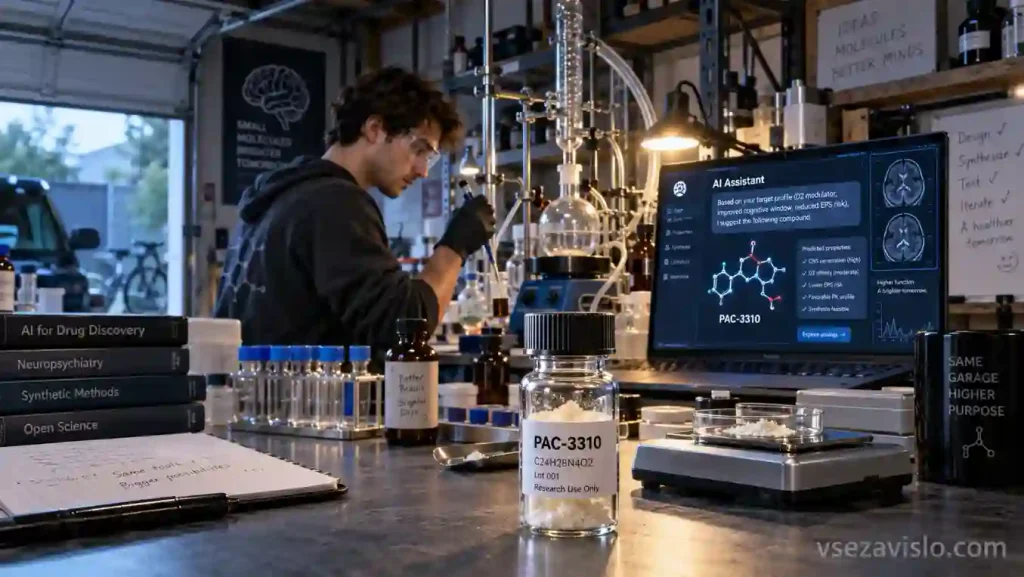
Harvard graduate Douglas Yao has unveiled PAC-3310, an experimental compound for the potential treatment of schizophrenia whose molecular structure was generated with the help of the ChatGPT language model. The biologist synthesized the substance in a home laboratory equipped with automated manipulators and ran preliminary tests on cell cultures and laboratory mice. Human clinical trials are still a long way off, but the case clearly shows how generative AI simplifies the search for promising drug molecules.
A Selective M4 Agonist and a Comparison With Cobenfy
The developer has a strong academic background: according to Douglas Yao’s personal website, he earned a PhD in computational biology from Harvard, graduated from UCLA in molecular biology, and has previously co-authored papers in Nature Biotechnology and Nature Genetics. He is now building an independent startup, Pace Pharmaceuticals.
PAC-3310 was designed as a highly selective agonist of M4 subtype muscarinic acetylcholine receptors. A report on the Pace Pharmaceuticals portal presents cell assay results: the molecule binds to the M4 receptor with an EC50 of 97 nM while barely activating the related M1, M2, M3 and M5 subtypes, which is critical for avoiding cardiac side effects.
In tests on model rodents, the compound successfully suppressed induced psychotic hyperactivity in cohorts of 11–12 animals without causing heart rhythm disturbances.
PAC-3310 is conceptually compared to the revolutionary drug Cobenfy, approved by the FDA in 2024. Cobenfy contains two substances — xanomeline and trospium — with the second component neutralizing the peripheral toxicity of the first. Because Yao’s formula acts precisely on M4 receptors, it could theoretically do without an auxiliary blocker.
An Open Protocol and the Limits of Garage Science
The researcher published the initial test data, video recordings of rodent behavior and the results-processing code in the Zenodo repository.
The project’s main achievement lies in the research approach itself. Yao combined neural network suggestions, affordable analytical equipment and laboratory robots to single-handedly carry out the drug design stage that at a classic big pharma company requires an entire department of chemists. The models helped select the molecule’s functional groups, write code for dispensers and plan the synthesis.
At the same time, it is too early to call PAC-3310 a medical breakthrough. The researcher’s data have not yet been peer-reviewed in scientific journals. The molecule still faces a difficult path of preclinical assessment of toxicity, metabolism and bioavailability, without which moving to human trials is impossible.