








$5.2 Trillion for Three: Why Comparing SpaceX, OpenAI and Anthropic to Every IPO of the Past 45 Years Is Misleading
 ·
23.09.2026 15:13
·
3 min read
·
23.09.2026 15:13
·
3 min read
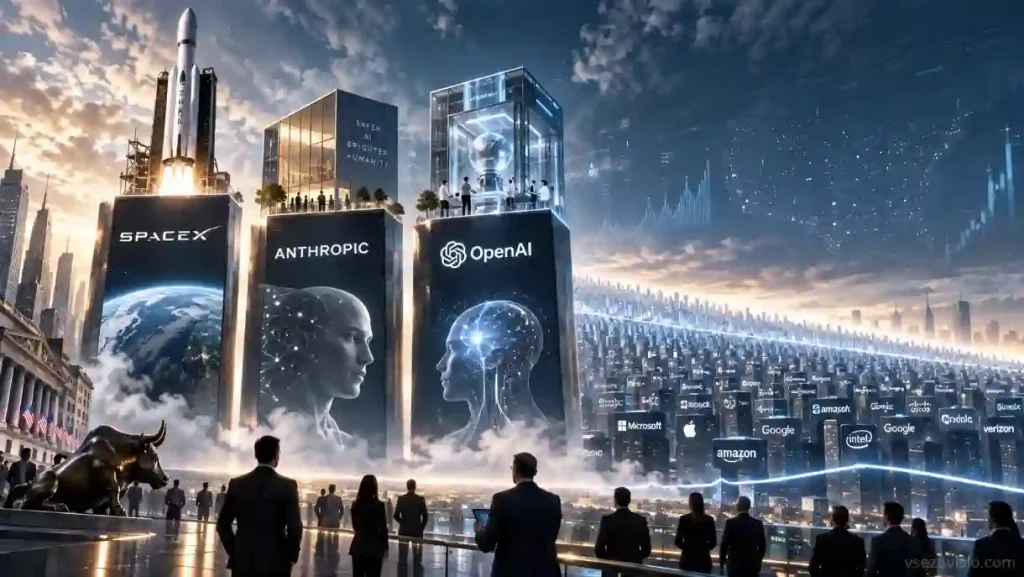
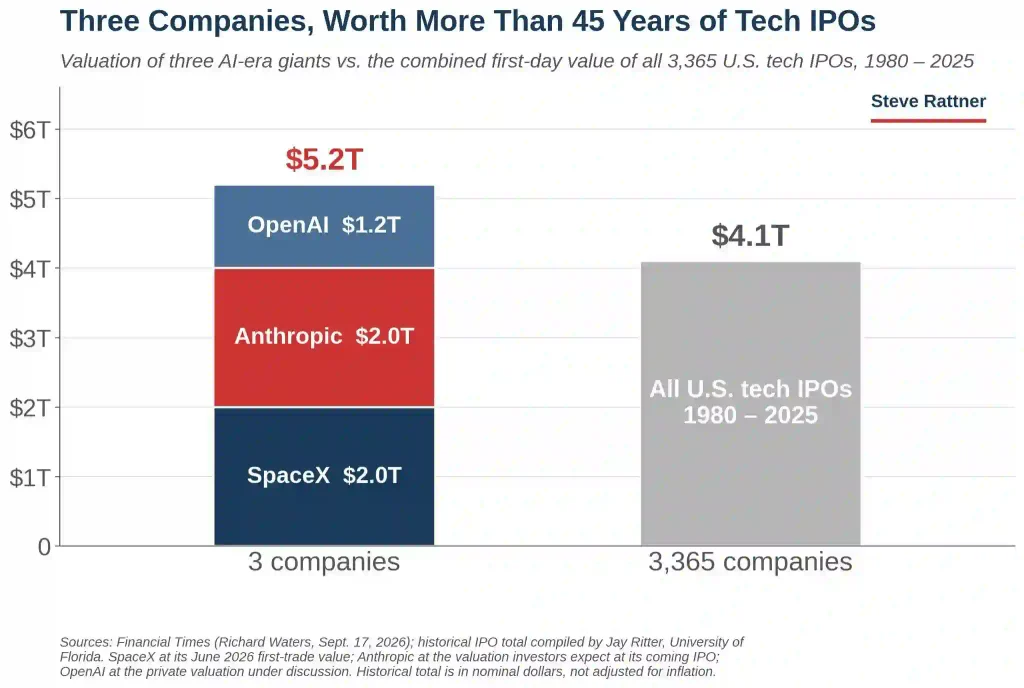
In September 2026, a chart showing an incredible concentration of capital in Silicon Valley went viral in business circles: the combined value of SpaceX, OpenAI and Anthropic reached $5.2 trillion. To illustrate the scale, analysts compared that figure with the total value of all 3,365 US tech IPOs between 1980 and 2025, whose combined market capitalization in their first days of trading came to $4.1 trillion. Calculations by University of Florida professor Jay Ritter, published in a Financial Times article, clearly show the enormous scale of the current tech boom, but from the standpoint of financial analysis, this kind of comparison involves a number of serious manipulations.
The main problem with the comparison is that its authors put three completely different metrics into a single table: a confirmed stock market valuation, preliminary expectations for a future listing, and the terms of private venture negotiations.
Musk’s Real Stock Exchange and Anthropic’s Preliminary Plans
Of the three, only Elon Musk’s aerospace giant is a full-fledged public company today. SpaceX held a historic initial public offering on June 12, 2026: the shares began trading at $135 apiece, and the company’s market capitalization immediately settled above the psychological $2 trillion mark, Reuters reports. It is the only figure on the list confirmed by open trading.
The creators of the Claude neural network at Anthropic are only now entering the home stretch of preparations for their stock market debut. According to Reuters sources, the share offering is tentatively scheduled for mid-October 2026, and underwriters are indeed aiming for a range of around $2 trillion. Still, that valuation remains purely a projected target set by investment bankers, not an accomplished fact of market capitalization.
OpenAI’s Private Round and the Inflation Factor
OpenAI fits into the chart least correctly of all. The $1.2 trillion figure appears exclusively in closed preliminary consultations about a new tranche of private investment, noticeably above the startup’s March valuation of $852 billion. Sam Altman’s company has no plans to go public: on September 12, the head of OpenAI told Reuters directly that an IPO during 2026 is completely ruled out because of AI safety concerns and an unfinished business restructuring.
Another distortion is the absence of an inflation adjustment. The $4.1 trillion historical base adds up first-day trading prices for companies over forty-five years in the nominal dollars of their respective eras — without recalculating the purchasing power of the times when Apple, Microsoft, Amazon or Google went public to 2026 levels. So the infographic makes a striking case for the astronomical capitalization of the leaders of the artificial intelligence era, but comparing those figures directly with half a century of Wall Street history is a methodological stretch.