








Ornith Team Releases Open Ornith-1.5 Models: Compact 9B Version Competes with Heavyweight AI
 ·
20.08.2026 18:48
·
2 min read
·
20.08.2026 18:48
·
2 min read
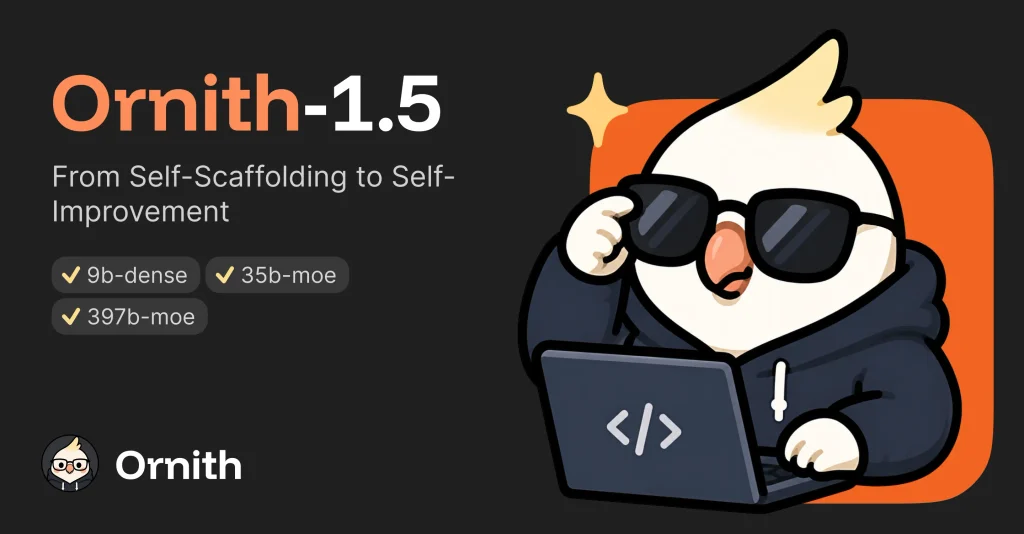
The Ornith development team has introduced the Ornith-1.5 family of open models distributed under the permissive MIT license. The compact Ornith-1.5-9B version with 9 billion parameters delivered benchmark results in coding and logic comparable to systems several times larger.
The lineup includes three configurations: the base compact 9B Dense, the 35B-A3B model based on Mixture-of-Experts (MoE) architecture, and the flagship 397B MoE.
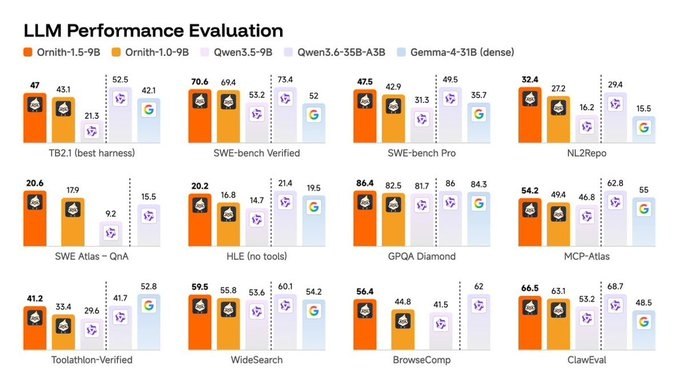
In agentic coding benchmarks on SWE-bench Verified, the Ornith-1.5-9B model scored 70.6 points, while reaching 86.4 points in the GPQA Diamond logic benchmark—coming close to the results of the significantly larger Qwen3.6-35B-A3B.
Meanwhile, the Ornith-1.5-35B-A3B version scored 79 points on SWE-bench Verified. Thanks to its MoE architecture, only 3 billion out of 35 billion parameters are activated per token, significantly lowering hardware requirements while maintaining high generation speeds.
Self-learning via task generation and 256k tokens
A key feature of the Ornith-1.5 training pipeline is its move away from static training datasets: during training, the system independently generates new tasks, searches for solutions, and learns from its own mistakes using reinforcement learning (RL) algorithms. As accuracy improves, the generator automatically increases the difficulty of test scenarios.
The Ornith-1.5-9B model features a native context window of 262,144 tokens, reasoning support, tool calling, and image recognition.
Architecture files are already available in the Hugging Face repository and have been added to the Ollama library for quick local deployment.
For more details on deploying this model on mobile devices, check out our step-by-step guide to running Ornith-1.5 on Android and iPhone.