









Alibaba Open-Sources RADAR, an AI That Reads Abdominal CT Scans and Detects 146 Conditions
 ·
19.09.2026 10:24
·
3 min read
·
19.09.2026 10:24
·
3 min read
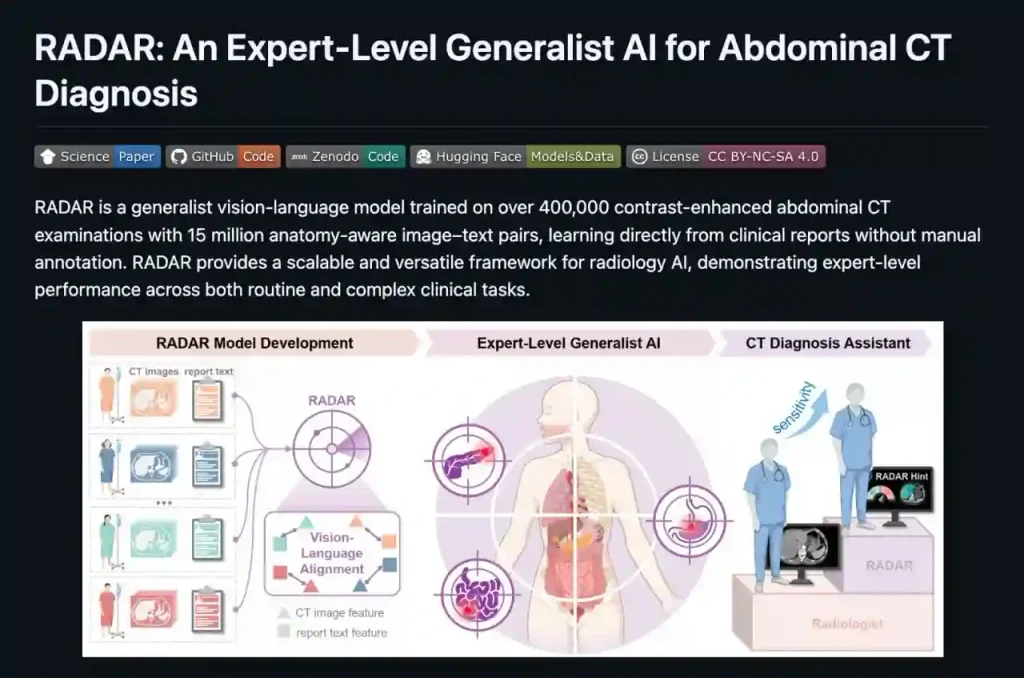
Alibaba DAMO Academy has unveiled RADAR, a general-purpose AI model for analyzing contrast-enhanced abdominal CT scans. The system can assess 18 anatomical structures and detect 146 pathological findings, including tumors and other clinically significant changes.
The RADAR study was published in the journal Science, and the model’s source code and weights are now available to other researchers.
RADAR was trained on more than 400,000 CT studies and roughly 15 million image-text pairs built from real radiologists’ reports. Instead of manually labeling every scan, the developers used a vision-language learning approach: the model learned to link specific regions of a CT scan to the corresponding passages in medical reports.
That made it possible to build not a narrow algorithm for finding one specific condition, but a more general system that analyzes several organs and a broad range of possible abnormalities at once.
The model was tested on tens of thousands of CT scans
On an internal sample of nearly 39,000 clinical studies, RADAR’s average ROC AUC across the 146 findings was 0.913. On data from eight external medical centers, the figure reached about 0.895.
The system was also tested on more than 27,000 emergency CT scans, even though it was not specifically trained on such data. There, the average AUC was 0.904.
AUC reflects a model’s ability to distinguish positive from negative cases at different thresholds and is not a direct percentage of correctly made diagnoses.
Separately, RADAR was tested in an experiment with 26 radiologists. Using the AI’s hints raised diagnostic sensitivity by about 10%, and the average time to interpret studies fell by more than 30%. According to the published data, the model’s standalone result was higher than those of 23 of the 26 participants.
RADAR does not replace doctors yet
The project’s main value is its attempt to combine into one system tasks that usually require many separate medical models. RADAR can analyze the liver, pancreas, kidneys, intestines and other structures within a single CT study.
At the same time, this is specifically a specialized tool for contrast-enhanced abdominal CT. RADAR is not designed to analyze any medical images, does not work as a general diagnostic system based on lab tests, and does not prescribe treatment.
Alibaba has open-sourced the project’s code on GitHub and posted the pretrained weights on Hugging Face. That lets independent teams test the model on their own data and check how well it transfers across different clinics and patient groups.
The next major step will be testing RADAR in real clinical practice. Strong results on large test samples show the model’s potential, but the full value of medical AI needs to be confirmed in settings where it works alongside doctors on a stream of real patients.