










PrismML Releases Bonsai 2 27B — a 27-Billion-Parameter AI Model That Takes Up Just 5.9 GB
 ·
20.09.2026 16:52
·
3 min read
·
20.09.2026 16:52
·
3 min read

US-based PrismML has unveiled Ternary Bonsai 2 27B, a multimodal AI model built on Qwen3.8 27B and optimized for local deployment. Despite having 27.8 billion parameters, its weights take up only 5.9 GB — more than nine times less than the full-precision version of the original model.
The developers achieved this through ternary weight representation. Instead of the usual 16-bit values, most parameters take only three states: −1, 0 or +1. Combined with FP16 group scaling, this yields an effective density of about 1.76 bits per parameter.
For comparison, the full-precision version of Qwen3.8 27B takes up about 53.8 GB. So Bonsai 2’s main advantage lies not in reducing the number of parameters but in drastically cutting the memory needed to store and run the model.
Compression Barely Changed Results in PrismML’s Tests
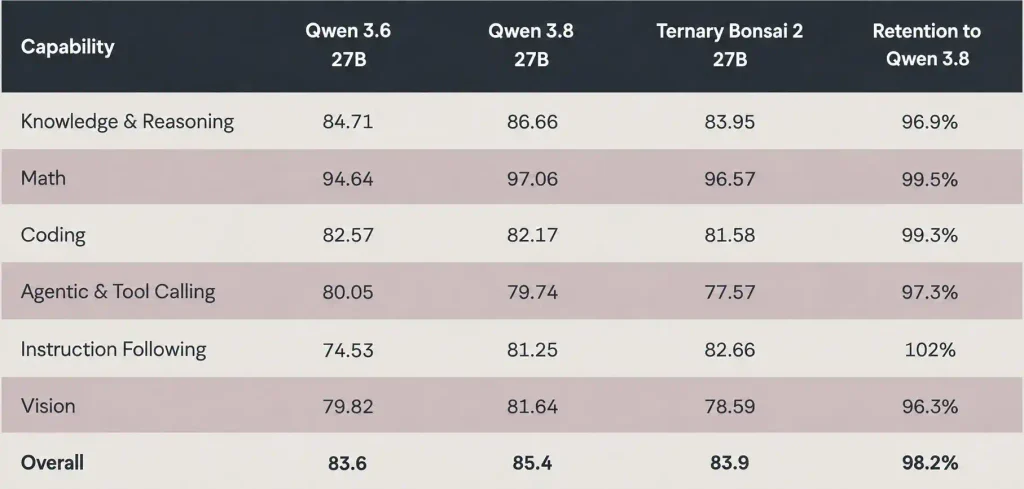
According to PrismML, Bonsai 2 27B scored 83.9 points across a set of 20 tests covering math, programming, reasoning, instruction following, computer vision and tool use. Full-precision Qwen3.8 27B scored 85.4 points.
The compressed model thus retained about 98.2% of the original’s overall score. The gap varies by task, though. In the computer vision test group, for example, Bonsai 2 scored 78.59 points versus 81.64 for full-precision Qwen3.8.
These are PrismML’s own results for now, so the model’s real-world quality has yet to be verified in independent tests and practical scenarios.
Bonsai 2 supports a context of up to 262,000 tokens, accepts text and images, and can write code, reason, call tools and operate within agentic systems. The company has demonstrated the model paired with Cline for programming and in computer-control scenarios.
Up to 143 Tokens per Second on an RTX 5090
Performance depends on the hardware platform. PrismML claims speeds of up to 143 tokens per second on a GeForce RTX 5090 and up to 46.8 tokens per second on an Apple M5 Max.
On an RTX 4090, the company measured power consumption of about 0.714 mWh per token. All these figures come from the developer’s own tests and may vary depending on configuration, context length and the software stack used.
The model runs on NVIDIA graphics cards via CUDA and on Apple devices via MLX and PrismML’s own low-bit kernels. A GGUF build and an MLX version are already available on Hugging Face.
The weights are distributed free of charge under the Apache 2.0 license, which allows the model to be used in commercial projects, among other things, as long as the license terms are met.
Bonsai 2’s main appeal is the ability to run a 27B-class model on far more affordable hardware. If the claimed quality retention holds up outside PrismML’s internal tests, ternary models could become one way to move larger AI systems off servers and directly onto personal devices.