










Cloudflare Updates Quick Tunnels — Publish Local Projects Without an Account or Domain
 ·
20.09.2026 23:37
·
3 min read
·
20.09.2026 23:37
·
3 min read
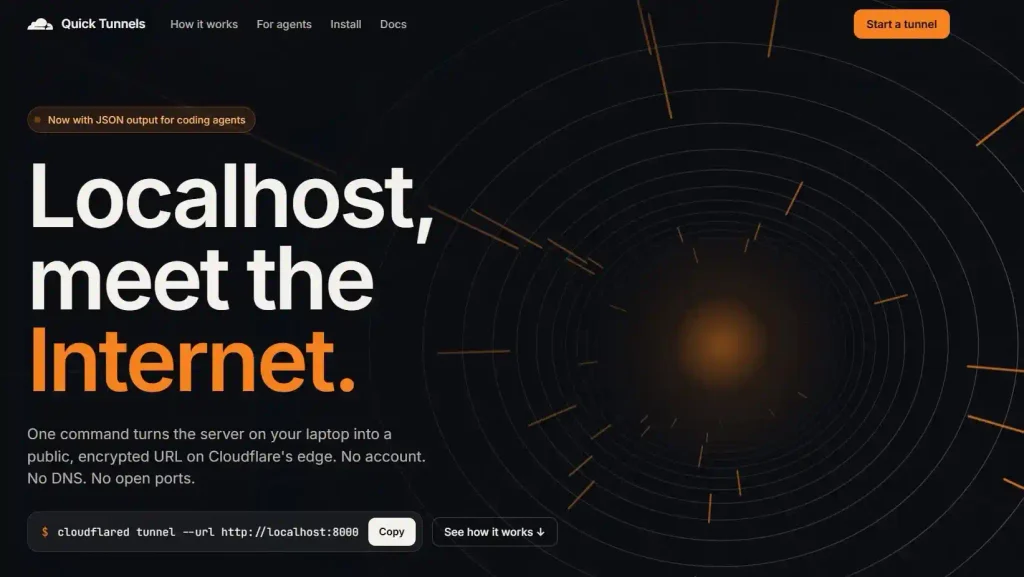
Cloudflare has updated Quick Tunnels, a tool for quickly exposing a locally running website or app through a public HTTPS link. The service lets you skip a Cloudflare account, your own domain, DNS setup and opening inbound ports.
The feature itself is not new, though. Quick Tunnels and *.trycloudflare.com addresses have existed since 2021. Cloudflare has now updated the service for modern development workflows and specifically highlights its use with coding agents.
After installing cloudflared, all you need to do is start a local server and run the command:
cloudflared tunnel --url http://localhost:8000
In response, the utility generates a random address like https://random-name.trycloudflare.com, through which the app becomes accessible from the internet.
The connection is initiated directly by the user’s computer toward Cloudflare’s infrastructure, so there is no need to open an inbound port on the router. Traffic travels over the company’s network with HTTPS and basic Cloudflare protection.
The company introduced the Quick Tunnels mechanism back on September 2, 2021, so the current update is better seen as an evolution of an existing tool rather than the launch of a new product.
Quick Tunnels Adapted for AI Agents
On the updated service page, Cloudflare specifically promotes use cases with AI agents that write and test code.
For example, an agent can get a public address for a local app and use it to:
- check the interface through a browser;
- take screenshots;
- test webhooks;
- run automated checks;
- hand off a working preview to a person or another system.
For these use cases, Cloudflare has added structured JSON output. An agent can get the hostname, connection status and other information without having to parse plain text logs with regular expressions.
This is especially handy for autonomous development tools that need to spin up an app on their own, expose it, check the result and end the session.
Quick Tunnels Are Not Meant for Permanent Hosting
A Quick Tunnel exists only while the corresponding cloudflared process is running. Once it ends, the public address stops working, and the next launch creates a new random subdomain.
Cloudflare states plainly in its documentation that Quick Tunnels are for development and testing, not for production.
The service has no guaranteed SLA, is capped at 200 concurrent requests, and returns a 429 error when that limit is exceeded. Quick Tunnels also do not support Server-Sent Events (SSE).
For permanent apps, the company recommends full Cloudflare Tunnels with an account, your own domain and managed configuration.
So the main change is not the arrival of trycloudflare.com itself, but that Cloudflare has repackaged the long-standing Quick Tunnels for modern development workflows and AI agents, adding more convenient machine-readable output and making this use case one of the central ones.