










AI Instead of a Candidate: AI Job Search Framework Goes Viral on GitHub for Automating the Job Hunt
 ·
25.09.2026 18:23
·
3 min read
·
25.09.2026 18:23
·
3 min read
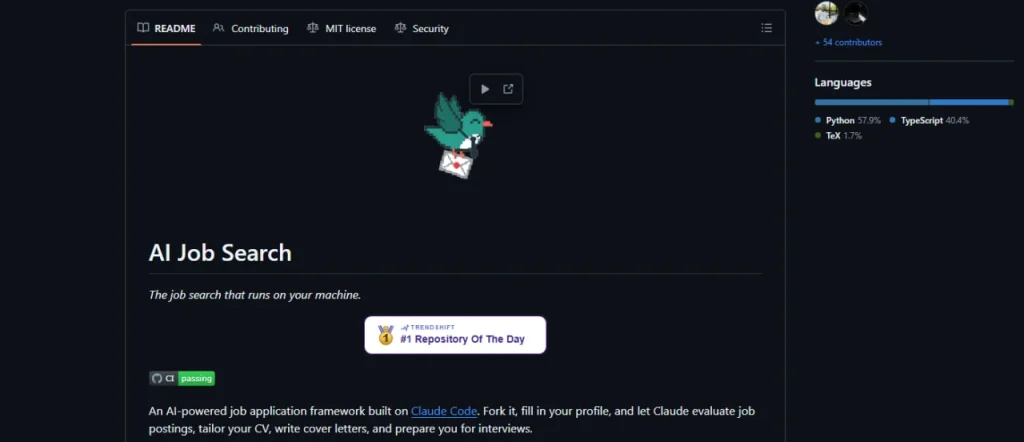
AI Job Search is rapidly gaining traction on GitHub — an open framework that turns the Claude Code command-line tool into a full-fledged AI assistant for job hunting. The system takes over the most tedious part of the search: from collecting job listings and tailoring a resume to specific requirements to writing cover letters and preparing for interviews.
Creator Mads Lorentzen built the system for himself after he was caught up in a wave of layoffs in 2025. According to the developer, he used the scripts to send 69 personalized applications, landed 20 invitations to first-round interviews, and in June 2026 successfully got hired as an AI engineer. And while this is the author’s personal experience rather than an independent study of effectiveness, the approach solves the main problem with mass applications — the low quality of generated texts.
From Scraping Job Listings to Rehearsing Interviews
AI Job Search is built around several console commands. First, the /scrape script collects fresh listings from job sites and removes duplicates. Then the /rank command runs them against the user’s profile, scoring them for how well they match their skills.
The key stage is triggered by the /apply command: the AI analyzes the selected job and produces a personalized resume (CV) and cover letter for it. The framework’s main difference from ordinary chatbot prompts is its built-in quality control. A second, independent AI agent reviews the finished documents, criticizing the draft for using templates or missing requirements and sending it back to the first agent for revision. The system then automatically compiles the final result into a neat PDF file.
The project goes beyond generating applications. Its built-in modules let users:
- /interview — prepare questions and answers for a specific interview stage based on a previously submitted resume;
- /upskill — identify gaps in the candidate’s knowledge relative to market requirements and draw up an individual learning plan;
- /outcome — keep a detailed history of applications, rejections and offers.
For convenience, the entire job-search funnel can sync with Gmail statuses and be displayed in a separate local HTML dashboard or a Notion table.
The Price of Free Open Source and the Risks of Data Leaks
Although AI Job Search itself is distributed as an open-source project under the permissive MIT license, you won’t be able to use it for free. The scripts require Claude Code, which is available only on paid plans (Claude Pro, Max, Team) or through Anthropic API payment for the tokens used.
The framework also requires some technical setup on your PC: running it takes Python 3.10 or higher, the Bun runtime and a LaTeX distribution for proper document formatting. Another limitation is regional. The basic scrapers are configured mainly for the Danish market (Jobindex, Jobnet and Akademikernes Jobbank), although working modules for LinkedIn and the Freehire aggregator are included. To scrape other local sites, users will have to write their own plugins.
Privacy deserves special attention. Applicant data is stored locally on the computer, but with a standard fork of the public GitHub repository, the user’s copy also becomes public. If you then run the basic setup command, the system will write your real name, contacts, detailed work experience and salary expectations into tracked files, putting them on public display. To avoid leaking personal data, the author strongly recommends creating a separate private repository for your job search and linking the original only as an update source (upstream).