








Anthropic Releases Claude Sonnet 5.5: The Model Runs a Third Faster and Breathes Down Opus’s Neck
 ·
28.09.2026 22:14
·
3 min read
·
28.09.2026 22:14
·
3 min read
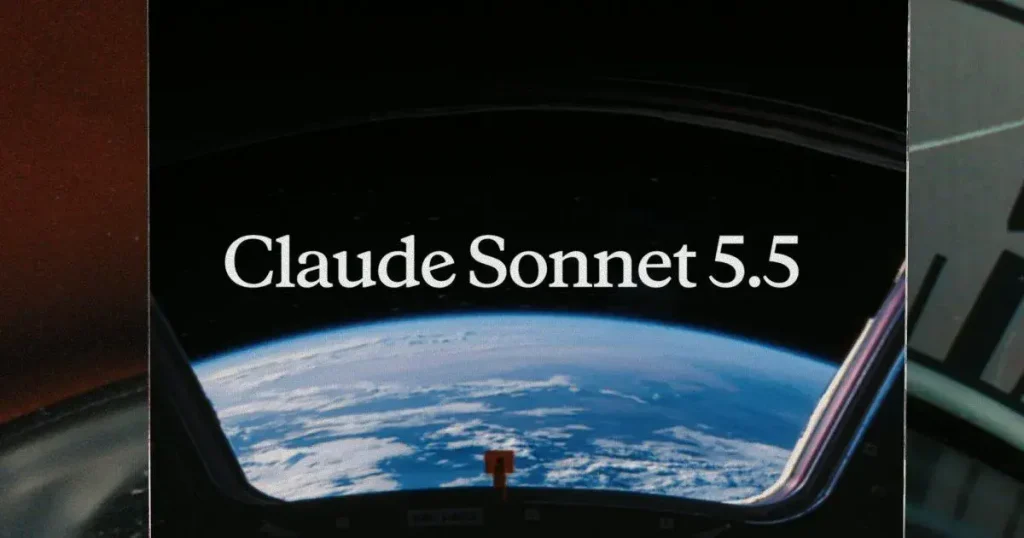
Anthropic has unveiled Claude Sonnet 5.5, a new mid-tier model in its current lineup of algorithms. The release is unusual: instead of simply cutting API prices, the developers focused on internal optimization. The model generates responses 30% faster than its predecessor, Sonnet 5, and on coding and agentic tasks it has come right up to the flagship Opus 5.5.
Officially, Sonnet 5.5 pricing is unchanged: $2 per million input tokens and $10 per million output tokens. For comparison, requests to the powerful Opus 5.5 cost exactly twice as much. However, as VentureBeat notes, the real cost of completing complex tasks has dropped by roughly 30%. The savings come from a smarter architecture: the model makes fewer mistakes, spends fewer tokens on reasoning, and calls external tools less often to arrive at the right answer.
Agentic Coding and Competition with GPT-6 Sol
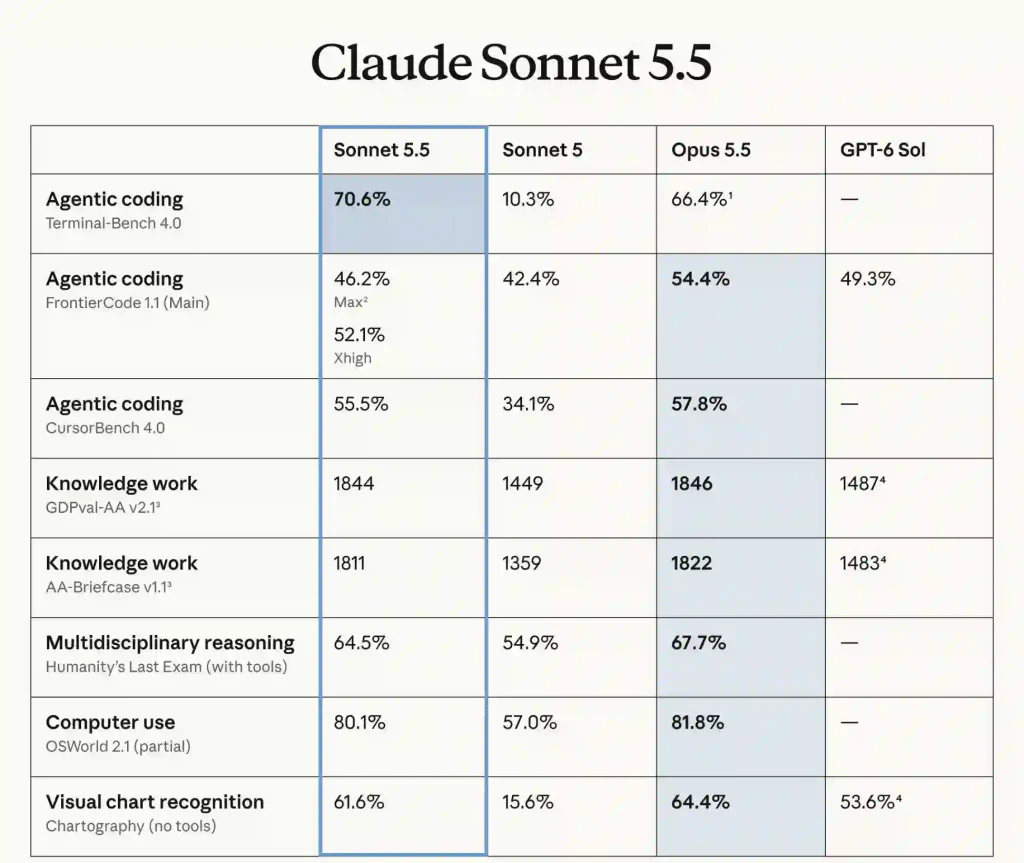
The biggest performance jump came in writing code and executing autonomous commands. On the specialized agentic benchmark Terminal-Bench 4.0, the new model completed 70.6% of actions successfully, beating not only the previous Sonnet 5 (10.3%) but also the flagship Opus 5.5 (66.4%).
On professional work tasks, the gap between the mid-tier and top-tier models has also nearly vanished. According to The Decoder, the new model scored 1,844 points on the GDPval-AA test, trailing Opus 5.5 by just two points.
Against that backdrop, developers have started calling Sonnet 5.5 a “killer” of OpenAI’s recently released GPT-6 Sol. That’s an exaggeration, though. Anthropic’s algorithm does beat its rival on a number of metrics (on GDPval-AA, for instance, the score is 1,844 versus 1,487 for Sol), but on the FrontierCode test at maximum reasoning effort, GPT-6 Sol is still ahead with 49.3% versus 46.2%. The models are running neck and neck, trading wins across different use cases.
Ecosystem and a One-Million-Token Context Window
Anthropic itself positions Sonnet 5.5 as a workhorse for everyday coding, refactoring, and document and spreadsheet analysis. The hardest tasks with a high degree of uncertainty are still best delegated to the heavyweight Opus 5.5, the company says.
The model is already available in the Claude web interface and via API. The company’s partners moved quickly to integrate it as well: Google Cloud’s documentation states that Sonnet 5.5 supports a massive context window of up to 1 million tokens and can output up to 128,000 tokens in a single response. On release day, the model also became available to users on paid GitHub Copilot plans.
Sonnet 5.5 is the second model in Anthropic’s current generation — the flagship Opus 5.5 arrived a week earlier, on September 22. The company’s next step will be the release of the lightweight Claude Haiku 5.5, aimed at fast processing of high-volume requests.