








Japanese Researchers Build 600 °C Transistor: Heat-Resistant Chips Could Free Venus Probes From Bulky Cooling
 ·
06.09.2026 16:36
·
2 min read
·
06.09.2026 16:36
·
2 min read
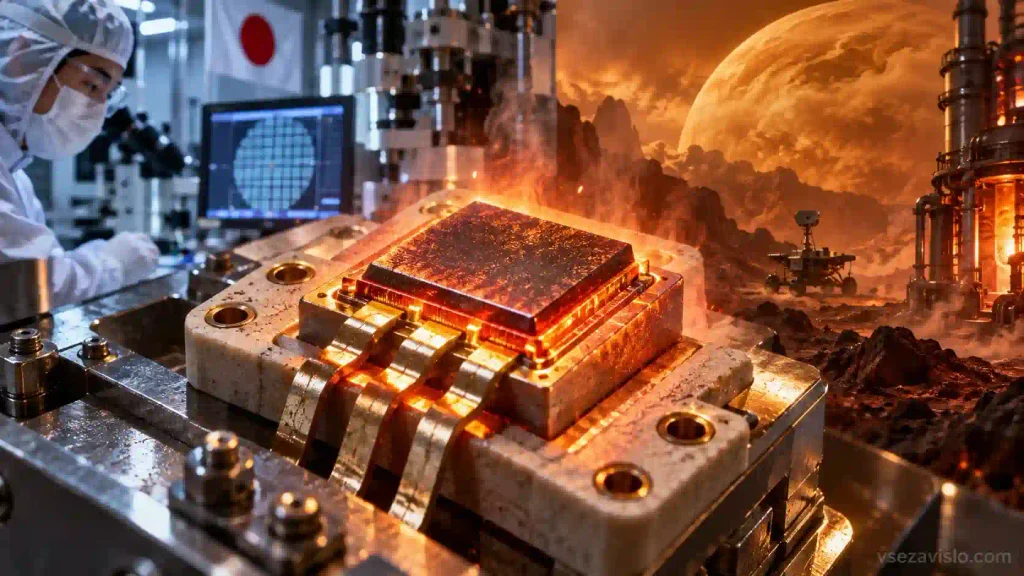
Engineers at Kyoto University have developed a silicon carbide (SiC) field-effect transistor that remains fully operational at temperatures exceeding 600 °C. The new semiconductor architecture resolves the long-standing issue of thermal breakdown, paving the way for durable electronics designed for Venus landers, jet engine combustion chamber monitoring, and deep geothermal drilling.
Buried Gate and Industry-Standard Fabrication
Silicon carbide appeals to engineers due to its wide bandgap, high thermal conductivity, and resistance to strong electric fields. However, conventional silicon carbide JFETs struggled to scale because of floating threshold voltages and runaway leakage currents when heated past 300 °C.
In a paper published in APL Electronic Devices, the Japanese researchers detailed their solution: they relocated the control gate beneath the conducting channel and isolated it using a system of dual semiconductor layers.
The design proved exceptionally stable: at 400 °C, the threshold voltage deviated from calculated values by no more than 0.1 V. When heated to 600 °C, leakage current density was roughly 100 times lower than in earlier designs on semi-insulating substrates operating at far milder temperatures.
A key practical advantage was highlighted by Tom’s Hardware: the transistor was fabricated using standard ion implantation. This process is fully compatible with existing semiconductor foundry equipment and requires no exotic lab techniques.
Why Space Exploration and Aviation Need This
The primary testing ground for these chips will be Venus exploration. Surface temperatures on the planet reach 460 °C with pressures exceeding 90 atmospheres. Under these conditions, Soviet Venera landers survived only a couple of hours before their heavily insulated compartments housing silicon instruments inevitably overheated. SiC-based electronics could allow landing modules to operate for weeks without bulky active cooling systems.
In aviation and power generation, similar sensors and control modules can be placed directly in the hot sections of turbines, eliminating kilometers of heavy shielded wiring.
However, as noted in a Kyoto University press release, researchers caution against expecting commercial processors overnight. The team still needs to integrate the transistors into multi-level logic circuits, scale manufacturing to full-size wafers, and identify heat-resistant alloys for interconnects and packaging that will not melt or oxidize over thousands of hours of extreme operation.