








Mercedes Patents Amphibious Vehicle: Why the Car Needs Retractable Marine Lights
 ·
06.09.2026 16:29
·
2 min read
·
06.09.2026 16:29
·
2 min read
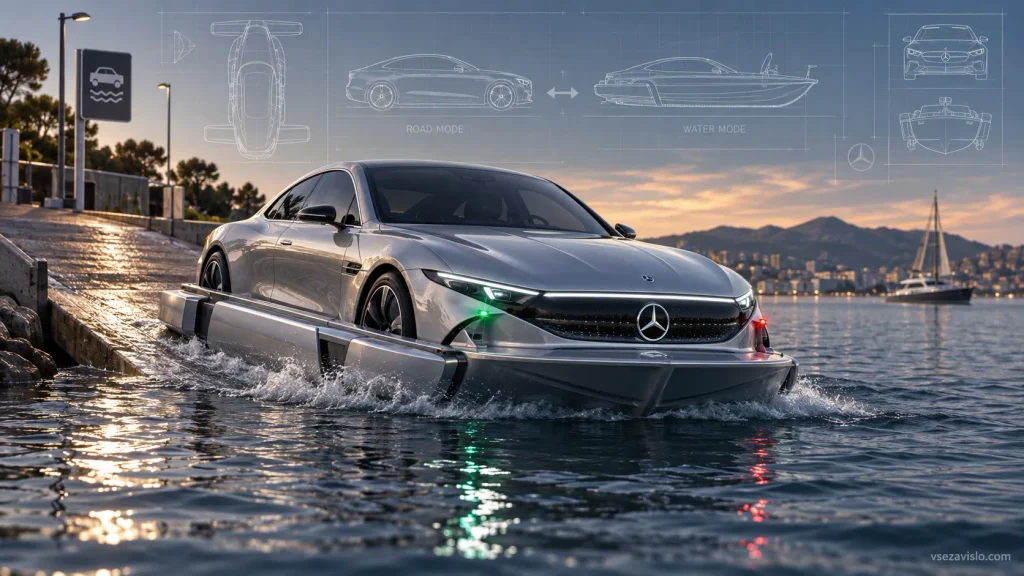
German automaker Mercedes-Benz Group has patented an amphibious vehicle capable of traveling on both public roads and water. However, behind the headlines about a “boat-car” lies a specific engineering challenge: the company’s engineers developed and legally protected an adaptive lighting system that complies with strict international maritime navigation rules.
Variable Hull and Maritime Regulations
Patent documentation DE102024002781B3 describes a vehicle with a variable buoyancy module. On land, the car drives on standard wheels, and when entering a body of water, it stays afloat thanks to its body geometry and moves using a separate propeller or waterjet drive system.
The main obstacle to legalizing such projects has always been legal status: rivers and coastal waters are governed by the International Regulations for Preventing Collisions at Sea (COLREGs). Standard automotive headlights and turn signals are not only useless on the water, but also dangerous, as they blind oncoming boats and fail to indicate the vehicle’s direction of movement in the dark.
Retractable Masts and Automatic Mode Switching
To solve this problem, Mercedes engineers proposed equipping the vehicle with a specialized set of marine lights:
- Sidelights (red on the port side and green on the starboard side);
- A white stern light;
- An elevated masthead light and an all-round anchor light.
The lighting elements are designed to be concealed: when entering the water, telescopic masts and additional modules automatically extend from the roof, hood, or mirror stalks. The onboard computer automatically disables road lighting and activates navigation lights. In addition, the system includes searchlights to assist the crew when docking on unimproved shorelines and detecting shallow water.
Filing a patent does not guarantee that the Stuttgart-based brand is preparing to release an amphibious G-Class or a concept car for yachting enthusiasts. Automotive giants regularly patent experimental developments to protect intellectual property. However, the document clearly demonstrates how the company envisions resolving complex technical conflicts at the intersection of two different transport realms.