










Moderna and Merck’s Personalized mRNA Cancer Vaccines Prove Effective and Enter Final Stage
 ·
23.08.2026 13:16
·
3 min read
·
23.08.2026 13:16
·
3 min read
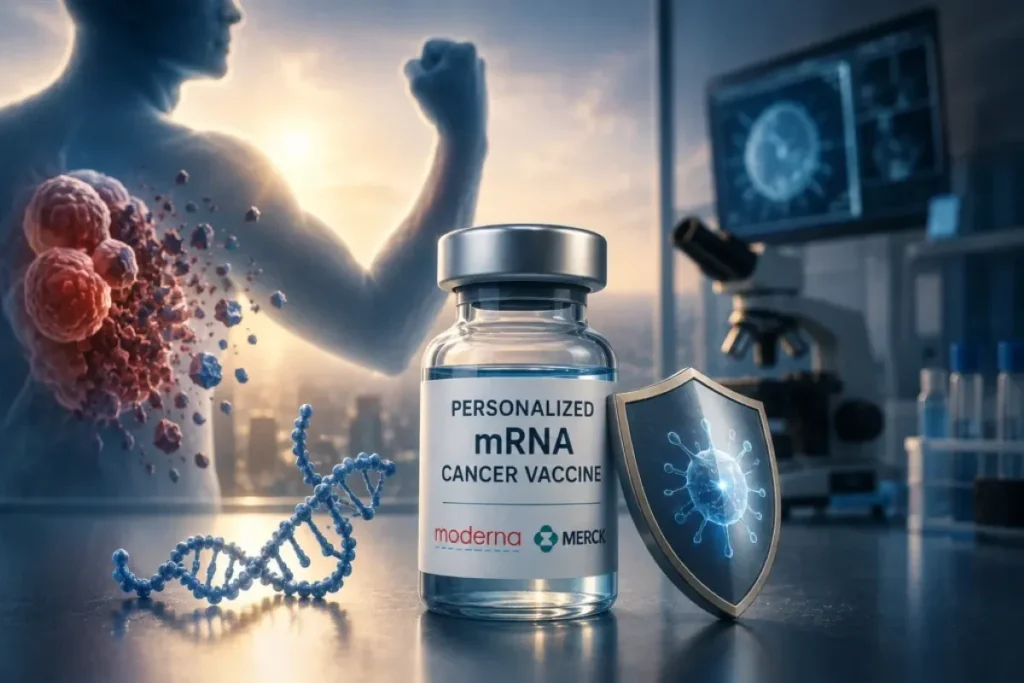
Pharmaceutical companies Moderna and Merck announced the successful completion of a key Phase III clinical trial stage for their personalized mRNA therapy, mRNA-4157 (intismeran autogene). The treatment, tailored to a patient’s unique mutational profile, proved superior to standard monotherapy in preventing melanoma recurrence.
The treatment works as a therapeutic vaccine: it is administered to patients after the surgical removal of the primary tumor to prevent recurrence.
Personalized Vaccine Development and Phase III Results
More than a thousand high-risk patients participated in the INTerpath-001 study. Combining the vaccine with the cancer drug Keytruda demonstrated a statistically significant advantage in two key areas: recurrence-free survival and reduced risk of distant metastasis.
According to official data from the companies, five-year Phase II follow-up showed that adding the mRNA vaccine reduced the risk of recurrence or death by 49%, and the risk of distant metastasis by 59%.
The technology relies on high-precision sequencing:
- After surgery, doctors compare the DNA of the patient’s tumor and healthy tissues;
- Computational algorithms identify up to several dozen specific neoantigens present exclusively on cancer cells;
- Based on these findings, a personalized mRNA molecule is synthesized, training the immune system’s T-cells to target hidden micrometastases.
Expansion to Other Cancer Types
The success of the melanoma therapy enabled a large-scale Moderna clinical trial program, which includes nine Phase II and Phase III trials for other cancers. The most advanced studies focus on non-small cell lung cancer, kidney cancer, bladder cancer, stomach cancer, and pancreatic cancer.
In a comment to Reuters, Moderna President Stephen Hoge stated that the first data on the method’s efficacy in other solid tumor types will emerge within the next one to two years.
Competition with BioNTech and Timeline for Approval
Parallel trials are being conducted by an alliance between BioNTech and Genentech (Roche) using autogene cevumeran (BNT122). According to a paper in Nature, in trials against pancreatic adenocarcinoma, the vaccine elicited a durable T-cell immune response in half of the patients, prompting the launch of a larger Phase II study.
The complexity of the technology lies in the impossibility of mass manufacturing: each dose must be designed and synthesized from scratch for an individual patient. Nevertheless, Moderna and Merck are preparing to submit applications for accelerated approval of the melanoma treatment to regulators, aiming to launch the therapy commercially in 2027.