







Smartphone-Controlled Car Crashes Into Police Van During TV Interview in Pakistan as Developer Presses Wrong Button
 ·
01.09.2026 19:45
·
3 min read
·
01.09.2026 19:45
·
3 min read
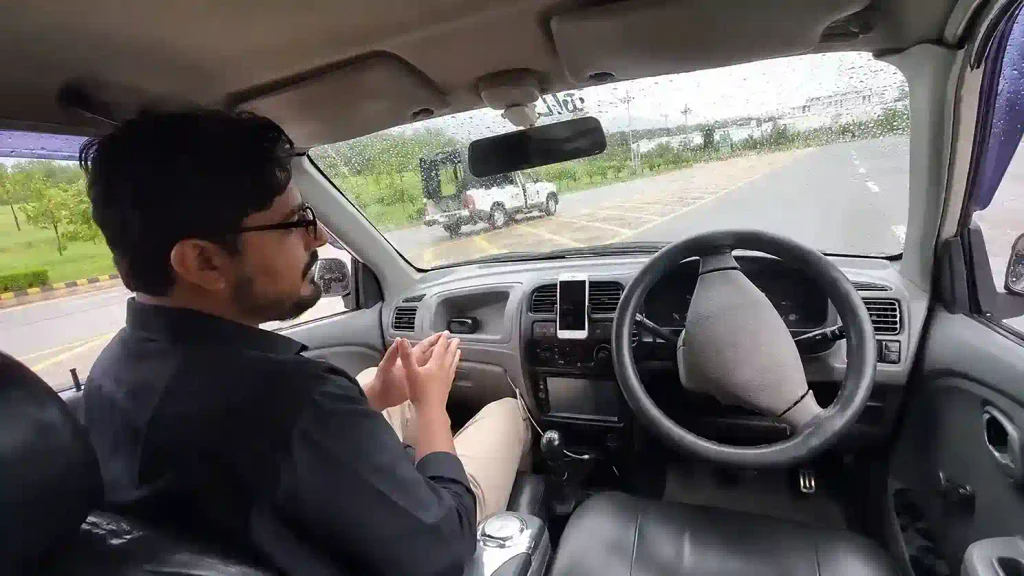
A demonstration of a student-built driverless car in Pakistan’s capital ended in a bizarre crash. Right during a live television interview, the vehicle suddenly veered off the road and hit a parked police van. The incident quickly became a viral meme, but an investigation revealed the crash was caused not by an algorithm failure, but by the developer accidentally pressing the wrong button on a smartphone screen.
The Perfect Meme: A Crash Right as Reporter Praises Local Talent
The incident occurred in Islamabad’s government district near D-Chowk. TV reporter Muhammad Aalijah was broadcasting from the front passenger seat while the driver’s seat remained empty and the steering wheel turned automatically.
As reported by Dawn, the reporter’s words made the scene even more comical. Just a second before impact, the journalist said on camera, “There is certainly no shortage of talent in Pakistan.” A moment later, the car swerved sharply to the left; the passenger tried to reach the handbrake but couldn’t prevent the collision with the police vehicle.
Not Autonomous, but Teleoperated
While viral posts quickly dubbed the project “Pakistan’s Tesla,” the vehicle is not technically a self-driving autonomous car.
The car was built by Ehsan Zafar Abbasi, a computer engineering student at the COMSATS University campus in Abbottabad. He modified a production vehicle by installing servomotors on the steering rack and pedals.
According to ProPakistani, the setup is a telemetry system (teleoperated vehicle):
- the car does not make decisions on its own or scan for obstacles using lidar;
- it is controlled remotely by a human via a smartphone or laptop web interface;
- video feeds are sent to the operator via a wide-angle front camera and a 360-degree dome vision sensor.
Cell Signal Glitch vs. Human Error
Initially, the journalist claimed that cellular coverage dropped in the city center, allegedly causing the vehicle to lose control.
However, Islamabad police conducted an official check of the equipment and refuted the hardware failure theory. In a video statement on Geo News, the developer himself admitted the accident was his fault: during filming, the camera operator asked him to show the phone screen, Abbasi got distracted, and accidentally tapped the virtual left turn button instead of right. The car followed the command and drove straight into the parked van.
According to Dr. Ayaz Hussain, head of the city zone police, officers found no malicious intent in the student’s actions. Law enforcement supported the young inventor, calling youth engineering experiments important for the country, and decided not to file charges.
Not every “driverless” car is autonomous.
— Grishin Robotics (@GrishinRobotics) September 1, 2026
Ehsan Zafar Abbasi’s internet-controlled prototype lost control during an Islamabad demo and rolled into a parked police van—a very literal reminder that every remote system needs a fail-safe.
Video: Muhammad Aalijah. pic.twitter.com/5EyKGL0Ovh
Previous Projects and Road Safety Concerns
This wasn’t Abbasi’s first high-profile project. Earlier, the engineer built a compact hatchback prototype controlled via a standard wired computer keyboard (which took six months and around $1,000 to complete) before switching controls to internet protocols.
Despite the lucky outcome with no injuries, the incident highlighted serious gaps in DIY vehicle safety protocols. The remote-controlled vehicle was tested on public roads without a backup emergency brake system in case of signal loss, leaving the passenger—who barely managed to pull the mechanical handbrake in time—as the only line of defense.