








GPT-6 Astra Arrives in Codex Tools: Who Gets Access to the New Coding Model
 ·
04.09.2026 22:41
·
2 min read
·
04.09.2026 22:41
·
2 min read
OpenAI has begun gradually rolling out its flagship GPT-6 Astra model to the Codex developer environment. The neural network has already started appearing in some users’ profiles, and access will open to paid Plus, Pro, Business, and Enterprise plans within a few days. However, the rollout is happening in waves, and usage limit rules depend on the account tier.
Software Requirements and Pricing Details
To work with the model via the terminal, users must update the Codex CLI client to version 0.153.0 or higher. According to the OpenAI help center, Astra generations consume the shared message pool allocated for Codex and Work services:
- Users on the basic Plus plan and Business Standard tier receive a reduced limit of requests to the flagship model;
- Pro and Business Premium plan holders can use their entire available query volume exclusively on Astra;
- Additional quotas can be purchased separately, but buying paid credits does not accelerate an account’s inclusion in the current rollout wave.
At the same time, the developers made an important distinction between the development environment and the standard conversational chat. Plus subscribers can only use Astra within Codex and the Work environment—the model will not appear for them in the standard ChatGPT interface switcher. In standard web chat, Astra’s capabilities will debut as GPT-6 Pro, available exclusively to higher-tier Pro, Business, and Enterprise subscriptions.
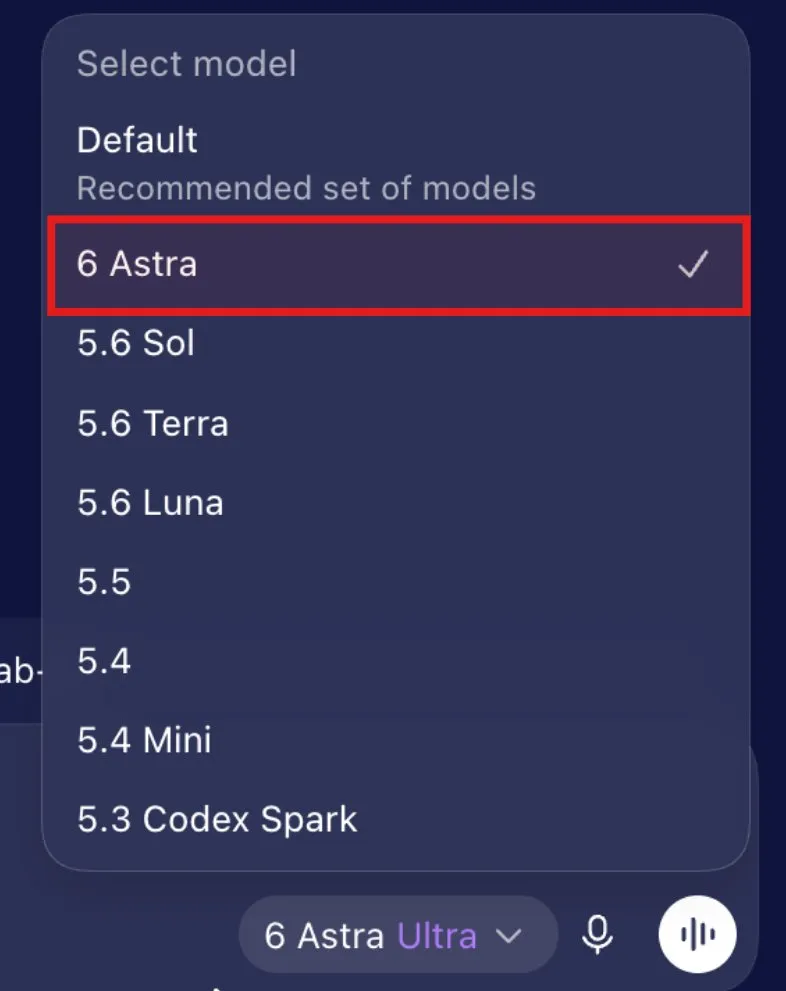
Cross-Session Memory and Reasoning Levels
Astra was designed with autonomous software debugging in mind: in the Terminal-Bench 4.0 benchmark, it scored 57.9% compared to 37.3% for the previous GPT-5.6 Sol. In the Astra feature presentation, the creators described a new context retention mechanism. Instead of roughly compressing the dialogue when the context window fills up, the model maintains an intermediate edit log that can directly extract facts from old command execution logs and third-party utility reports.
Alongside this, OpenAI published a prompting guide. The documentation notes the algorithm’s increased proactivity, so the authors recommend defining task completion criteria more strictly. Additionally, the time spent “thinking” through a solution can now be controlled manually: the reasoning effort parameter features five fixed modes—ranging from low for fast function generation to xhigh and max for multi-level refactoring.