








Antidote from Rattlesnake Blood: Snake Proteins Neutralize Deadly Venom 10 Times Better Than Traditional Antivenoms
 ·
08.09.2026 17:43
·
3 min read
·
08.09.2026 17:43
·
3 min read
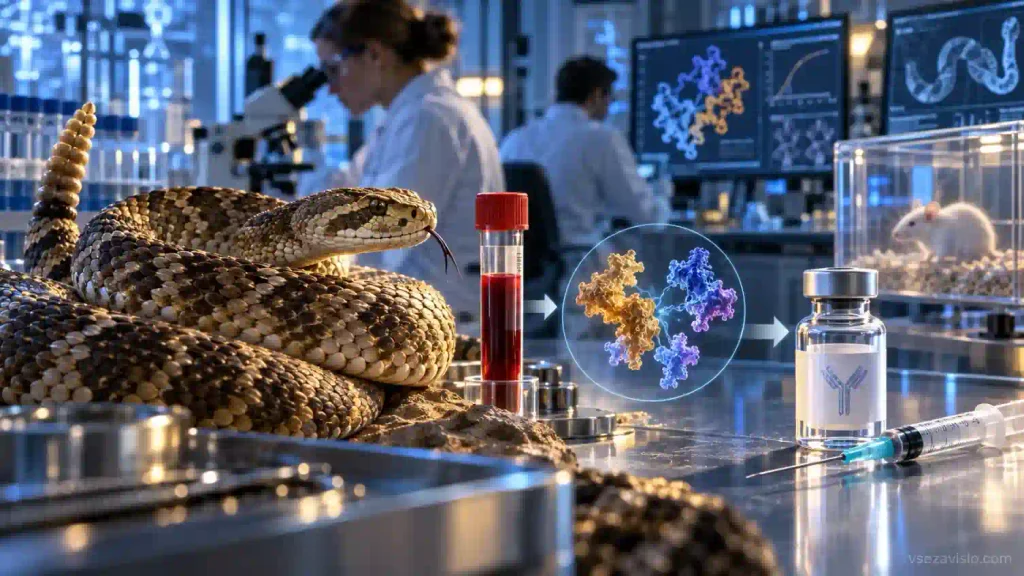
Biologists have discovered the foundation for a new generation of safer antivenoms directly in the bloodstream of venomous reptiles. A mix of protective proteins from the western diamondback rattlesnake proved ten times more effective than the standard medical antivenom CroFab, completely shielding lab rodents from three times the lethal dose of the toxin. The study by researchers from the University of Maryland and Texas A&M University–Kingsville was published in Proceedings of the National Academy of Sciences (PNAS).
The FETUA Protein Family and Phasing Out Horse Antibodies
Vipers possess natural immunity to their own venom thanks to metalloproteinase inhibitors from the FETUA protein family circulating in their blood. Individually, these compounds only blocked specific symptoms, such as localized bleeding or vascular damage. However, when researchers combined the FETUA-2, FETUA-3, and FETUA-5 isoforms, the resulting cocktail demonstrated a synergistic effect.
The therapeutic dose of the mixture was just 5.6 mg/kg of body weight. In terms of specific neutralizing capacity, the protein formulation proved three times more potent than native snake serum and outperformed the approved antivenom CroFab tenfold.
The discovery addresses a longstanding challenge in toxicology: conventional antivenoms are still produced by immunizing horses and sheep and harvesting their plasma. This process is expensive, difficult to scale, and frequently causes severe serum sickness or anaphylactic shock in snakebite victims. FETUA proteins can instead be synthesized recombinantly in laboratory bioreactors, delivering a stable and pure therapy without involving animals.
Evolutionary Milestones and Veterinary Potential
As highlighted in a University of Maryland press release, the isolated proteins protect against the venom of several related viper species that diverged from a common ancestor roughly 35–50 million years ago.
Still, the complex is not yet a universal antidote: while the proteins neutralize metalloproteinases, they are ineffective against other venom components such as phospholipases and neurotoxins, which is why the mixture failed to protect mice from the bite of an African puff adder. The researchers are already searching for additional inhibitors to build a complete polyvalent cocktail.
The formulation must undergo extensive safety testing before reaching human clinical trials. According to biologist Sean Carroll, veterinary clinics will be the first to receive the recombinant proteins to treat bitten dogs and livestock, after which the treatment will be adapted for emergency medical use.
According to the World Health Organization, snakebites kill between 81,000 and 138,000 people globally each year, while another 400,000 victims suffer amputations and permanent tissue damage.