








Concrete with Biochar from Human Waste Is 42% Stronger in Flexure
 ·
09.09.2026 12:11
·
2 min read
·
09.09.2026 12:11
·
2 min read
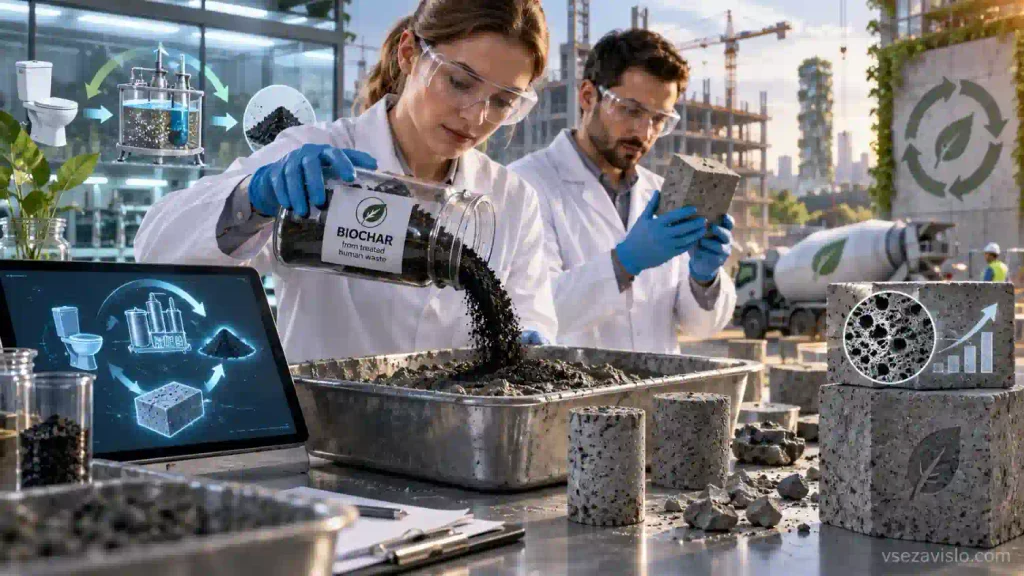
Indian researchers have shown that thermally processed sewage sludge can significantly improve the properties of construction mixes. Partially replacing Portland cement with biochar made from treated sewage sludge increased concrete’s flexural strength by 42% and its compressive strength by 21%. The results of the experiment were published in the scientific journal Scientific Reports.
Pyrolysis at 450 °C and the Microstructural Effect
Viral social media posts about “reinforcing concrete with feces” distort the essence of the process: no one hauls raw sewage to construction sites. The scientists took solid sludge from the Warangal wastewater treatment plant, dried it, and subjected it to pyrolysis — oxygen-free high-temperature heating at 350–450 °C. As a result, the biological mass turned into a sterile, porous carbon powder rich in silicon.
The resulting biochar was added to standard Portland cement in proportions of 5%, 10%, and 15%. The best result came from the mix with 10% replacement: after 91 days, the control samples showed a 21% increase in compressive strength and a 42% increase in flexural strength. When the biochar share was raised to 15%, the material’s properties began to decline due to reduced mix homogeneity.
As ScienceAlert notes, the strengthening of the concrete is due to three factors:
- Internal curing: the porous biochar granules absorb water during mixing and slowly release moisture as the concrete sets, preventing microcracks;
- Pozzolanic activity: the silica in the ash reacts with calcium hydroxide to form a strong hydrate gel;
- Matrix density: the fine particles effectively seal voids, reducing water absorption in the finished monolith.
Environmental Potential and Frost Resistance Testing
The development opens the way to tackling two environmental problems at once: recycling accumulating sewage sludge and reducing the use of traditional cement, whose production accounts for about 8% of global carbon dioxide emissions.
However, before the mix can be used in construction, applied engineering issues must be resolved. The researchers need to assess the cost-effectiveness and energy intensity of the pyrolysis process itself, as well as test the new concrete’s resistance to freeze-thaw cycles, road salts, and the risk of long-term leaching of heavy metals that may be present in municipal sewage sludge.