









Startup Fluxnium Wants to Extract Uranium from Seawater — the Oceans Hold Enough for About 50,000 Years
 ·
16.09.2026 21:12
·
3 min read
·
16.09.2026 21:12
·
3 min read

American startup Fluxnium has emerged from stealth and unveiled a technology for industrial-scale extraction of uranium directly from seawater. The company closed a $7 million seed round with participation from Constellation Energy, the largest nuclear power plant operator in the US. The developers aim to turn the world’s oceans into an inexhaustible source of raw material for nuclear power, with reserves that could theoretically last 50,000 years.
Ocean Farms and Polymer Threads
The world’s oceans hold a colossal amount of dissolved uranium — about 4.5 billion tons, roughly a thousand times more than all known onshore mineral deposits. But the metal’s concentration in water is microscopic: only about 3.3 parts per billion (ppb).
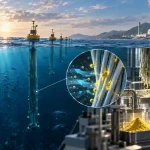
Instead of trying to filter cubic kilometers of water with pumps, Fluxnium has licensed chemical research from US Department of Energy national laboratories. The technology relies on the hydrodynamics of natural ocean currents:
- Braided ropes are made from special polymer fibers and suspended from buoys in the sea, resembling seaweed farms;
- The material selectively binds dissolved uranyl ions over 30–60 days;
- The nets are hauled onto ships, the accumulated concentrate is washed off with a chemical solution, and the fibers are returned to the water;
- The resulting solution is purified into standard uranium concentrate (yellowcake).
According to TechCrunch, the method avoids the environmental problems of traditional mining: it leaves behind no hundreds of thousands of tons of radioactive tailings and waste rock piles.
The Economic Barrier and US Import Dependence
Cost remains the biggest challenge. Early experiments by national laboratories with amidoxime fibers, described in research on PubMed, yielded a cost of more than $200 per pound of uranium oxide. For comparison, according to the US Energy Information Administration, the average price US nuclear plants pay for uranium is around $58–60 per pound.
Although Fluxnium says its new fiber structure has multiplied the contact area, the founders are keeping exact commercial cost figures secret for now. On the open sea, the equipment faces biofouling by algae and storms, and maintaining the fleet requires regular spending.
Even so, investor interest in the startup is driven by geopolitics. Under US Department of Energy plans, the country intends to triple its nuclear generating capacity by 2050, adding 200 GW. At the same time, US plants today depend on uranium imports from abroad for more than 90% of their supply.
For investors, the value of the Fluxnium project lies not in an abstract fuel reserve stretching tens of thousands of years into the future, but in the chance to secure an independent domestic supply channel for uranium straight from the ocean shelf — if the startup can bring its synthesis costs close to the prices of traditional open-pit mines.