









Jellyfish Reveal Unexpected Cancer Defense Mechanism Through Rapid Cell Turnover
 ·
19.08.2026 19:14
·
2 min read
·
19.08.2026 19:14
·
2 min read
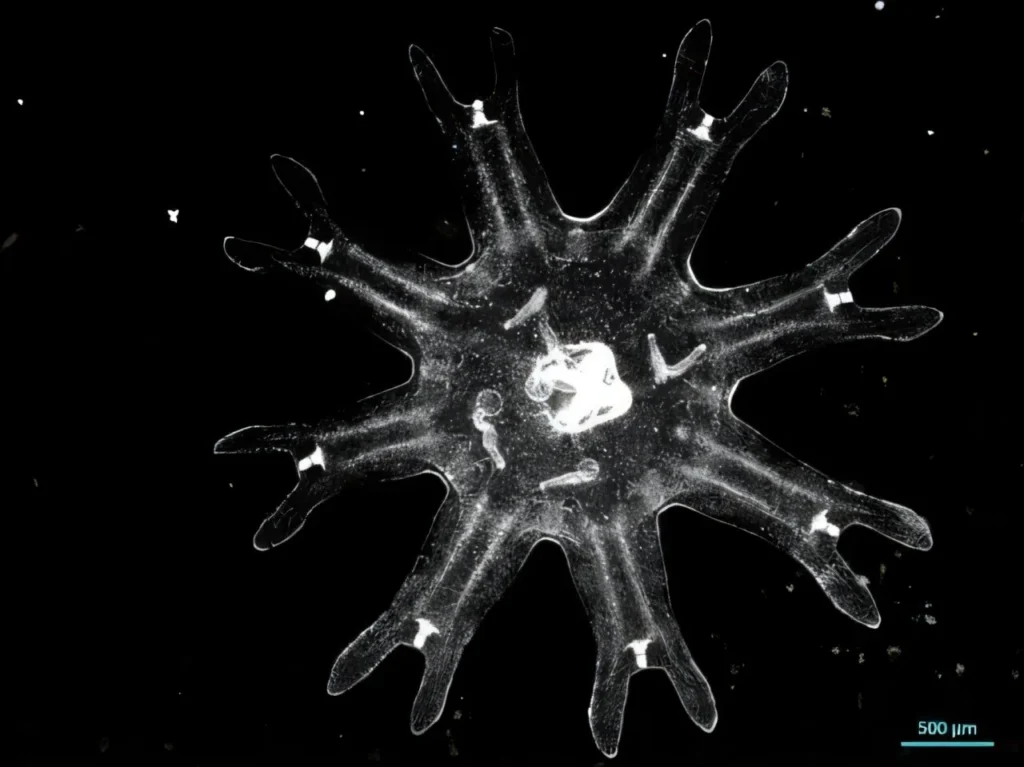
Biologists at the California Institute of Technology (Caltech) have uncovered the mechanism behind jellyfish’s remarkable resistance to cancer. According to a study published in the journal PNAS, ultra-fast cell division combined with active cell culling helps the organism eliminate mutations long before a tumor forms.
The finding challenges the classic oncology dogma that high rates of cell division automatically increase the likelihood of malignant mutations.
Biological Proofreading and Quality Control
Moon jellyfish Aurelia aurita rarely develop abnormal growths even when directly exposed to chemical carcinogens. Study author Anish Sarma built a mathematical model showing that with rapid regeneration, the body can ruthlessly eliminate any suspicious cells.
The mechanism works like proofreading: when tissue continuously produces new cells, a damaged cell loses its biological value—it’s easier to destroy and quickly replace with a healthy copy. The model demonstrated that slowing down cell turnover paradoxically increases the risk of mutation accumulation and neoplasia.
Experiments on Living Organisms
According to a Caltech press release, the calculations were tested on live jellyfish:
- When apoptosis (programmed cell death) was artificially suppressed, jellyfish lost their ability to clear tissues, and tumor-like structures began to develop under carcinogen exposure;
- Blocking the rate of cell division also led to pathologies;
- Restoring the natural rate of cell division caused the growths to completely disappear.
The experiment showed that reliable anti-tumor defense requires a balance: simultaneous production of new cells and elimination of defective ones.
Implications for Medicine and Pediatric Oncology
As reported by Phys.org, the identified model is of interest for studying childhood cancers, where tumors arise without years of age-related mutation accumulation.
The researchers emphasize that the work is fundamental and does not offer a ready-made treatment for humans. Next, the team plans to study human tissues to determine whether natural tissue control mechanisms can be stimulated to prevent early-stage cancer.