









The Secret of Cancer’s Invulnerability Revealed: Scientists Find Hidden Mechanism That Saves Tumors From Chemotherapy
 ·
25.09.2026 18:47
·
3 min read
·
25.09.2026 18:47
·
3 min read
Biochemists have discovered a previously unknown backup pathway for cysteine synthesis in mammals — an amino acid essential for protection against cellular stress. The mechanism allows living cells to stay alive even after the complete shutdown of enzyme systems that had been considered fundamental and irreplaceable for decades. The results of a years-long study by an international team of scientists were published in the journal Nature Chemical Biology. For molecular biology and oncology, this is a fundamental breakthrough: the discovery not only rewrites classic biochemistry textbooks but also explains why some aggressive tumors can survive harsh courses of radiation and chemotherapy.
Cysteine is critically important to the body for building proteins and producing glutathione — the main antioxidant that protects cellular structures from toxic free radicals. Under standard conditions, cells convert cystine into cysteine using two enzyme complexes: thioredoxin reductase and glutathione reductase. It was believed that blocking both chains would inevitably kill the cell as toxins accumulated.
Yet back in 2014, a team led by Professor Edward Schmidt of Montana State University bred mice in which both of these reductase pathways were genetically switched off in liver cells. The animals not only survived but also retained a fully functioning liver, which pushed researchers to spend more than ten years searching for the hidden source of the amino acid.
Breaking the C–S Bond Instead of Standard Reduction
The biochemical puzzle was solved through detailed molecular mapping. It turned out that when the main reductases fail and excess cystine builds up, the cell activates an alternative chemical route.
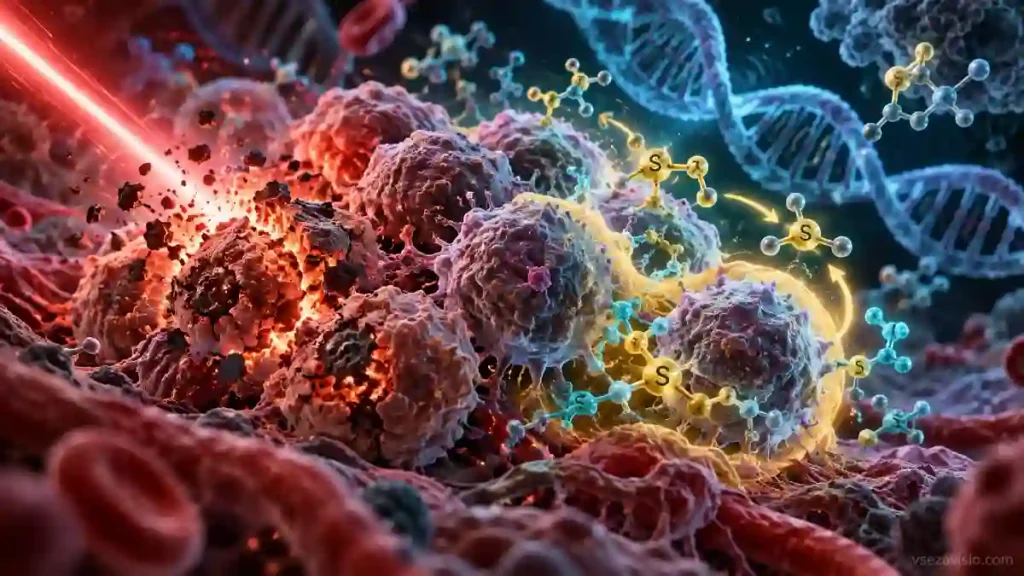
Instead of breaking the classic disulfide bond between two sulfur atoms (S–S), the backup system cleaves the bond between carbon and sulfur (C–S). This reaction produces cysteine persulfide, which then converts into pure cysteine on its own, without the direct involvement of enzymes. Experiments on transgenic mice confirmed that this noncanonical pathway can fully cover an organ’s cysteine needs under critical conditions. The authors believe the mechanism is autonomous, is induced under stress and is present in most mammalian tissues.
A Potential Gap in Cancer Cells’ Defenses
The discovery is of particular interest to pharmacology and oncology, according to the science portal ScienceDaily. Rapidly dividing malignant cells depend on cysteine far more than healthy ones do — it is the antioxidant barrier that saves a tumor from the oxidative destruction caused by modern drugs and radiation exposure.
There is a strong possibility that treatment-resistant cancer clones use the newly discovered workaround to survive the onslaught of therapy. If researchers manage to create small-molecule inhibitors that selectively block C–S bond cleavage in tumor tissues, cancer could be stripped of its backup shield and made sensitive to existing treatments again.
At the same time, the authors caution against inflated expectations: the discovery describes the basic physiology of mouse liver and cell cultures, not a ready-made drug. Years of laboratory testing lie ahead before specific blockers of the new pathway reach clinical trials. The scientists suggest that the mechanism originally emerged in ancient multicellular organisms to protect against dietary toxins, and that cancer cells’ resistance is merely a byproduct of evolution.