








Robot Pollinates Tomatoes in 10 Seconds: How Chinese Geneticists Reshaped Flowers for AI
 ·
09.09.2026 15:34
·
2 min read
·
09.09.2026 15:34
·
2 min read
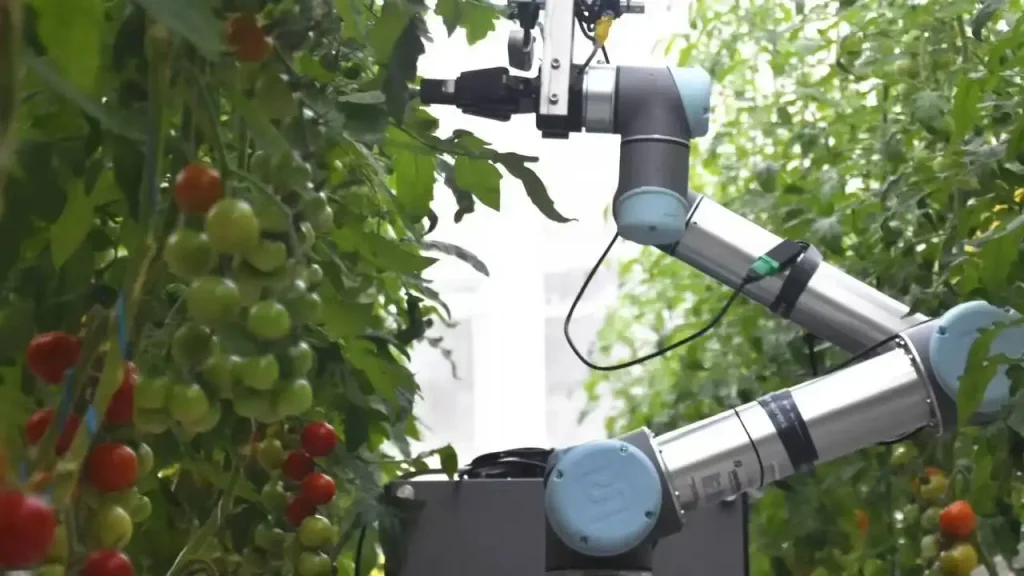
Chinese researchers have introduced GEAIR 2.0, an automated system capable of independently locating tomato flowers and performing cross-pollination without human assistance. The system takes less than ten seconds to process a single bloom. The project’s main engineering breakthrough is a non-standard approach: to make the mechanical manipulators’ job easier, biologists used gene editing to alter the plant’s anatomical structure in advance.
Two Robotic Arms, Computer Vision, and 50 Pollinations Per Brush Charge
The system was developed by a research team at the Institute of Genetics and Developmental Biology of the Chinese Academy of Sciences (CAS), led by Professor Xu Cao. As reported by China Daily, the second revision of the robot was presented at the Beijing Seed Industry Conference.
The key difference from the earlier version is the addition of two independent manipulators:
- The first mechanical arm gently holds the stem, pushes aside interfering leaves, or feeds a container with material;
- The second manipulator uses a special brush to apply pollen directly to the stigma;
- A neural network-based recognition system increased targeting accuracy from 85% to 92.8%;
- A single charge of pollen on the brush is enough to process roughly 50 flowers in a row.
The robotic cart navigates greenhouse rows autonomously, avoids heating pipes, and can operate overnight, expanding the time window for breeding.
Adapting Plants for Robots and Breeding Tasks
The acronym GEAIR stands for “Genome Editing-Assisted AI Robotics.” Biologists applied a co-design concept for crops and robots, detailed in a paper published in Cell: they bred specialized lines of tomatoes and soybeans with protruding pistils. This shape makes the flower’s reproductive organs easily accessible to optical sensors and eliminates the risk of stiff manipulators breaking branches.
On social media, the system’s success has already been linked to the country’s record grain harvests (which topped 714 million metric tons, according to a bulletin from China’s National Bureau of Statistics). However, such comparisons are inaccurate: the robot does not yet operate in open fields.
The machine is currently undergoing testing in specialized agricultural parks for accelerated hybridization. The system is designed to relieve scientists of tedious, painstaking manual work with tweezers and brushes when producing elite crop seeds.