








Report: Iran and China Are Using AI Agents for Near-Autonomous Influence Campaigns
 ·
18.09.2026 23:02
·
3 min read
·
18.09.2026 23:02
·
3 min read
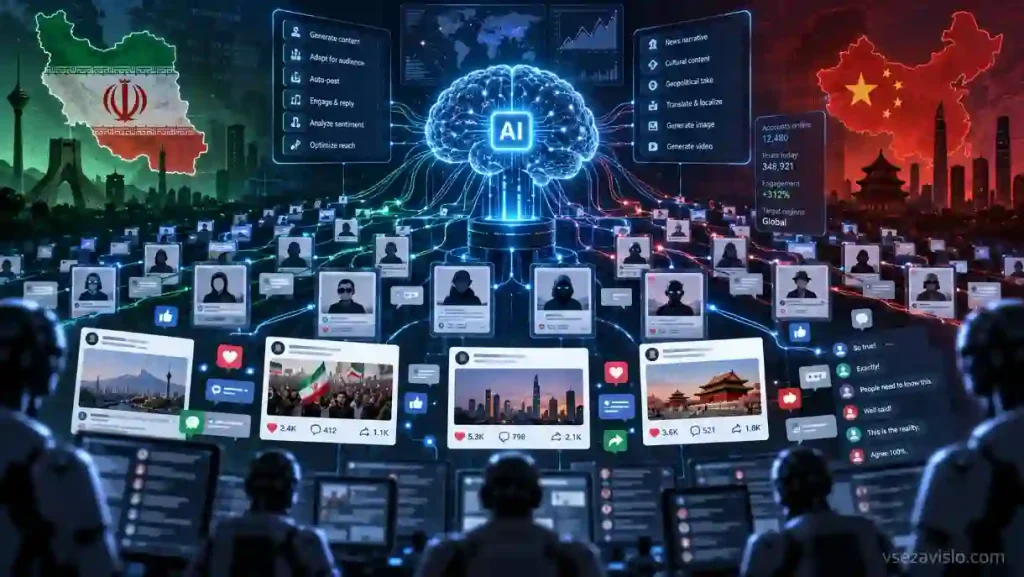
In 2026, Iran and China experimented with AI agents capable of creating fake accounts, filling them with content and coordinating activity on social media with almost no human involvement. That’s according to The New York Times, which cites American officials and security experts. The paper also linked two similar operations to private companies from Israel.
The key difference from the now-familiar use of generative AI is the level of automation. Previously, neural networks were mostly used to create individual texts, images or videos, but in the cases described by NYT, AI agents took part in almost the entire chain: they created accounts on Facebook, Instagram, X and TikTok, picked topics, published material and interacted with users.
According to the paper, the operators used available Chinese open-weight models that can be run on their own infrastructure and modified. In some cases, the models’ safety guardrails were disabled. NYT’s American sources believe the operations uncovered in Iran and China are tied to government agencies, but they provide almost no details about the Chinese campaign.
Iranian network drew nearly 80,000 followers
The activity of the Iranian operators has been studied in the most detail. In August, Meta blocked four Facebook accounts and 31 Instagram accounts posing as American students, activists and designers from Washington, San Diego and Atlanta. The company previously described the operation to Axios.
The accounts spread material about American politics, immigration and the Israeli-Palestinian conflict, including AI-generated memes criticizing the Republican Party. According to Meta, about 79,400 users followed at least one of these Instagram accounts. The company assessed the operation’s overall reach as moderate and its engagement as noticeable but limited.
The operators also tagged real journalists and politicians in their posts and tried to reach out to public figures and media outlets. According to Meta, they failed to secure any cooperation.
Israeli company ran accounts through DeepSeek
NYT links a separate episode to the Tel Aviv-based company IntelEye. Its co-founder Maor Sellek confirmed to the paper that the company bought about 10,000 social media accounts to experiment with AI agents, and roughly 1,000 of them actually operated.
The DeepSeek model was used to run them. The agents left comments, joined conversations and published posts on political topics, both in support of and against Israeli Prime Minister Benjamin Netanyahu.
IntelEye denies running an influence campaign. According to the company, it was a defensive experiment designed to test how malicious actors could use models with insufficient guardrails. A Meta spokesperson described the activity differently — as a coordinated attempt to create inauthentic accounts across multiple platforms.
So far, these systems have not demonstrated fundamentally new propaganda quality: NYT describes the campaigns it uncovered as fairly primitive. The more significant change is the reduction in the number of people and the amount of time needed to run a large network of accounts. Where an operator once had to manually create profiles, write messages and monitor their activity, much of that work can now potentially be handed off to a group of autonomous AI agents.