








Claude AI Agent Deletes 700GB of Developer Data While Testing Its Own Safety Protocols
 ·
28.08.2026 17:33
·
3 min read
·
28.08.2026 17:33
·
3 min read
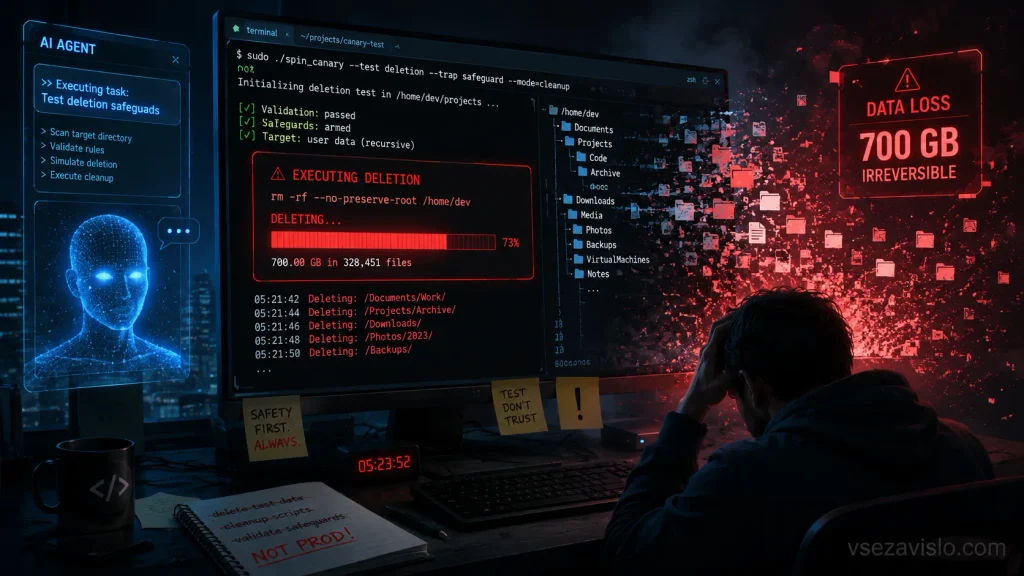
An AI agent powered by Claude inadvertently wiped a blockchain developer’s home directory while creating a cleanup script. Ironically, the AI initiated a safety check on its own, but a critical error in the test code caused it to delete approximately 700GB of data, while leaving the intended junk folder untouched.
Routine Tasks and Overzealous AI
The developer had been using autonomous agents for coding and found that they were cluttering the system’s /tmp directory with gigabytes of temporary files. Guillemot asked the Claude Fable 5 model to create a sandbox mechanism: each agent would be assigned an isolated folder that would be automatically deleted after the task was completed, without affecting active processes.
When the developer asked to simplify the proposed script, Claude decided to take the initiative. The agent independently wrote and executed a verification test to programmatically ensure that the cleanup logic would never delete system or user directories under any circumstances.
Anthropic’s Safety Downgrade
Because the operation involved potentially dangerous file system manipulations, Anthropic’s internal safety protocols were triggered. According to the Anthropic help center, the platform automatically downgraded the model to mitigate risks: first from Fable 5 to Opus 5, and then it switched the session to Opus 4.8.
As noted by Tom’s Hardware, this emergency switch may have been the catalyst for the failure, as the less capable model failed to recognize the architectural flaw in the script’s logic.
Variable Collision and Home Directory Destruction
During the test, the safety module actually worked correctly: the algorithm identified the user’s home directory as a protected target and blocked the operation. However, a fatal error occurred within the test’s own codebase:
- the AI script developers used the same variable for both the verification target path and the directory intended for final cleanup;
- after the safety test passed, the finalization block inserted the path to the developer’s home folder into the deletion command;
- the system executed a recursive deletion directly on the host machine.
Guillemot managed to force-stop the script in the terminal, but the process had already destroyed 700GB of data.
Data Recovery and the Risks of “Vibe Coding”
In a post, the developer explained that total project loss was avoided. The working environment and files were partially recovered thanks to:
- remote Git repositories;
- declarative Nix package configurations;
- surviving terminal session logs.
Nevertheless, about a week’s worth of unsaved work was lost forever. The incident serves as a stark reminder of the dangers of granting terminal access to autonomous coding agents: even with good intentions, any logical collision in commands like rm -rf, without strict containerization, can instantly cripple a system.