









Scientists Partially Reverse Aging Signs in Mice by Restoring One Protein in the Hypothalamus
 ·
18.09.2026 23:08
·
3 min read
·
18.09.2026 23:08
·
3 min read
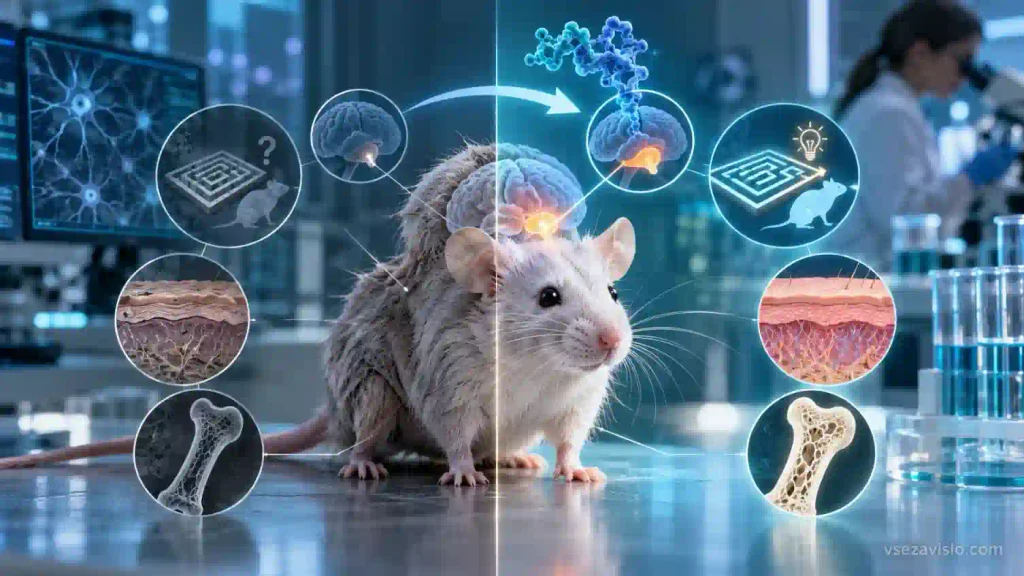
A new wave of publications about “reversing aging” in mice is not tied to a brand-new breakthrough but to a fresh look at already known work. On September 18, ScienceDaily revisited a study first published in PLOS Biology back in March 2023: researchers at Xiamen University showed that a decline in the protein Menin in the hypothalamus is linked to several age-related changes in mice, and that restoring it partially improved the animals’ condition.
The authors studied the ventromedial nucleus of the hypothalamus, a brain region involved in regulating metabolism. They found that with age, Menin levels in certain neurons drop, while inflammation in that area increases. When the researchers artificially lowered Menin in younger mice, the animals developed signs of aging earlier: memory worsened, bone mass decreased, skin thinned, metabolism was disrupted, and lifespan shortened.
The team then ran the reverse experiment. In 20-month-old mice, they boosted Menin expression in the hypothalamus using a viral vector. After 30 days, several parameters improved at once: skin thickness and bone mass increased, some inflammation markers fell, and in behavioral tests the mice performed better on memory, learning and balance tasks. The paper also reports an increase in lifespan in the experimental group.
The role of D-serine
The study matters not only for the effect itself but also for the mechanism it proposes. The authors linked Menin to the enzyme PHGDH, which is involved in the synthesis of D-serine. This substance affects NMDA receptors, which in turn are important for learning and memory.
When old mice and animals with reduced Menin were given D-serine in their drinking water for three weeks, their cognitive scores did improve. But here lies the key limitation: D-serine alone did not reproduce the full effect of restoring Menin. In the paper’s discussion, the authors state directly that the improvement from D-serine was mainly related to cognitive function, while it did not eliminate peripheral signs of aging.
This is an important clarification, because it is easy to draw the wrong conclusion from such news—that this is a ready-made “anti-aging supplement.” In fact, the study was conducted in mice, and D-serine and ordinary dietary L-serine are not the same thing. The long-term effectiveness and safety of this approach in humans have not been proven.
Interest in the hypothalamus as one of the centers of age-related changes is indeed growing. For example, in a Nature paper published in 2025, researchers analyzed about 1.2 million mouse brain cells and concluded that some of the cell types most sensitive to aging are concentrated around the third ventricle of the hypothalamus. In these cells, the activity of genes linked to normal neuron function declined, while immune and inflammatory signals intensified.
That is why the Menin work is interesting: it does not prove that aging can be “rolled back,” but it adds another concrete mechanism to the growing picture of how age-related changes in the brain can affect the whole body. Clinical use in humans is still a very long way off, but as a direction for fundamental research, this is a genuinely strong result.