







Fruit Fly Nervous System Transferred to Walking Robot: Why Viral News About a “Resurrected Fly” Is Fake
 ·
14.09.2026 16:16
·
3 min read
·
14.09.2026 16:16
·
3 min read
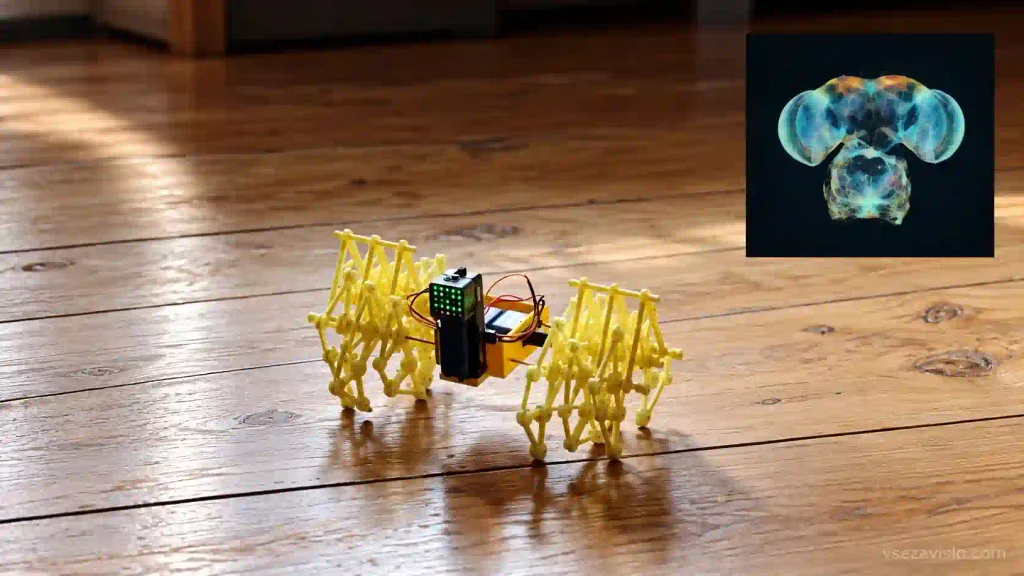
Videos claiming that researchers supposedly “connected the brain of a dead fly to a mechanical spider,” giving the insect a new metal body, have racked up millions of views on social media. Fact-checking the original sources reveals a fascinating scientific experiment, but it has nothing to do with biological resurrection: the robot is connected to a digital simulation of neural circuits, not living tissue.
166,000-Neuron Map and Project Ommatid
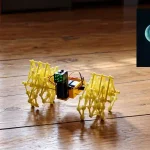
The viral headlines were sparked by the release of the Ommatid project on GitHub. A developer using the alias FutureJJ recreated a digital model of a fruit fly’s (Drosophila melanogaster) nervous system and used it as a controller for a six-legged walking robot, the Hiwonder RoSpider.
There are no biochips or extracted tissues in the design. The project is built on the Male CNS v1.0 atlas—a complete digital connectome of the male fruit fly’s central nervous system, mapped by researchers at Google Research, the Howard Hughes Medical Institute (HHMI), and the University of Cambridge.
Using electron microscopy, scientists digitized layer-by-layer a map of all 166,700 of the insect’s neurons and roughly 50 million synapses, covering not just the brain, but also the ventral nerve cord—the arthropod equivalent of a spinal cord.
THE FLY BRAIN ESCAPED THE COMPUTER. I PUT IT INSIDE A PHYSICAL ROBOT.
— Frank (@Frank_web33) September 13, 2026
Scientists released a reconstructed map containing 166,700 neurons from a fruit fly.
I connected it to a Strandbeest.
The panel in the top-right shows the simulated brain running. Its neural activity is… pic.twitter.com/gTPeHK8FLz
Software Emulation Instead of Sci-Fi
In the Ommatid project, the natural neural network runs as a software simulation on a server. The robot scans its surroundings with its built-in camera and streams the footage to the software. The fly’s virtual visual neurons process the light signals and generate motor impulses, which are then relayed to the twelve servos powering its mechanical legs.
The developer’s key goal is to study how an unaltered biological connectome behaves inside an unfamiliar artificial body (embodied simulation). The model was not trained using traditional machine learning nor tuned for a spider’s gait: movement emerges solely from the natural architecture of neural connections.
The project’s creator emphasizes that this is not a transfer of the insect’s personality or consciousness. It is an experimental demonstration, and early tests showed limited movement coordination.
Nevertheless, the project clearly illustrates a practical application for fundamental brain-mapping data published in Cell: researchers now have a tool to test natural neural circuits on real physical hardware without tampering with living organisms.