







Best AI Models of 2026: ChatGPT, Claude, Gemini, Grok, DeepSeek, and Perplexity Compared
 ·
23.08.2026 15:00
·
13 min read
·
23.08.2026 15:00
·
13 min read
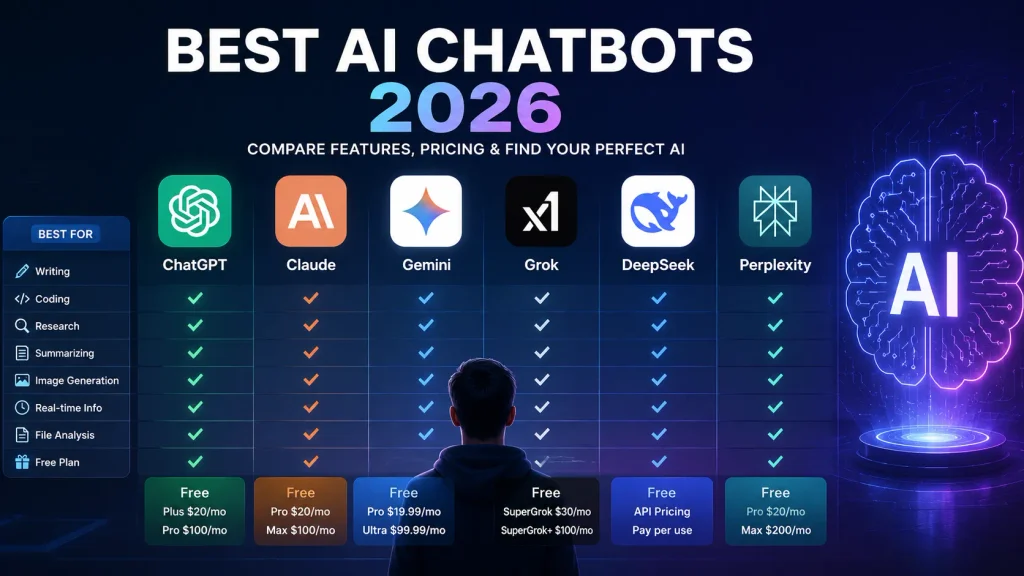
Choosing a single “best AI model” in 2026 has become nearly impossible. ChatGPT has evolved into a versatile workhorse, Claude excels at programming and large projects, Gemini is deeply integrated into Google’s services, Grok focuses on real-time information and content creation, DeepSeek remains one of the most affordable options, and Perplexity effectively replaces traditional search for research tasks.
We compared the leading AI services based on capabilities, current models, free access, and subscription costs as of August 2026.
Quick Guide: Which AI to Choose in 2026
| Task | Best Choice |
| One AI for almost everything | ChatGPT |
| Programming and coding | Claude |
| Large documents and multimodality | Gemini |
| Information search and research | Perplexity |
| Free usage | DeepSeek |
| News, X, and current events | Grok |
| Image generation and general creativity | ChatGPT / Gemini / Grok |
| Working within Google Docs, Gmail, and Drive | Gemini |
| Large software projects | Claude |
| Maximum features for around $20 | ChatGPT Plus / Claude Pro / Google AI Pro / Perplexity Pro |
There is no clear winner here: the best choice depends heavily on the task. If you need just one subscription for everyday work, ChatGPT remains the most versatile option. For programming, Claude is particularly compelling, and for constant work with search and sources, Perplexity stands out.
How Much Do Popular AI Models Cost?
Prices below are for individual users in the US, excluding taxes. Costs may vary in other countries.
| Service | Free | Main Subscription | Power User Plan |
| ChatGPT | $0 | Go — $8, Plus — $20 per month | Pro — $100 or $200 per month |
| Claude | $0 | Pro — $20 per month | Max — $100 or $200 per month |
| Gemini | $0 | Google AI Pro — $19.99 per month | AI Ultra — from $99.99 to $199.99 per month |
| Grok | $0 | SuperGrok — $30 per month | SuperGrok Plus — $100 per month |
| DeepSeek | $0 | No separate subscription required for regular chat | API is pay-per-token |
| Perplexity | $0 | Pro — $20 per month | Max — $200 per month |
Almost all services can be fully tried for free, so there’s no need to pay right away. The main difference with paid subscriptions is access to the most powerful models, increased limits, deep research, image and video generation, handling large files, and agentic features.
ChatGPT — Best All-Rounder
ChatGPT remains the most versatile service in this roundup. It can write and edit texts, search the web, analyze documents and spreadsheets, code, generate images, work with voice, and handle multi-step tasks.
OpenAI’s flagship model is now GPT-5.6 Sol. It is designed for complex tasks in programming, research, science, design, and professional work. Free users and Go plan subscribers get the cheaper GPT-5.6 Luna, while Plus unlocks GPT-5.6 in ChatGPT with deeper reasoning modes. Pro offers the most resource-intensive modes and GPT-5.6 Sol Pro.
ChatGPT’s strength isn’t just the model itself. A single interface combines web search, file handling, memory across conversations, image generation, voice, Deep Research, Codex, and connections to external apps for teams via the ChatGPT Team program.
For someone who doesn’t want to juggle five different AI services, this is one of the most convenient options.
Pricing:
- Free — $0;
- Go — $8 per month;
- Plus — $20 per month;
- Pro — $100 or $200 per month depending on usage volume.
The Plus plan remains the most rational for most users: it costs about the same as competitors but provides access to nearly the entire ChatGPT ecosystem.
Best for: those who need one AI for texts, work, search, files, programming, and content generation.
Main drawback: the best modes and highest limits quickly push subscription costs well beyond the usual $20.
Claude — One of the Best for Programming
Claude from Anthropic excels at tasks that require sustained work with large amounts of information: analyzing projects, editing long texts, refactoring code, or completing multi-step assignments.
In the free version and on Pro, the main working model is Claude Sonnet 5. It focuses on programming, tool use, and agentic tasks. The more powerful Claude Opus 5 is available to paid subscribers of Claude plans and is designed for complex, long-running processes.
Particularly notable is Claude Code — an agent that works directly with software projects via the terminal. It can read a repository, modify multiple files on its own, run commands and tests, find bugs, and work through tasks in a series of steps.
In professional development, this often matters more than small differences between models in synthetic benchmarks.
Pricing:
- Free — $0;
- Pro — $20 per month or the equivalent of $17 per month with annual billing;
- Max 5x — $100 per month;
- Max 20x — $200 per month.
According to Anthropic’s plan guide, the Max tier primarily offers significantly increased limits, and the full API price list is available on Anthropic’s official pricing page.
Best for: programmers, authors of long texts, analysts, and those who need to manage long-term projects with AI.
Main drawback: Pro limits can run out noticeably faster than you’d like with very active use.
Gemini — Best for the Google Ecosystem
Gemini’s main advantage is combining powerful models with Google services.
The AI is integrated into Gmail, Docs, and other apps, connected to Google Search, works with NotebookLM, and is used in tools for programming and multimedia content creation.
For complex tasks, Google offers the Gemini 3.1 Pro model within the Gemini model family, with a context window of up to one million tokens. The model can simultaneously analyze text, images, video, audio, PDFs, and large codebases. The newer Gemini 3.7 Flash focuses on speed, programming, and agentic scenarios.
Another strong point for Google is generative multimedia. Gemini works with Nano Banana for images, Flow, and the Gemini Omni family for video creation and editing. As a result, the Google AI subscription on Google One is gradually becoming less of a standalone chatbot and more of a full suite of AI tools with access to Gemini Advanced.
Pricing:
- Basic Gemini — free;
- Google AI Pro — $19.99 per month;
- Google AI Ultra with 5x higher limits than Pro — $99.99 per month;
- AI Ultra with up to 20x higher limits than Pro — $199.99 per month.
Google AI Pro also includes increased cloud storage and additional NotebookLM, Flow, and other service features.
Best for: Google users, people working with huge files, video, images, Gmail, Docs, and NotebookLM.
Main drawback: Google’s model and pricing structure changes so quickly that it can be hard for the average user to figure out which mode to use.
Grok — Strong for Real-Time Info and X
Grok has long ceased to be just a chatbot inside X. xAI is developing standalone apps, a web version, image and video generation, voice, pluggable services, and its own environment for building software.
The current flagship model, Grok 4.6, launched in August 2026. It is designed for long-running agentic tasks, programming, research, and building working applications. In xAI’s own tests, the model is roughly on par with GPT-5.6 Sol according to the aggregate Artificial Analysis Intelligence Index.
Grok has one advantage that competitors can’t easily replicate: tight integration with X. For finding fresh posts, user reactions, and unfolding events, this can be especially useful.
The service also includes Grok Build, described in the Grok documentation: you describe a website, game, app, or interactive tool, and the AI assembles a working version right within the conversation. Since August, Build is available even to free users.
Pricing:
- Free — $0;
- SuperGrok — $30 per month;
- SuperGrok Plus — $100 per month.
The full list of plans is published on xAI’s official pricing page. There are also more expensive options for the heaviest usage and agentic features.
Best for: those who need up-to-date information from the web and X, multimedia generation, and experimentation with AI apps.
Main drawback: the base subscription costs more than the standard $20 for ChatGPT, Claude, Gemini, and Perplexity.
DeepSeek — Maximum Features for Free
DeepSeek remains the top choice for those who refuse to pay for a monthly subscription.
In 2026, the company released the DeepSeek V4 family. The top-tier V4-Pro is designed for complex reasoning, programming, and agentic tasks, while V4-Flash is faster and cheaper.
Both models support a context window of up to 1 million tokens, Thinking Mode, tool calling, and OpenAI- and Anthropic-compatible APIs on the DeepSeek platform. DeepSeek V4-Pro is available through the official website and mobile app without a mandatory paid subscription.
The API pricing is particularly impressive, according to DeepSeek’s official rates and platform news releases:
- DeepSeek V4-Flash — $0.14 per 1 million standard input tokens and $0.28 per output token;
- DeepSeek V4-Pro — $0.435 for input and $0.87 for output;
- Cache hits on input data reduce costs even further.
This is several times cheaper than most flagship Western models.
Best for: those who need a powerful free chatbot, developers with high API call volumes, and users who want maximum value for minimal cost.
Main drawback: the consumer tool ecosystem is significantly less developed than ChatGPT, Gemini, or Grok.
Perplexity — Best AI for Search and Research
Perplexity is a bit different from the others. The company doesn’t try to force users to stick with its own language model.
The core idea is AI search that always uses internet sources. Perplexity gathers information from multiple pages, compiles a single answer, and immediately shows links so you can verify claims.
The paid version is especially interesting: users can choose models from different companies in one interface. Currently available are Claude Sonnet 5, Gemini 3.1 Pro, Grok 4.5, GPT-5.6 Terra, and others. The Perplexity Max plan additionally unlocks GPT-5.6 Sol and Claude Opus 5.
In effect, one subscription gives you access to several leading AI models — though with Perplexity’s own limits and without the full feature set of the original services.
Pricing:
- Standard — free;
- Pro — $20 per month or $200 per year;
- Max — $200 per month or $2000 per year.
As noted in Perplexity’s plan guide, the free version is fine for regular search, while Pro unlocks advanced models, expanded Research, file handling, and additional sources.
Best for: journalists, students, researchers, analysts, and anyone who needs to quickly find information with supporting links.
Main drawback: as a general-purpose work environment, Perplexity still lags behind ChatGPT, Claude, and Gemini.
Which AI Is Best for Programming?
If your primary task is development, Claude should be your first try.
Sonnet 5 offers a good balance of speed and quality, Opus 5 is for the most complex tasks, and Claude Code turns the model into a full-fledged agent that works directly with your codebase.
Next come ChatGPT with Codex, Gemini with Antigravity, and Grok with Grok Build. In 2026, the difference between leading models is so small that for a real project, what often matters more than the result of a single test prompt is the quality of the entire agentic environment around the model.
Which AI Is Best for Writing?
For general writing tasks, ChatGPT and Claude are the most convenient.
ChatGPT wins on the number of tools and the ability to keep the entire workflow in one service. Claude often handles long-form content, maintaining structure, and reworking large volumes of text well.
Gemini makes sense if your source materials are already in Google Docs or Drive, and Perplexity is useful if you need to gather many fresh sources before writing.
Which AI Is Best for Images and Video?
Here, the competition looks different.
ChatGPT is convenient because image generation and editing are built directly into the regular chat. Gemini has the Nano Banana family of models and is increasingly combining image and video work through Gemini Omni and Flow. Grok is actively developing Imagine and can create both images and videos.
So the choice depends on the scenario:
- Quickly get or fix an image in a regular chat — ChatGPT;
- Complex multimedia workflow — Gemini;
- Lots of experimentation with images and video — Grok.
Which AI Is Best for Free?
If you don’t want to pay at all, DeepSeek remains the most interesting option.
The company provides free access to its current model via the web version and app, and the limitations are much less restrictive for typical text use.
Next, consider the free versions of ChatGPT, Gemini, Claude, and Grok. Their capabilities are already sufficient for most everyday queries, but advanced models and tools usually have stricter limits.
What to Choose for $20 a Month
This is where competition is fiercest.
For around $20, you get:
ChatGPT Plus — $20
Best all-round option. Choose it if you need texts, images, search, file analysis, voice, and programming in one place.
Claude Pro — $20
Particularly good for texts, code, and serious professional work.
Google AI Pro — $19.99
Ideal for Google users and those who need Gemini, NotebookLM, Flow, and additional Google service features.
Perplexity Pro — $20
The most interesting option for search, research, and working with many internet sources.
If you’re not sure what you’ll use AI for, ChatGPT Plus is the safest bet. If 70–80% of your work involves programming, compare it with Claude Pro. If your main task is search and fact-checking, Perplexity Pro might be more useful than both.
What About API Pricing?
For developers, the difference between platforms is much larger than between regular subscriptions.
As of August 2026, the cost per 1 million input/output tokens according to OpenAI API rates and Gemini API pricing for several popular models looks like this:
| Model | Input | Output |
| GPT-5.6 Sol | $4* | $20* |
| Claude Opus 5 | $5 | $25 |
| Claude Sonnet 5 | $2* | $10* |
| Gemini 3.1 Pro | $2 | $12 |
| Gemini 3.7 Flash | $0.75* | $3.75* |
| Grok 4.6 | $2 | $6 |
| DeepSeek V4-Pro | $0.435 | $0.87 |
| DeepSeek V4-Flash | $0.14 | $0.28 |
Asterisks mark temporary or promotional rates. For example, the price cut for GPT-5.6 Sol is promised at least until November 21, 2026; Sonnet 5 costs $2/$10 until the end of August; and the introductory price for Gemini 3.7 Flash lasts until the end of 2026. Some companies charge higher rates for very long contexts.
In terms of price, DeepSeek is in a league of its own: V4-Pro costs more than ten times less than many flagship models for generating responses.
Verdict: Which AI Is Best in 2026?
If we boil the comparison down to a few recommendations:
ChatGPT — the best all-round option and our top recommendation for most users.
Claude — choose it for programming, long texts, and complex, long-running projects.
Gemini — most interesting for multimodality and Google ecosystem users.
Perplexity — the best specialized option for search, research, and working with sources.
DeepSeek — the best choice when free access or minimal API cost is the top priority.
Grok — especially useful for real-time information, X, multimedia generation, and new agentic capabilities.
That said, the AI market is evolving so quickly that the leader can change every few months. So it’s much wiser to choose not the “smartest AI overall,” but the service that best solves your specific task.