









Google Unveils Gemini 4 Argon, a Model That Can Output Up to 1 Million Tokens per Request
 ·
30.09.2026 23:48
·
4 min read
·
30.09.2026 23:48
·
4 min read
Google has officially unveiled Gemini 4 Argon, a new flagship AI model for complex programming, professional work and cybersecurity. One of its key features is a maximum output of up to 1 million tokens per generation — the previous limit was 64,000.
There is no public launch yet. Argon is first being given to select cybersecurity specialists through the Fairwind program, after which Google plans to open access to developers, companies and regular users.
The company calls Gemini 4 Argon a model for long, multi-step tasks where AI has to reason for extended periods, work with large codebases and independently carry out entire sequences of actions.
Up to a million tokens per response
In the official announcement, Google says it has increased Argon’s maximum output from the previous 64,000 to 1 million tokens.
That doesn’t mean every response from the model will be that huge. The extra headroom is needed primarily for tasks where AI has to complete hundreds of intermediate steps within a single long trajectory — for example, analyzing a large software project, conducting research or independently fixing a complex bug.
Google is already using Argon internally. In one project, agents based on the model analyzed data center telemetry and found optimizations that, once implemented, freed up more than 300 TiB of RAM. In another case, Argon was used to port large C/C++ projects to Rust, including the Zircon kernel codebase from Fuchsia, which spans more than 800,000 lines.
For the libgav1 video decoder, the model reworked about 32,000 lines of SIMD code, and according to Google, the resulting Rust version ran 2.7 times faster than the previous one with identical decoding results.
Google bets on code and cybersecurity
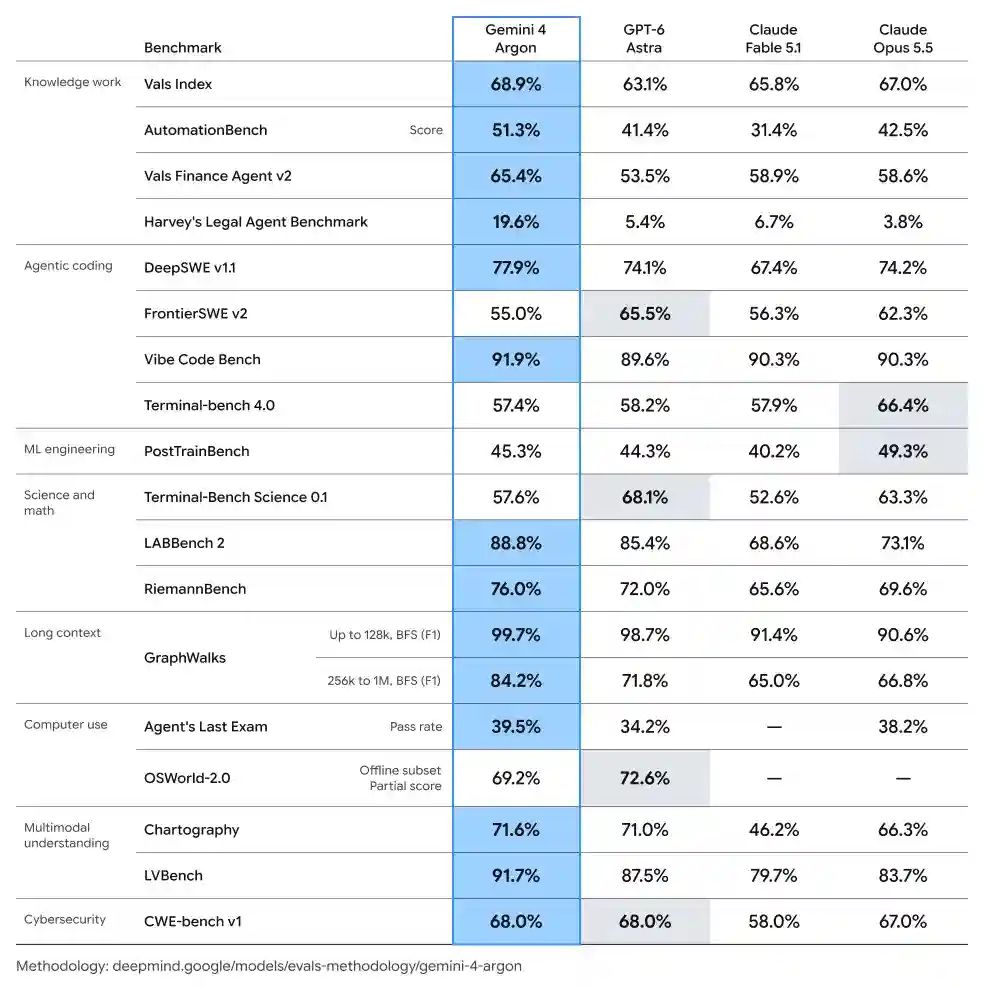
On the DeepSWE v1.1 long-horizon software development test, Gemini 4 Argon scored 77.9%. Google also claims the model ranks first on Vals Index, AutomationBench and several specialized tests for financial and legal tasks.
Cybersecurity gets particular attention. Argon was trained to find, confirm and independently fix software vulnerabilities.
On CWE-bench v1, the model scored 68%, sharing first place. Wiz is already testing Argon in the Scan for Good program, which is designed to find vulnerabilities in critical infrastructure.
At the same time, benchmark results show performance only on specific tests. They do not prove that Argon is universally superior to GPT-6 Astra, Claude Opus 5.5 or other flagship models across all real-world tasks.
API starts at $2 per million input tokens
Google also announced future pricing for Gemini 4 Argon. Input will cost $2 per 1 million tokens, and output will cost $10 per 1 million tokens.
However, this is introductory pricing for a limited period. After it ends, the rate will rise to $4 per million input tokens and $20 per million output tokens.
Cached input will get a 95% discount off the regular price, so at the introductory rate it will cost about $0.10 per 1 million tokens.
No mass access yet
The first access to Gemini 4 Argon is going to trusted cybersecurity specialists through the Fairwind Program. Google is using this stage to test the model in real conditions and strengthen safeguards before a broader launch.
The company is also taking part in the US government’s voluntary program for pre-deployment testing of new powerful AI models.
The next stage should be paid API users and Google AI Ultra subscribers, after which access will expand to developers, enterprise customers and regular users.
Google has not yet given a specific date for when Gemini 4 Argon will appear in Gemini, AI Studio or the public API.