









Terminator in Real Life: Figure Melts Down Outdated Robots in a Finnish Furnace with Schwarzenegger’s Help
 ·
01.10.2026 17:10
·
3 min read
·
01.10.2026 17:10
·
3 min read
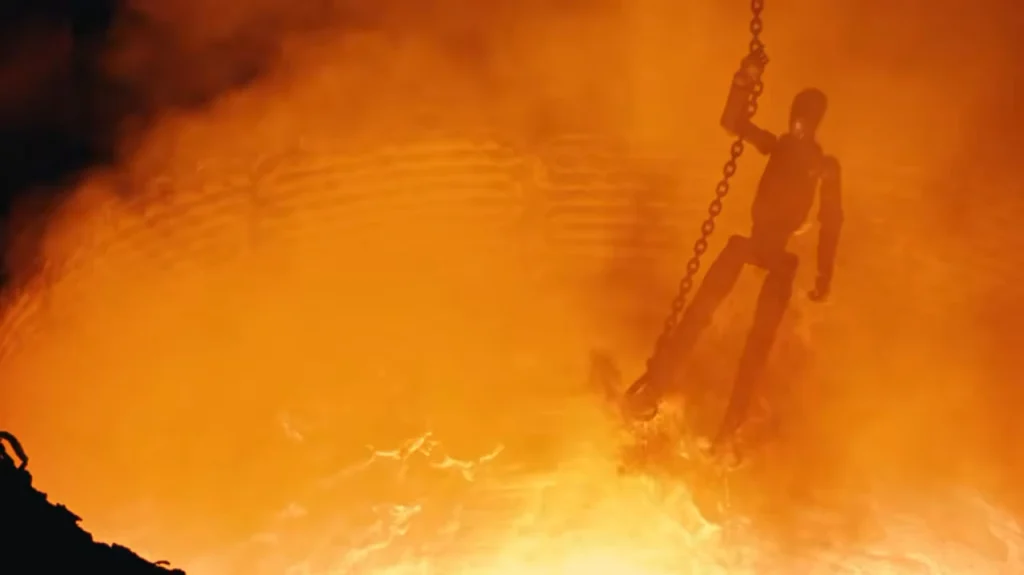
Robotics developer Figure gave its fleet of F.02 humanoids a Hollywood send-off. Instead of the long and costly process of manually dismantling the retired machines, engineers taught them to jump into a cauldron of molten steel on their own. The performance was a direct nod to the finale of Terminator 2: Judgment Day, and Arnold Schwarzenegger himself took part in creating the farewell video.
The reason for this radical destruction is purely practical. As Figure representatives explained, as the new F.03 fleet was deployed, maintaining the older models became unprofitable. At the same time, the decommissioned robots could not be thrown away or sold because of strict intellectual property protection: inside are unique custom actuators and the company’s proprietary technologies. Engineers would have had to disassemble each humanoid by hand, which would inevitably have delayed the launch of the next generation, F.04.
US Plants Refuse, a Finnish Electric Arc Furnace Steps In
Schwarzenegger proposed the melting pot idea after the company asked users online what to do with the outdated hardware. The actor volunteered to take part in the project himself, but finding a suitable location turned out to be far harder than getting a movie star on board.
Metallurgical plants in the US and Mexico flatly refused to drop devices packed with lithium-ion batteries into their expensive furnaces. With help from a team previously associated with the show MythBusters, the developers managed to find the only site willing to take on such an experiment — a plant with a 75-ton electric arc furnace in the city of Imatra, Finland.
Learning Stunts and Molten Artifacts
Preparation for the jumps took place at the company’s headquarters in San Jose. The robots were made to jump from the second floor onto air cushions, using digitized movements from professional stunt performers as a reference. A dedicated AI model was trained on that data in simulation so the machines could calculate their own fall trajectory at an unfamiliar plant.
At the production site itself, the team had only 24 hours. Filming was complicated by tight timing: each of the six melting cycles had a 20-minute window before the liquid steel formed a solid crust. Despite the extreme heat and powerful electromagnetic fields that knocked out the operators’ cameras, the robots’ control algorithms ran without a hitch.
This unusual marketing move highlights a new problem for the industry: as smart humanoids quickly become obsolete, companies will have to find efficient ways to dispose of equipment containing dangerous batteries and secret chips. Figure has already sent the metal recovered from the melt back to the US to produce a limited series of collectible souvenirs commemorating the F.02 generation. A small part of the fleet was still saved from the fire — several machines were kept as museum exhibits at the company’s office.