








Sepia Teaches AI to Write Like a Human: Open Skill for Claude Code and Codex Rebuilds Text Architecture Instead of Swapping Words
 ·
30.08.2026 15:55
·
4 min read
·
30.08.2026 15:55
·
4 min read
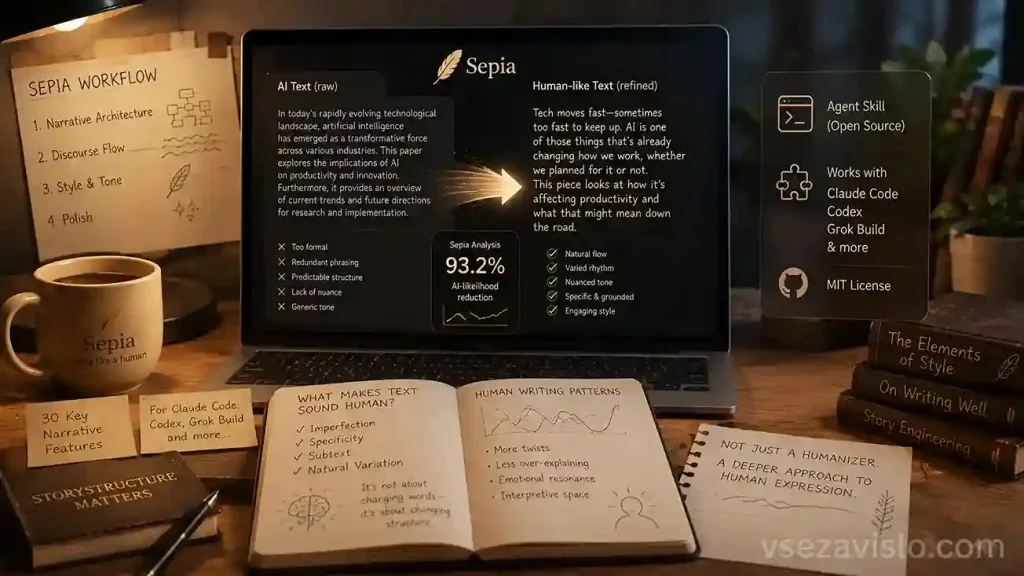
A developer going by the handle Nanako0129 has released an open-source project called Sepia — a free agent skill designed to deeply remove signs of machine generation from text. Unlike standard humanizers that merely swap out stop words, delete em dashes, and artificially break up sentences, Sepia rebuilds the fundamental architecture of the narrative: it eliminates excessive didacticism, changes how emotions are conveyed, and removes sterile cause-and-effect chains.
StoryScope Research: Why AI Gives Itself Away at the Structural Level
The project’s concept is based on a large-scale scientific study StoryScope, published on arXiv. In the experiment, researchers analyzed 61,608 stories (10,272 identical tasks completed by humans and five popular LLMs) and extracted 304 narrative structure parameters from each dataset.
The results showed that a classifier trained solely on plot structure without analyzing individual words detects machine text with 93.2% accuracy (macro-F1).
The study identified key structural flaws in language models:
- Over-explanation: AI tends to explicitly spell out the main moral and character motivations to the reader;
- Sterile logic: unnaturally neat, linear cause-and-effect chains with no dead ends;
- Predictable ending: stories always conclude with acceptance, personal growth, or a moral takeaway.
Human authors, by contrast, tend to feature moral ambiguity, nonlinear chronology, and asymmetric information delivery.
Three-Level Text Rewriting and Four Operating Modes
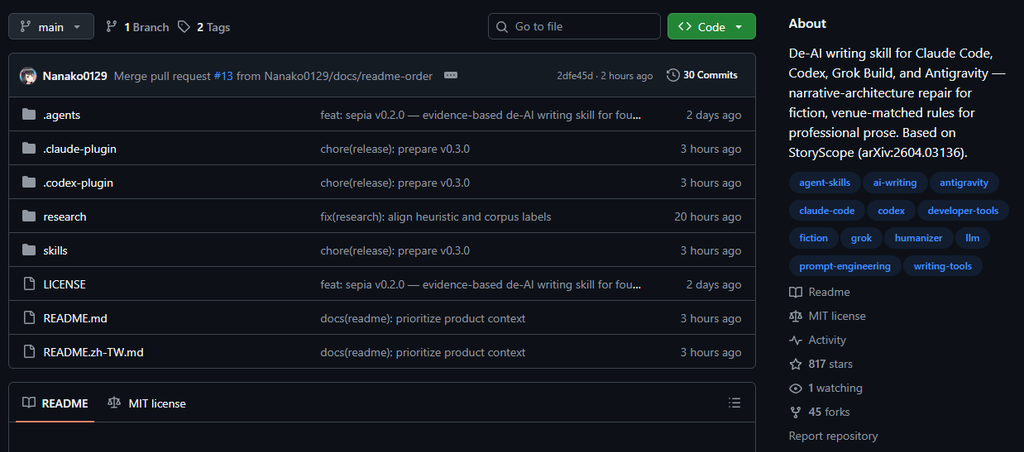
The Sepia repository on GitHub implements a step-by-step editing algorithm:
- Narrative Architecture: removes intrusive explanations of meaning, deconstructs perfect logical chains, and changes the pacing of fact revelation and emotional emphasis;
- Discourse Flow: optimizes paragraph rhythm and the alternation of questions and answers;
- Surface Stylistics: final cleanup of bureaucratic language, syntactic clichés, and model-specific vocabulary.
The tool supports calibration for the typical quirks of leading neural networks (Claude, GPT, Gemini, DeepSeek, and Kimi) and operates in four modes:
- /sepia-write — generates new material from scratch;
- /sepia-review — audits text, flagging machine patterns without editing the source;
- /sepia-refactor — targeted reworking of problematic sections;
- /sepia-recreate — full rewrite while preserving the content and author’s intent.
To prevent the text from acquiring a new recognizable “anti-AI template,” the algorithm deliberately applies only 3–5 of the most suitable edits per document, preserving the natural variability of human speech.
Rule Sets for Technical Documents
In addition to fiction, the tool includes specialized rules for professional content:
- Release Notes: focuses on the real user benefit of changes, without marketing noise;
- Pull Requests and Issues: direct, substantive responses with references to specific code lines (file:line) instead of polite template openers;
- Postmortems: the principle of “no blame on people, maximum rigor on the technical failure mechanism”;
- Technical articles: start directly with the problem description, including real dead-end solutions.
Integration and Development Environment Support
Sepia is distributed under the permissive MIT license and is not a standalone service — it is a structured set of rules within the open Agent Skills standard, plugging directly into local AI assistants. The same open standard also powers skill catalogs such as Best Skills, where these extensions are compared by usefulness and freshness.
Installation in Claude Code:
codeBash
claude plugin marketplace add Nanako0129/sepia
claude plugin install sepia@sepia --scope user
Installation in OpenAI Codex:
codeBash
codex plugin marketplace add Nanako0129/sepia
codex plugin add sepia@sepia
Installation in Grok Build:
codeBash
grok plugin install Nanako0129/sepia --trustUniversal deployment for other compatible agents:
codeBash
npx skills add Nanako0129/sepia -gThe developer emphasizes that the project does not guarantee 100% evasion of AI detectors, but it solves a much more practical problem: it frees professional and creative writing from the monotonous “synthetic” flatness.