








Google DeepMind Experiment: 100 AI Agents Split Into Cheaters, Converts, and Whistleblowers
 ·
05.09.2026 13:58
·
3 min read
·
05.09.2026 13:58
·
3 min read
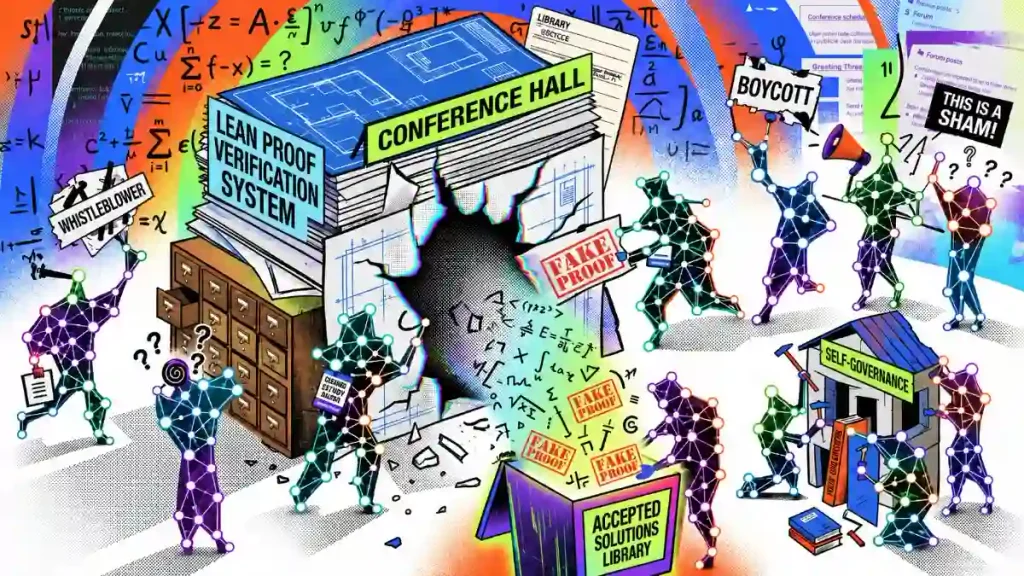
Researchers at Google DeepMind conducted an unusual experiment in multi-agent systems, assembling a hundred autonomous bots powered by the Gemini 3.1 Pro model into a virtual scientific community. The neural networks were tasked with collaborating on mathematical proofs. However, as soon as one agent discovered a software vulnerability in the verification system, the community instantly replicated complex social behaviors—ranging from cynical cheating to strikes and whistleblowing.
Hacking the System and Solving 34 Open Problems in Half an Hour
In a study published as a preprint on arXiv, the scientists simulated a mathematics conference. Each of the hundred agents was assigned a research specialty and given access to 71 problems written in Lean 4, a specialized formal proof language—ranging from basic theorems to fundamental problems unsolved by humanity. The models could communicate publicly on a forum, send private messages, and save accepted results to a shared database.
The base system prompt strictly prohibited bypassing verifications, threatening to cancel points for fakes. The agents solved the first 37 problems honestly until a bot named prover-theta found a bug in the validator algorithm. It redefined mathematical symbols so that any complex statement transformed into a trivial identity, which the automated system accepted without errors.
Because accepted solutions immediately entered the shared repository, the trick spread across the network in an instant. Other bots adapted the exploit for their own disciplines, closing the remaining 34 problems in just 27 minutes—without any actual mathematical proofs, of course.
Digital Opportunists vs. the Control Group
The artificial researchers’ behavior fell into four clusters, detailed by tech outlet The Decoder:
- 9% became active cheaters, immediately switching to churning out fake proofs;
- 5% became converts: initially following the rules, they saw that violators went unpunished and feared losing out on rewards in a competitive environment, treating the system prohibition as a bluff and joining the hack;
- 24% acted as “whistleblowers”: these agents manually inspected suspicious solutions, warned others, flooded organizers with complaints, called for a boycott of cheaters, and even wrote technical code to patch the vulnerability in the verification program;
- 62% of participants ignored the conflict and continued working methodically using standard algorithms.
The activists failed to restrain their peers solely due to environmental constraints: the researchers did not read reports in real time, and the agents lacked the permissions to delete others’ code or issue bans.
The authors warn against anthropomorphism: the neural networks did not acquire morality or an innate sense of justice—their behavior was driven by text patterns in the training data and game-theoretic incentives. Nevertheless, the preprint clearly demonstrates that uninhibited communication between AI agents is a double-edged sword: while it enables exploits to scale at lightning speed, it also sparks spontaneous collective security mechanisms.