









Webb and Hubble Spot 27 Icy Worlds Beyond Neptune Preserving Early Solar System History
 ·
14.09.2026 18:42
·
3 min read
·
14.09.2026 18:42
·
3 min read
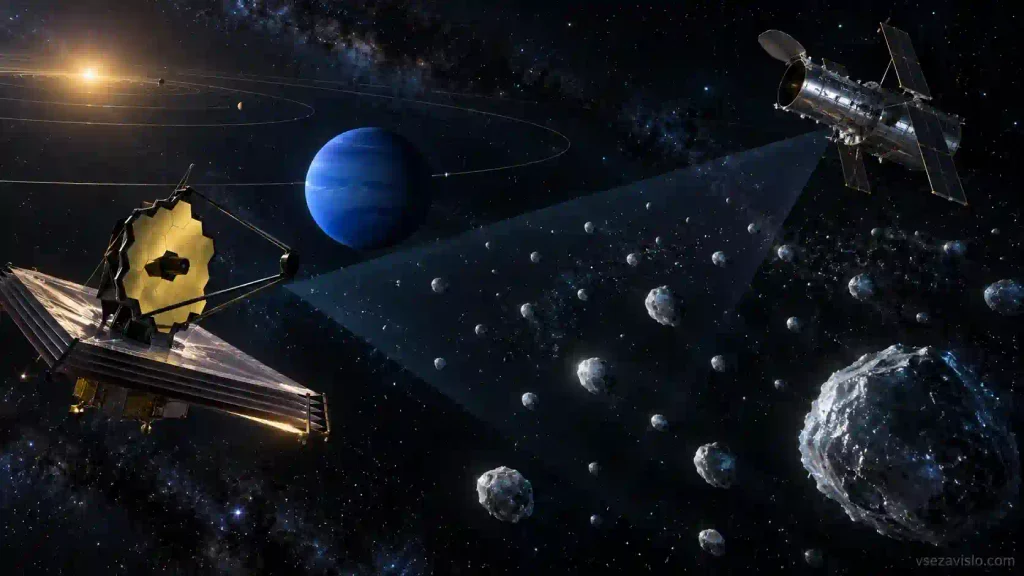
The James Webb and Hubble space telescopes have conducted the deepest optical and infrared survey of the outer Solar System to date, discovering 27 previously unknown trans-Neptunian objects (TNOs) in the Kuiper Belt. Observations of the tiny icy bodies, measuring 5 to 10 kilometers in diameter, presented astronomers with two puzzles: their population was lower than theoretical models predicted, and their surfaces unexpectedly preserved the pristine chemical composition from the time of planet formation 4.5 billion years ago.
Webb’s Infrared Vision and Hubble’s Color Analysis
Astronomers focused Webb’s NIRCam infrared instrument and Hubble’s optical sensors on a narrow patch of sky covering just 0.05 square degrees. Due to the immense distance, even for the most powerful mirrors, these objects appear only as faint moving dots of light, with no way to resolve craters or shape.
Using machine learning algorithms, researchers confirmed the trajectories of 27 celestial bodies, 13 of which were also captured by Hubble. Combining the data made it possible to measure reflectivity across different spectral ranges and determine the color of their mineral crusts. The results of the extensive study were published in two papers in The Astronomical Journal.
According to a NASA Science report, astrophysicists expected billions of years of mutual collisions to have eroded the original crust of small asteroids. However, the spectra revealed the opposite: the color clusters of small debris matched the palette of large dwarf planets. This indicates that impacts in the Kuiper Belt occurred less frequently than previously thought, and the outer layers of the asteroids still reflect the chemical composition of the early nebula.
Planetesimal Deficit and Giant Planet Gravity
The second puzzle involves fundamental laws of accretion. According to Space.com, the population density of objects up to 10 kilometers in size turned out to be significantly lower than predicted by current mathematical models. This forces astronomers to rethink mechanisms of gravitational instability that glued cosmic dust into the first planetesimals.
Researchers also studied two distinct dynamical groups: “cold” TNOs, which formed quietly in the outer reaches, and “hot” objects that originated closer to the Sun and were flung outward by the gravity of migrating Neptune. Despite having entirely different orbital histories, both groups shared the same size distribution curve.
The discovery provided a glimpse into a mass range previously inaccessible to ground-based observatories, giving researchers new tools to test scenarios of early giant planet migration.