









The Sun May Have Swallowed a Super-Earth at the Dawn of the Solar System: Hypothesis Explains Our Star’s Anomalies
 ·
17.09.2026 21:49
·
3 min read
·
17.09.2026 21:49
·
3 min read
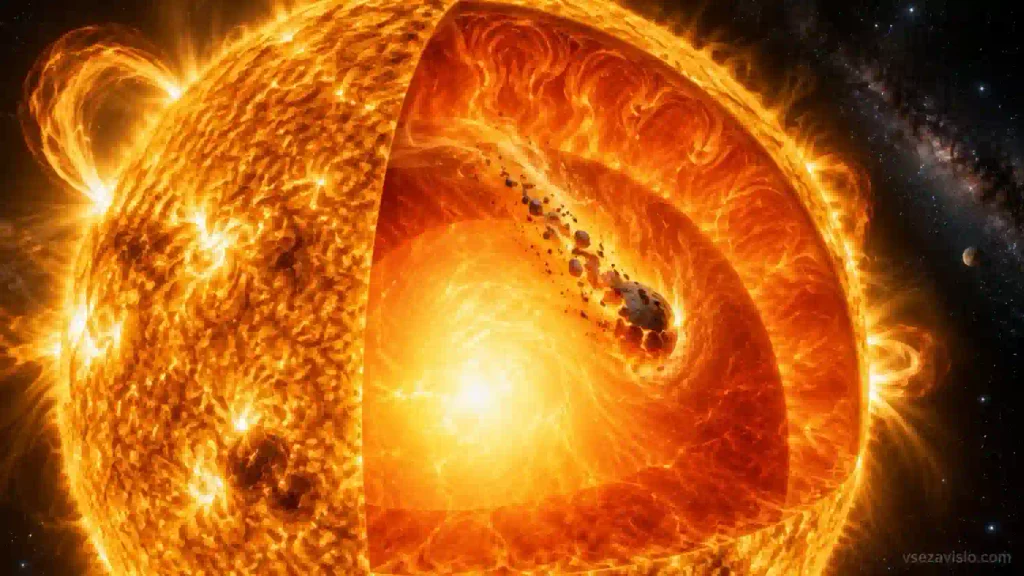
During the early stages of the Solar System’s formation, our star likely swallowed a large rocky planet of the super-Earth class. That is the conclusion of Ege University professor Mutlu Yıldız in a new study published in Monthly Notices of the Royal Astronomical Society. The computer model he built not only answers the question of why there are no super-Earths near the Sun but also solves several long-standing mysteries about our star’s internal structure.
Chemical Traces in the Convection Zone
Astrophysicists have struggled for decades with a problem: standard models of stellar evolution do not fully match helioseismology data — physical observations of the Sun’s interior. In particular, scientists could not reconcile the calculated and actual speed of sound just below the convection zone, the depth of that zone itself, and the anomalously low lithium content on the star’s surface.
According to the new modeling, all these deviations are explained by the scenario of a massive rocky object being swallowed. As noted in a statement from the Royal Astronomical Society, the calculations pointed to a planet with a mass between 5 and 10 Earth masses (the best match came at about 5.6 Earth masses).
One popular social media error is worth correcting here: the figure of 5.6 refers solely to the object’s mass, not its physical diameter.
According to Yıldız’s calculations, the dense super-Earth was able to punch through the outer envelope of the young Sun. Because of its high density, it lost almost no mass to aerodynamic drag and ablation as it penetrated deep below the convection zone. Once there, the planetary material created a local region with a high concentration of heavy elements. This permanently changed the star’s internal opacity and formed the very structure that instruments detect today.
Where Did Our System’s Super-Earths Go?
The proposed scenario fits naturally into the broader theory of planet formation. Astronomers have long wondered why our system has no super-Earths, even though they are ubiquitous around other stars. Earlier work had already put forward hypotheses that large rocky worlds could have formed inside Mercury’s orbit, then migrated toward the star and fell into it. Until now, however, science had no understanding of whether they could leave a structural trace inside the Sun.
At the same time, the scientist emphasizes that this is so far only a successful mathematical model, not a proven historical fact. The study did not calculate the complex orbital mechanics of the fall, the planet’s disruption process, or hydrodynamic instabilities.
The next step should be an independent search for the chemical “fingerprints” predicted by the model in the Sun’s interior. If they are confirmed, astrophysicists will have real evidence that our star swallowed one of its largest neighbors at the dawn of its life.