








Scientists Recalculate How Long the Outer Solar System Will Stay Stable — and It’s Much Shorter
 ·
05.10.2026 16:08
·
3 min read
·
05.10.2026 16:08
·
3 min read
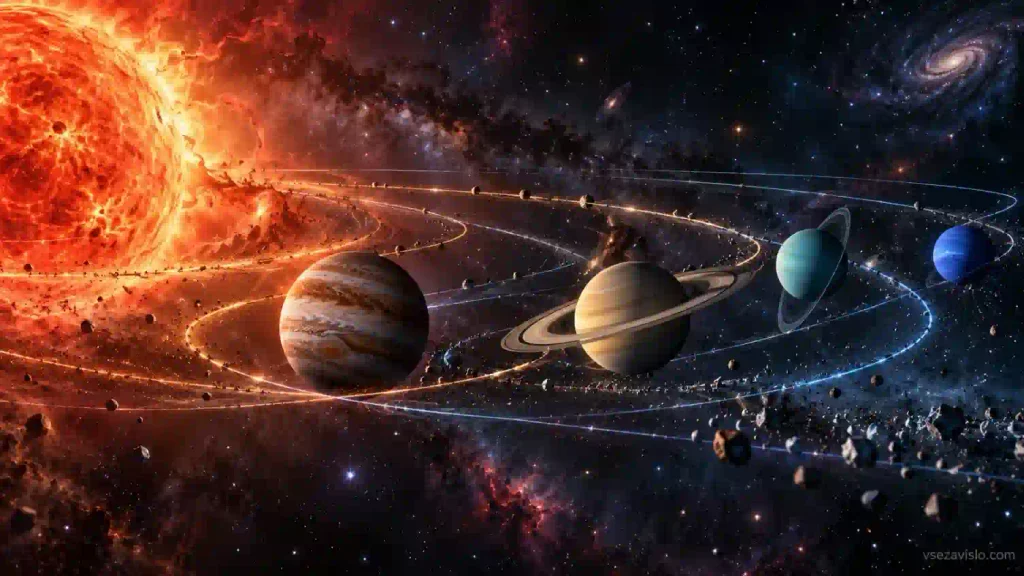
The orbits of the giant planets may lose stability far sooner than earlier models suggested. A new study proposes that after the Sun becomes a white dwarf, the current configuration of the outer Solar System will typically survive for only about 1 billion years, not tens or hundreds of billions.
The work by Konstantin Batygin, Jim Fuller and Fred Adams was published in The Astrophysical Journal Letters. The authors modeled the future of Jupiter, Saturn, Uranus and Neptune, taking into account how the Sun will shed its outer layers at the end of its life.
The outer part of the system was previously considered extremely stable. Without accounting for the Sun’s evolution, its own dynamical lifetime was estimated at roughly 10¹⁸ years, while models that included solar mass loss and flybys of other stars gave about 100 billion years before the current architecture would be seriously disrupted.
Small ‘kicks’ from the dying Sun change everything
The key difference in the new model is that mass loss is not treated as perfectly smooth and symmetric.
The authors draw on observations of white dwarf motion that point to a possible small recoil impulse when material is shed. If the Sun also loses its envelope in separate, uneven ejections, each one would slightly alter the star’s own motion.
A single such kick would change almost nothing. But a sequence of them produces random perturbations that gradually shift the planets’ orbits. At some point the giant planets’ orbits may begin to cross, after which close gravitational encounters and the ejection of individual planets from the system become possible.
With parameters the researchers consider consistent with observations, about 40% of simulations ended with the stable configuration breaking down or the planets scattering strongly even before the white dwarf fully formed. In roughly 90% of cases the system became unstable within the next 3 billion years. The results were also covered by AAS Nova.
This doesn’t mean the Solar System ‘has 6 billion years left’
That framing oversimplifies the study. It does not set a date for the Solar System’s disappearance, nor does it claim that all the planets will be destroyed at once a few billion years from now.
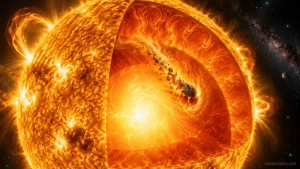
According to NASA, in about 5 billion years the Sun will leave the main sequence and become a red giant. Mercury and Venus will be engulfed, Earth’s fate remains less clear, and then the Sun will shed its outer layers and become a white dwarf.
The new work concerns primarily Jupiter, Saturn, Uranus and Neptune after that stage. If the asymmetric mass-loss scenario proves correct, their familiar configuration may survive for only about a billion years after the Sun’s death.
What’s more, ‘instability’ does not necessarily mean a planet’s physical destruction. The outcome could be a changed orbit, a close approach to another giant, or a complete ejection into interstellar space.