









Supermassive Black Holes Can Grow Without Major Galaxy Mergers – DESI Finds 546 Such Systems
 ·
02.10.2026 22:28
·
4 min read
·
02.10.2026 22:28
·
4 min read
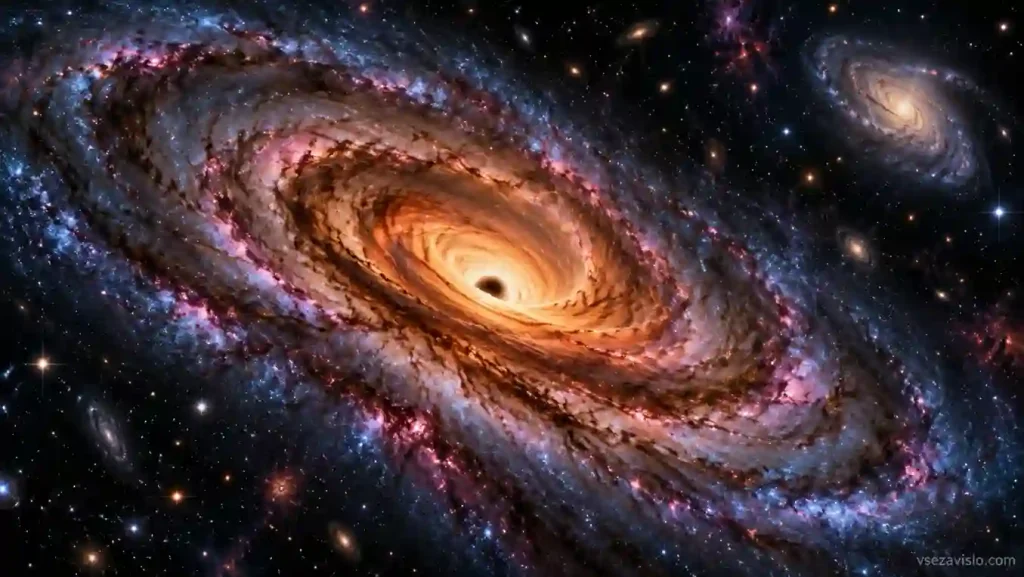
Supermassive black holes probably don’t need major galaxy mergers to gain mass along with their hosts. Astronomers analyzed 2,435 disk galaxies with active nuclei and found 546 systems with virtually no central bulge – a structure often associated with a violent history of galactic collisions.
The work was published in Monthly Notices of the Royal Astronomical Society. The sample was built from DESI spectroscopic data, and the team was led by Sophie Jewell of the University of Oxford.
The researchers looked for disk galaxies with active nuclei – that is, supermassive black holes that are currently consuming matter. They decomposed the images into individual components, separating the disk, bulge, bar and central source.
The result was a collection of 546 nearly bulge-less galaxies with active black holes – more than five times as many as in previous comparable samples.
Black holes grow along with the entire galaxy
The key result emerged from comparing black hole mass with the total stellar mass of the galaxy.
In systems without a noticeable bulge, this relationship turned out to be virtually the same as in the other disk galaxies studied. In other words, the mass of the central black hole continues to scale with the mass of the entire galaxy even where there are no obvious signs of major mergers.
The picture was completely different when the scientists compared black hole mass with bulge mass alone. Between galaxies with a central thickening and those without it, a discrepancy of more than 7σ appeared.
In many bulge-less systems, the black holes turned out to be too massive relative to the small number of stars in the central region.
The authors see this as an argument that the observed link between the growth of galaxies and their black holes may form not only through major collisions.
Calmer processes can feed a black hole
The alternative is so-called secular processes – the gradual evolution of the galaxy itself without a major external disturbance.
Gas can slowly move toward the center along spiral arms and stellar bars, gradually becoming fuel for the supermassive black hole. This mechanism can operate over a very long time without the need to collide two large galaxies.
This is consistent with earlier research as well: active black holes in nearly bulge-less galaxies had been found before, but the new DESI data made it possible for the first time to study such a population on a much larger scale.
The preprint of the study is also available on arXiv.
At the same time, the absence of a pronounced bulge does not prove that a particular galaxy has never collided with anything. In the paper, this morphology is used as a sign of a relatively calm history without major mergers. Minor collisions and other external interactions cannot be ruled out entirely.
Simulations fail to find some of these black holes
The researchers also compared the observations with the Horizon-AGN cosmological simulation and found another problem: the model could not reproduce the large number of low-mass black holes present in the DESI sample.
This may mean that current models of galaxy evolution underestimate the growth of a certain population of supermassive black holes in calm disk systems.
Future observations with the Euclid and Nancy Grace Roman Space Telescope should refine the result. Their more detailed images will make it possible to detect faint central structures and check whether some of the galaxies studied really are almost completely devoid of a bulge.
If the conclusion holds, major galactic mergers will remain one way to quickly supply black holes with gas, but they will no longer look like a prerequisite for their joint evolution with the galaxy.