









First Look at Saturn: How Pioneer 11 Paved the Way for the Voyagers
 ·
01.09.2026 21:49
·
2 min read
·
01.09.2026 21:49
·
2 min read
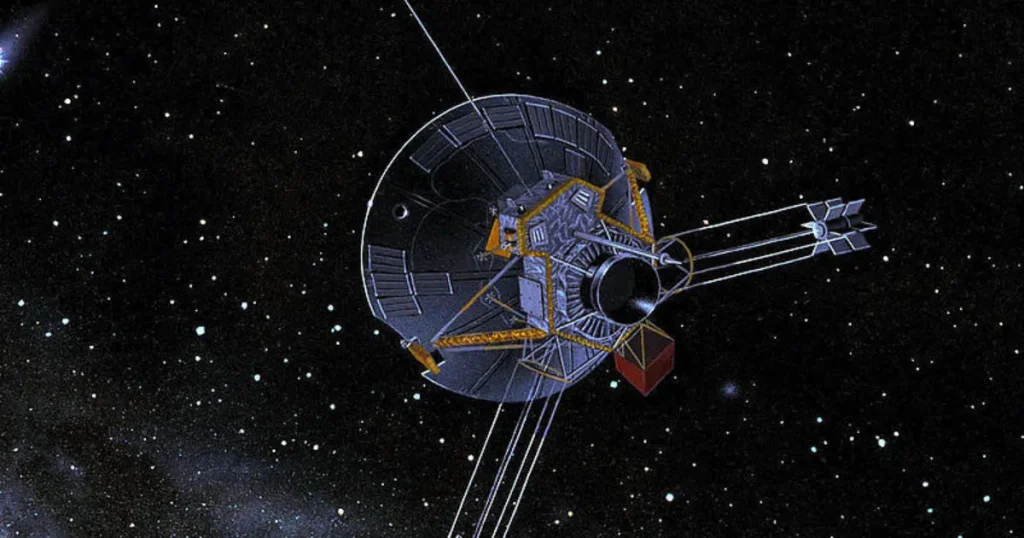
On September 1, 1979, NASA’s Pioneer 11 spacecraft made the first close flyby of Saturn in human history. The probe came within about 21,000 km of the giant planet’s cloud layer, traveling at 114,000 km/h. This maneuver not only opened a new chapter in the exploration of deep space but also saved the future route of another legendary project — Voyager.
The station was launched on April 6, 1973. To reach its second target, Pioneer 11 first crossed the asteroid belt, studied Jupiter, and used its gravity as a slingshot. During the encounter with Saturn, the probe transmitted 440 images of the system, recorded Titan’s temperature at −193 °C, confirmed the planet’s strong magnetic field, and discovered previously unknown moons and a new ring.
Reconnaissance with Risk
The main intrigue of the flyby was testing the safety of the trajectory. Scientists and engineers at NASA deliberately directed Pioneer 11 through the plane of Saturn’s outer rings. It was a calculated risk: if the density of dust and microparticles in that zone had been critical, the probe would have been destroyed.
But this test was exactly what the upcoming Voyager 2 needed. That spacecraft was to repeat the gravity assist at Saturn to follow a rare trajectory onward to Uranus and Neptune. Pioneer 11’s successful breakthrough proved the corridor was clear and confirmed the safety of the complex Grand Tour.
22 Years Instead of Two
Initially, engineers expected the station’s active service life to be only 21 months. In reality, the reliability of the design exceeded expectations by nearly twelve times: the probe operated for more than 22 years. The station transmitted its last engineering signal in November 1995, after which contact was lost forever, and Pioneer 11 continued its journey beyond the Solar System. Decades later, that line of deep-space missions continues through different NASA instruments, including the Nancy Grace Roman telescope and its planned wide infrared map of the universe.