








NASA and SpaceX Launch Nancy Grace Roman Space Telescope: It Will Cover 100 Times More Sky per Shot Than Hubble
 ·
31.08.2026 11:06
·
5 min read
·
31.08.2026 11:06
·
5 min read
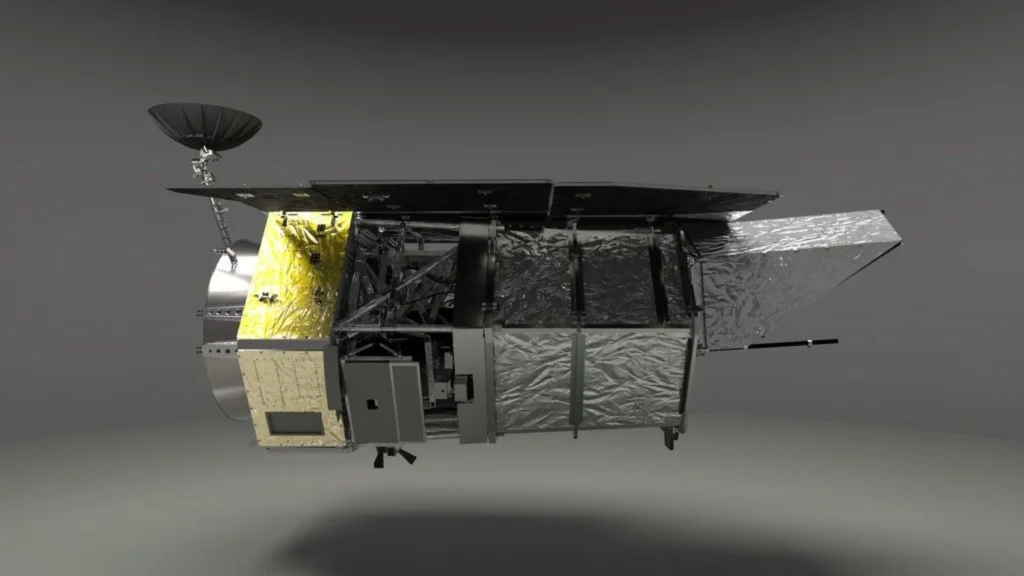
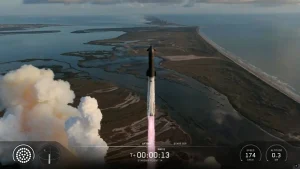
NASA has successfully launched its new flagship astrophysics observatory, the Nancy Grace Roman Space Telescope, which cost about $4 billion. The spacecraft lifted off on a SpaceX Falcon Heavy rocket from pad LC-39A at Kennedy Space Center and is now heading to the second Lagrange point (L2), where it will study the nature of dark energy, search for tens of thousands of exoplanets, and create a massive infrared map of the universe.
A field of view 100 times wider than Hubble’s and a 300-megapixel camera
The Roman telescope’s main advantage is its unique combination of ultra-high resolution and a giant field of view.
The observatory’s primary mirror is 2.4 meters in diameter — exactly the same as the legendary Hubble. However, its main scientific instrument, the Wide Field Instrument (WFI), captures a patch of sky measuring 0.28 square degrees, which is 100 times more than Hubble’s cameras can cover at comparable sharpness.
According to the official NASA press release, a single Roman image replaces about 100 consecutive Hubble frames:
- The camera’s sensor consists of 18 4K detectors with a total resolution of about 300 megapixels;
- Its panoramic sky-scanning speed is a thousand times faster than that of previous-generation spacecraft;
- In its first five years of operation, Roman will photograph 50 times more patches of space than Hubble studied over its 30-year mission;
- Its infrared optics will pierce dense dust veils and capture light from more than a billion distant galaxies.
Falcon Heavy launches @NASA’s Nancy Grace Roman Space Telescope from pad 39A in Florida, beginning its more than three-month journey to its destination where it will generate never-before-seen photos of the universe pic.twitter.com/L3gHrBiQ08
— SpaceX (@SpaceX) August 30, 2026
The mystery of dark energy and a ‘cinematic timelapse’ of the universe
The observatory’s primary cosmological goal is to study the accelerating expansion of the universe. Roman will conduct a global survey called High-Latitude Wide-Area Survey, covering more than 5,000 square degrees — about 12% of the entire celestial sphere — measuring gravitational lensing and the distribution of dark matter.
In parallel, the telescope will run a deep-space survey, re-photographing the same sectors every five days. Over two years, the project will build an unprecedented dynamic video archive, capturing Type Ia supernova explosions, neutron star mergers, and the processes of stars being consumed by supermassive black holes.
Hunting for 100,000 exoplanets and a next-generation coronagraph
According to NASA Science, the telescope will revolutionize exoplanet research:
- Using the transit photometry method, the spacecraft can detect up to 100,000 new worlds around other stars;
- The gravitational microlensing method will reveal more than a thousand distant cold planets and ‘rogue’ planets that drift freely in interstellar space without a parent star.
In addition, the observatory is equipped with an experimental instrument called the Coronagraph Instrument (CGI), which suppresses the blinding light of stars 100–1,000 times more effectively than current analogs. This is a key test step for the future Habitable Worlds Observatory project, which aims to directly search for signs of life on Earth-like exoplanets.
A mirror from intelligence agencies and a perfect tandem with James Webb
The telescope’s optical foundation has an unusual origin: in 2012, the U.S. National Reconnaissance Office (NRO) gave NASA two finished 2.4-meter space-based mirrors. Engineers at Goddard Space Flight Center radically modified the design for scientific purposes. The resulting mirror weighs just 186 kg — four times lighter than Hubble’s mirror.
Roman is heading to a distance of 1.5 million km from Earth, to the L2 Lagrange point, where the James Webb Space Telescope is already operating. The telescopes will work in synergy: the wide-field Roman will act as a global scout, finding rare cosmic phenomena, while James Webb can study the discovered objects in detail with its narrow beam. In that sense, Roman continues a long NASA tradition of scout missions that predates modern observatories: Pioneer 11 first flew by Saturn in 1979 and tested the path later used by the Voyagers.
Thank you! @SpaceX and @NASAAdmin.
— PK Solstice 280 (@KShiverz) August 30, 2026
The Nancy Grace Roman Space Telescope is on its way. The mysteries it will open on dark matter & dark energy should be extraordinary. Its coronagraph will block the glare of nearby stars so we can finally see faint planets & mass🔭💫 pic.twitter.com/lm6dgGSido
1.4 TB per day: first science images in early 2027
The observatory will generate about 1.4 TB of data per day — an absolute record for NASA astrophysics. To process the terabytes of images, the mission will use artificial intelligence and open citizen science platforms.
According to the NASA mission blog, the journey to L2 and instrument calibration will take about three months, with the first high-resolution science images expected in early 2027.