








Hubble Captures a Galaxy Whose Central Stars Spin Almost Perpendicular to Its Main Disk
 ·
20.09.2026 20:33
·
3 min read
·
20.09.2026 20:33
·
3 min read
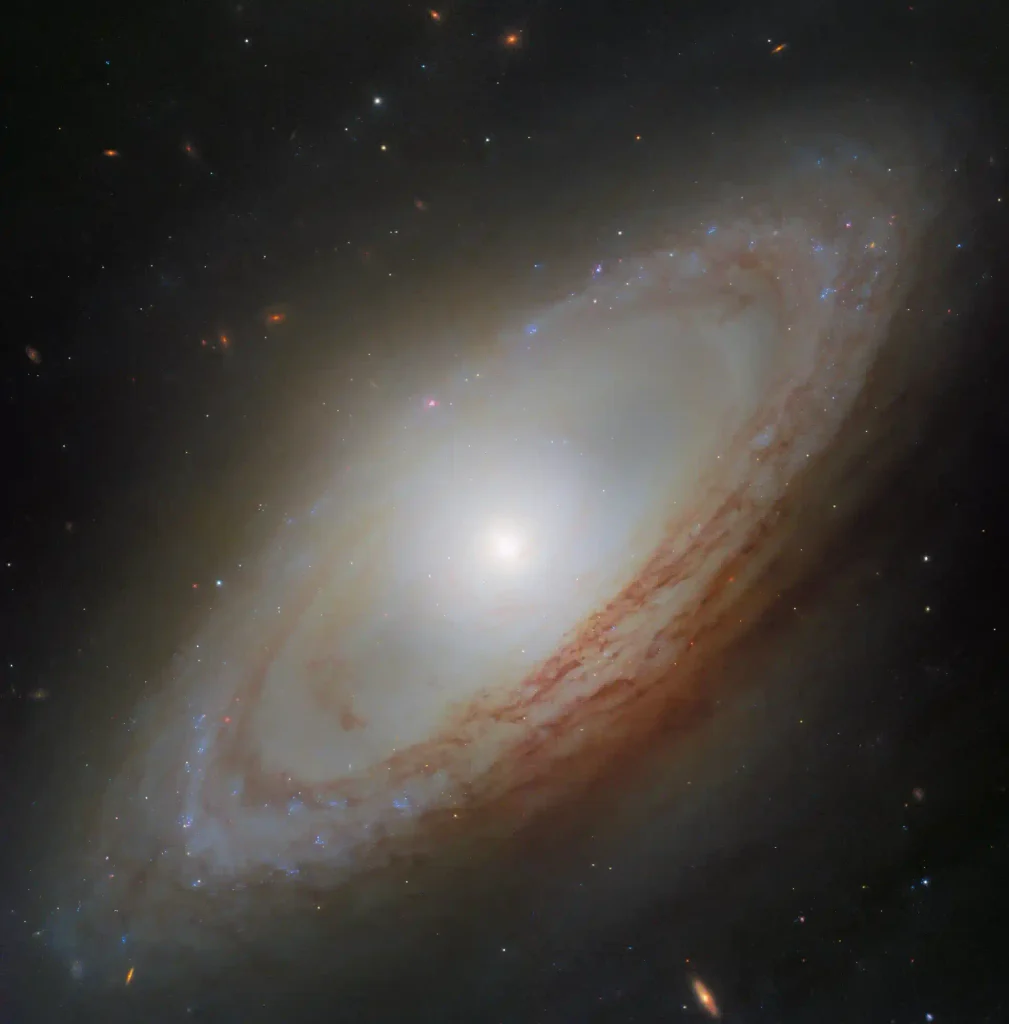
The Hubble Space Telescope has captured a new image of the spiral galaxy NGC 4698, located roughly 55 million light-years from Earth in the constellation Virgo. At first glance it looks fairly ordinary, but the motion of material in its central region is very different from the rest of the galaxy.
NGC 4698 belongs to the Virgo Cluster — the largest cluster of galaxies nearest to the Milky Way, which contains more than a thousand objects. The new image was released by NASA and ESA.
NGC 4698’s defining feature is its elongated central bulge, which sits almost at right angles to the main stellar disk. What’s more, the stars and gas near the center rotate almost perpendicular to the material in the rest of the galaxy.
This is a fairly rare configuration: NGC 4698 is one of only a small number of known spiral galaxies whose central and outer structures are so strongly misaligned.
The spiral arms behave unusually too
In most spiral galaxies, the arms can be traced almost all the way to the central region. In NGC 4698, by contrast, they are most visible in the outer parts of the disk and form a ring-like structure around the nucleus.
The central bulge consists mostly of older, cooler stars, while in the outer disk Hubble resolves bright blue clusters of young stars and long lanes of dust.
At the very center lies a supermassive black hole with the mass of millions of Suns. Astronomers have found signs that it remains active and continues to gain mass by pulling in surrounding gas.
The cause may have been gas captured from outside
The unusual orientation of NGC 4698’s central region has been known to astronomers for a long time. One of the most likely explanations suggests that the galaxy acquired a significant amount of gas from an external source in the past.
The captured material may have had a different angular momentum direction and formed its own system of gas and stars at the center, rotating at a large angle to the original disk.
There are also signs of a possible minor galactic merger. On one side of NGC 4698, a short tail of neutral hydrogen has been found, which may be a trace of a past interaction with another galaxy. NASA and ESA, however, treat this scenario as a likely explanation rather than the object’s definitively established history.
The new image was taken as part of Hubble’s program to observe galaxies in the Virgo Cluster. Researchers are studying individual star clusters and star-forming regions while also trying to understand how life inside a dense galaxy cluster changes the structure and subsequent evolution of galaxies.