





Tint at the Touch of a Button: How Smart Film for Cars Works and Why It’s Not New
 ·
31.08.2026 10:58
·
3 min read
·
31.08.2026 10:58
·
3 min read
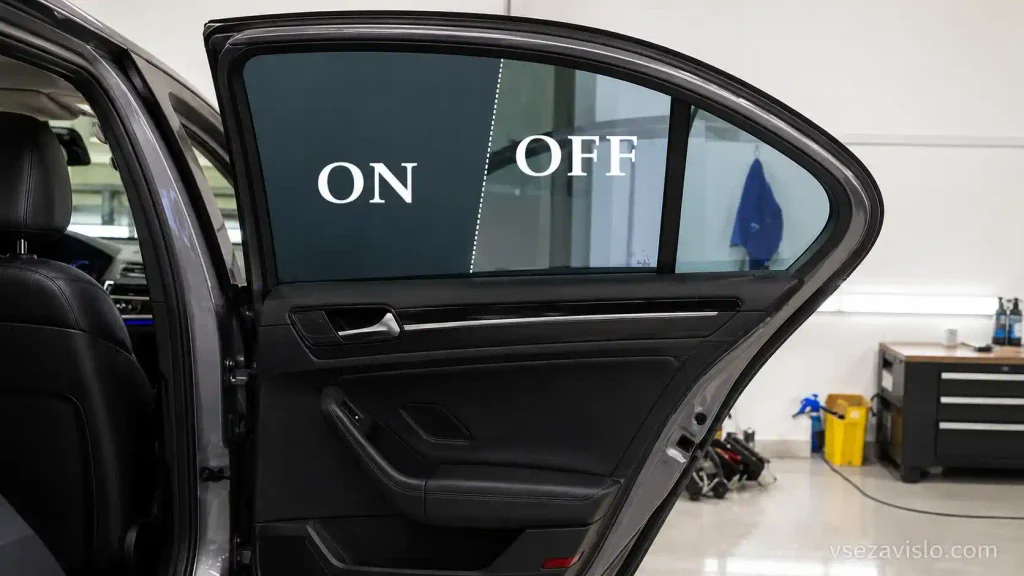
Videos showing off “smart” car tint are racking up millions of views on social media: with the press of a button inside the cabin, side windows instantly switch from completely transparent to deeply darkened. Such kits are indeed widely sold on Asian marketplaces, but the concept of electronic smart glass itself is nothing new — it has been used in the global auto industry for over a decade.
How Smart Tint Works: SPD vs. PDLC vs. Electrochromic
Under the common marketing name Smart Tint lie fundamentally different physical technologies:
- SPD (Suspended Particle Device): Between the film layers are microscopic particles that absorb light. Without current, they are randomly arranged and block the light flow. When 12V is applied, the particles align with the field in 1–3 seconds, letting light through. By adjusting the voltage, you can smoothly set the tint level without losing optical clarity;
- PDLC (polymer-dispersed liquid crystal film): The most common and cheapest Chinese option. When power is off, the liquid crystals scatter light, making the glass not black but frosted white (privacy effect), which suits office partitions better than classic car tinting;
- Electrochromic glass: Changes light transmission through a chemical reaction driven by current (electrochromism). It consumes minimal energy, but switching between modes takes significantly longer.
Mercedes-Benz’s Legacy and Affordable Tuning
Electronic control of transparency appeared long before the social media clips. Back in 2012, Mercedes-Benz introduced the production Magic Sky Control system on the SL roadster, then extended it to the S-Class Coupe and Maybach to control the panoramic roof’s tint. Later, Continental showed a test sedan where all 11 glass body panels changed transparency at the command of the electronics.
The main change today is the democratization of the technology: while smart glass used to be a privilege of rare supercars, it has now become an affordable aftermarket tuning option.
According to listings on Alibaba, basic 12V PDLC film kits for side windows cost $100 to $160, while quality automotive SPD solutions from specialized developers like Gauzy run into the hundreds or thousands of dollars per kit, installed.
Sun Protection and Battery Savings
Beyond privacy, smart films offer direct practical benefits. Research Frontiers notes that quality polymer SPD structures block over 99% of harmful ultraviolet radiation and reflect a significant portion of the thermal spectrum. In hot weather, this reduces cabin heat buildup when parked and lessens the load on the car’s air conditioning, which is especially critical for electric vehicle range.
Legality and Installation Challenges
Viral videos create a false impression that smart tint lets you legally bypass traffic police checks (“press the button in front of the inspector, and the window is clear”).
However, regulations in most countries, including the international UN/ECE Regulation No. 43, require a constant light transmission coefficient of at least 70% for the windshield and front side windows. Road enforcement measuring devices assess the installed equipment and the glass itself, not the momentary state of the regulator.
Moreover, DIY installation of film on moving door windows carries risks:
- the need to route a flexible power cable inside the moving window regulator mechanism;
- the risk of micro-scratches (haze effect) from friction against seals and moisture inside the door panel;
- delamination of cheap Chinese films during sharp winter temperature swings.
The “tint at the touch of a button” technology does work in real life, but it requires choosing quality SPD materials, professional wiring installation, and strict compliance with local road laws.