








Mars’s North Pole Ice Turns Out to Be Nearly Pure as Scientists Recalculate Dust Levels Using Earth-Based Methods
 ·
05.10.2026 21:17
·
3 min read
·
05.10.2026 21:17
·
3 min read
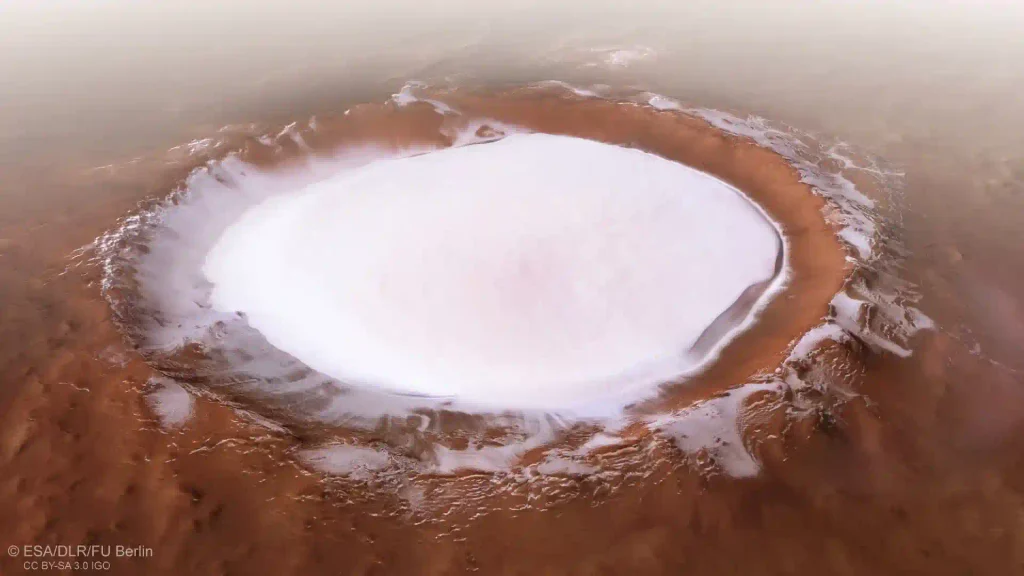
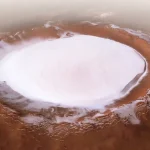
Planetary scientists at the University of Washington have found that the water ice deposits at Mars’s north pole are far cleaner than previously thought. Where older mathematical models allowed for up to 25% mineral dust, fresh calculations show that exposed layers contain no more than 3%, and in some horizons the share drops to tenths of a percent. The discovery forces researchers to rethink the Red Planet’s climate history, since clean ice has a much higher albedo and reflects solar heat differently than previously assumed.
The reason for the earlier inflated estimates lay in the methodology. For a long time, the optical properties of the Martian surface were calculated using algorithms originally developed for dry lunar dust. But when tested against Earth’s glaciers, the formulas produced enormous errors. According to the University of Washington news office, researchers Pari Mohan and Aditya Khuller recalculated spectral data from NASA’s Phoenix lander and orbiting probes using a radiation transfer model calibrated on Earth’s snowpacks.
The lunar calibration error and a layered “sandwich”
The new calculations were published in the journal npj Space Exploration. It turned out that the structure of the 1.5-kilometer-thick polar deposits is built like a layer cake.
At the surface, exposed layers contain less than 3% dust, and the cleanest lenses hold just 0.05% to 0.5% impurities. Between them lie contrasting dirty layers where particle concentrations reach 25–75%.
The authors also managed to explain the cyclical brightness shifts in the polar region: during Martian winter, a thin layer of fine dusty frost settles on top, creating the illusion of heavy contamination, and by summer it sublimates, exposing the ancient clean monolith.
What this means for the climate and the search for life
The degree of ice contamination directly affects the planet’s thermodynamics. Dark impurities absorb sunlight, speeding up the heating and evaporation of glaciers into the thin atmosphere. A bright deposit, by contrast, effectively shields against radiation, making the polar caps more resistant to seasonal swings and to climate cycles driven by shifts in Mars’s axial tilt.
At the same time, scientists flatly reject speculation about signs of life, Space.com explains. In earlier work, researchers suggested that at mid-latitudes dark grains inside the ice could warm up and create microdroplets of liquid water theoretically suitable for microbial photosynthesis. At the north pole, however, temperatures are too harsh for such a process. The main value of the work is purely fundamental: astrophysicists now have a reliable scale for reading Mars’s ancient climate layers without corrections for lunar errors.