









Three Water Eras on Ancient Mars: Perseverance Rover Reveals Jezero Crater’s Turbulent Hydrological Past
 ·
22.09.2026 22:08
·
3 min read
·
22.09.2026 22:08
·
3 min read
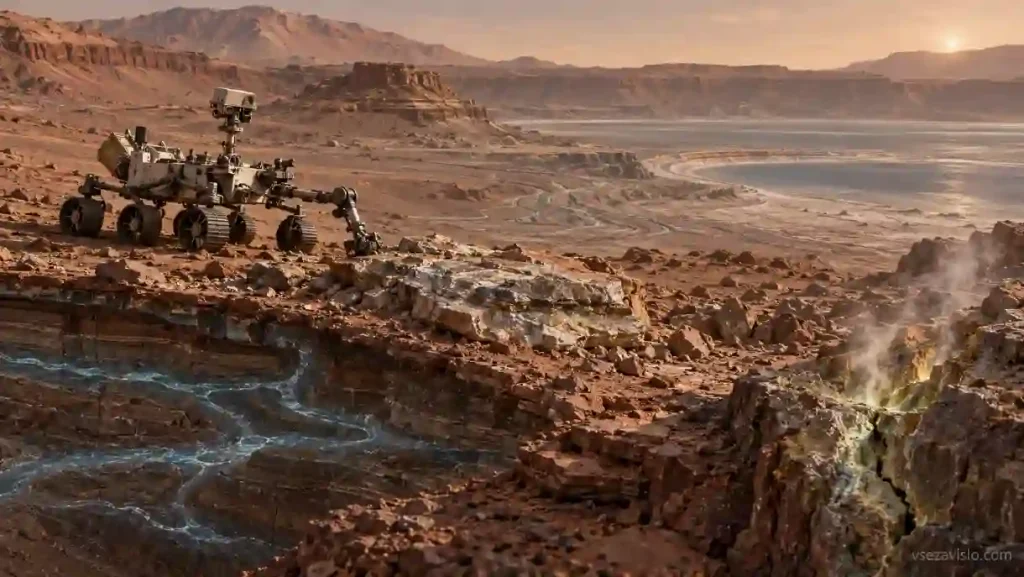
On September 21, 2026, the journal Communications Earth & Environment published a study by an international team of scientists based on data from NASA’s Perseverance rover. An analysis of the mineral composition of the so-called Margin Unit showed that the bedrock of Jezero Crater was exposed to liquid water at least three times under completely different geological conditions. For planetary scientists, this is an important discovery: it turns out that the hydrological history of early Mars was far more complex and varied than orbital images had suggested, and that a liquid environment existed here over vast stretches of time.
The researchers processed spectral measurements from the SuperCam spectrometer at more than 185 bedrock sites. Orbital probes had indicated that the carbonate-rich layer was an ordinary shoreline of an ancient lake, but the rover’s ground data revealed a multilayered chain of geological processes.
From Magmatic Depths to Hot Underground Geysers
On the elevated terrain, the rover found coarse-grained rocks rich in olivine. Their crystal structure confirms that they initially cooled deep in the Martian interior from a magmatic melt with virtually no contact with liquid, until subsequent erosion brought them to the surface.
The rocks’ subsequent history split into three independent stages of interaction with water, as described in NASA’s official release and in materials from the Jet Propulsion Laboratory (JPL):
- Groundwater: in the first stage, cold underground water saturated with carbon dioxide seeped through cracks in the strata and reacted chemically with olivine, producing carbonates.
- Lacustrine environment: later, the underlying rocks were reworked and enriched with silica — a process linked either to the direct influence of the waters of Jezero or to a separate phase of groundwater circulation.
- Hydrothermal activity: the final event was the appearance of mineral veins about 25 centimeters thick. In them, scientists identified calcium sulfate and fluorite — a mineral that forms exclusively when high-temperature hydrothermal fluids circulate through volcanic rocks.
Significance for Astrobiology and Data Limitations
On Earth, chemical reactions between water and iron-rich olivine rocks release free hydrogen, a key energy source for chemotrophic microorganisms. In addition, carbonate and silica deposits are considered an ideal natural “trap” for preserving microfossils and chemical traces of biological activity, making this area a priority target for sample collection.
At the same time, the authors of the work in the study published in Communications Earth & Environment emphasize that the discovery itself is not direct evidence of life. The rover’s results only confirm that on ancient Mars, fundamentally different ecological niches succeeded one another for a long time, from cold underground aquifers to boiling mineral springs that had all the basic conditions for microbiological structures to emerge. The exact time intervals between these three eras can be established only after the collected cores are delivered to Earth.