









Meta Unveils VR Glasses, a 100-Gram Alternative to Vision Pro Priced at $1,299
 ·
24.09.2026 19:29
·
4 min read
·
24.09.2026 19:29
·
4 min read
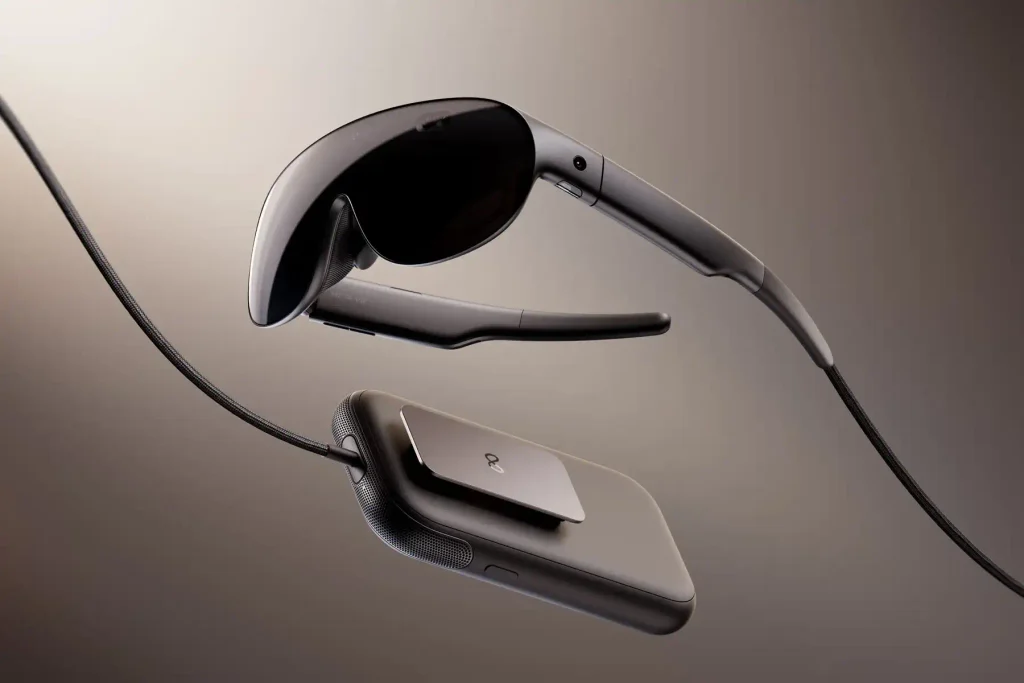
Meta has unveiled Meta VR Glasses, a new VR device that stands out sharply from the familiar Quest headsets. The glasses themselves weigh about 100 grams: they skip the bulky head strap and rest on the nose and ears much like ordinary glasses.
That weight was made possible by a two-part design. The glasses house the displays, optics and necessary sensors, while the processor, battery and storage sit in an external computing module connected to them by an optical cable.
That puck can be carried in a pocket or bag, or clipped to clothing. According to UploadVR, it weighs roughly 300 grams, so the advertised 100 g applies specifically to the part of the device the user wears on their face.
5K micro-OLED and eye and hand controls
Meta uses a 5K Infinite Display based on micro-OLED along with custom compact pancake lenses. The company claims an image density of 37 pixels per degree, plus support for Dolby Vision and Dolby Atmos spatial audio.
The system can be controlled with your gaze, hand gestures and voice via Meta AI. Most interface tasks don’t require separate controllers.
That said, the traditional Touch Plus controllers can be connected separately — primarily for VR games that need physical buttons and more precise controller tracking.
Processing is handled by the new Qualcomm Snapdragon Reality Elite. Claimed battery life reaches about three hours when playing high-resolution content, and 45W charging is supported.
Meta VR Glasses
— Meta VR (@MetaVR_Official) September 23, 2026
Coming Spring 2027. pic.twitter.com/fq7zL3TEzc
Virtual monitors, a movie theater and games
Meta positions VR Glasses as both an entertainment device and a personal workspace.
Users can place virtual monitors around themselves and turn a flat surface into a virtual keyboard and trackpad. Color passthrough lets them keep seeing their physical surroundings at the same time.
At launch, the company promises more than 75 games fully controlled by hand, plus access to hundreds of titles through Xbox Cloud Gaming.
Meta also calls VR Glasses the first VR device with IMAX Enhanced certification. 3D movies and content from Disney, Prime Video, YouTube, HBO Max, Paramount+, Crunchyroll and other services are being prepared for it.
Sports broadcasts are a separate focus. The company promises more than 100 immersive streams a year with a 180-degree view and streaming video at up to 8K. ESPN, MLB, NBC Sports, TNT Sports and UFC are among the announced partners.
Hologram Calling creates a digital copy of the user
Another unusual feature is Hologram Calling. The system creates a photorealistic digital representation of the user and transmits their facial expressions and movements in real time.
If both people on a call are using VR Glasses, the digital counterpart can appear directly in the space in front of the user. When connecting from a regular computer or smartphone, the person sees the digital avatar as standard video.
Meta says the technology is compatible with WhatsApp and Zoom, among others.
Nearly three times cheaper than Vision Pro, but the weight comparison isn’t entirely direct
Meta VR Glasses will go on sale in spring 2027 at $1,299.99.
For comparison, the current Apple Vision Pro with the M5 chip starts at $3,499. That makes Meta’s device roughly 2.7 times cheaper.
The weight difference is even more striking, but comparing it directly takes some care. Apple Vision Pro weighs about 750–800 g on your head and uses a separate battery weighing around 350 g. With Meta, only about 100 g stays on your face, though the roughly 300-gram computing unit still has to be carried separately.
So the key feature of VR Glasses isn’t so much the record-low total weight of the system as the fact that most of the weight has been moved off the user’s head, which could make long VR sessions considerably more comfortable.