









Starship Reaches Orbit for the First Time and Deploys Starlink V3 Satellites, but SpaceX Cuts the Flight Short
 ·
28.09.2026 18:39
·
3 min read
·
28.09.2026 18:39
·
3 min read
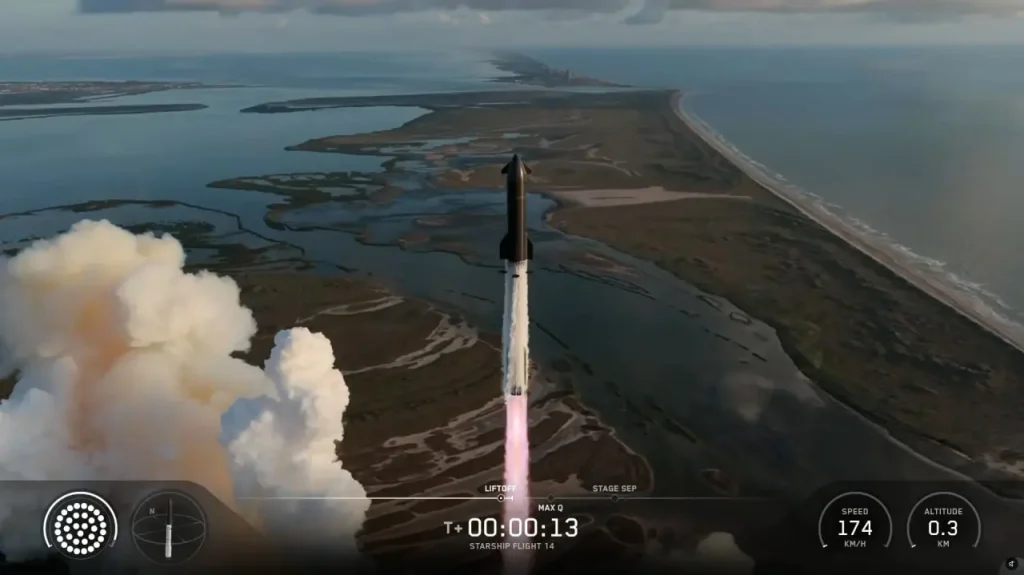
On September 28, 2026, SpaceX took one of the most important steps in the development of its super-heavy space program. During the 14th test flight, the Starship vehicle successfully reached a stable low-Earth orbit for the first time in its history, climbing to an altitude of 275 kilometers. For the aerospace industry, this effectively marks the system’s transition from suborbital prototypes to a full-fledged launch vehicle ready to carry payloads.
Immediately after settling into orbit, the vehicle carried out its first real commercial task — deploying a group of 26 Starlink V3 satellites. On all previous flights, SpaceX used only mass simulators. According to Spaceflight Now, the third-generation internet satellites offer ten times the throughput of the current V2 Mini.
Notably, three of the 26 deployed satellites are equipped with special external cameras. They are pointed at Starship itself and will help engineers visually assess the condition of the vehicle’s heat-shield tiles in open space. In the future, SpaceX plans to launch up to 60 of these large satellites on a single flight.
🚨 SpaceX just launched STARSHIP into ORBIT.
— Mr Producer (@RichSementa) September 28, 2026
Flight 14. 33 Raptors. 26 Starlink V3 satellites. First time this machine is going for six laps around Earth.
America just lit the biggest rocket ever built and pointed it at the future. Thanks @elonmusk pic.twitter.com/uO9GpSEs3G
Engine Failure and an Emergency Mission Cut
Despite the eventual success of the satellite deployment, the flight was not without technical problems. During the climb, one of the Raptor 3 engines on the upper stage shut down early. On the live broadcast on SpaceX’s website, flight controllers even considered canceling the orbital insertion entirely, but after a quick telemetry review, mission control cleared the flight to continue. An additional burn of a working engine allowed Ship 41 to reach the intended trajectory.
Flight 14 was originally planned as a long stay in space: the vehicle was to spend nearly 10 hours in orbit, make about six laps around Earth, and only then perform a controlled splashdown west of the coast of Chile. But the plan was drastically changed mid-flight.
As Reuters reports, right after the first orbital phase, SpaceX decided to bring the vehicle back to Earth much earlier. At around 15:00 UTC, the craft performed a braking burn and headed for a backup landing zone in the northern Pacific Ocean.
The company has not yet disclosed the exact reason for such a sharp change of plans. At this point, it is too early to say whether the emergency deorbit was caused by the early Raptor 3 engine failure or by some other anomalies in the vehicle’s life-support systems. Still, the main goal of the 14th flight was achieved: the largest rocket system in the world has confirmed its ability to deliver cargo to orbit, opening the way to regular commercial missions.