








Scientists 3D-Print a Filter That Cleans Microplastics Out of Water Without Electricity
 ·
30.09.2026 17:45
·
2 min read
·
30.09.2026 17:45
·
2 min read
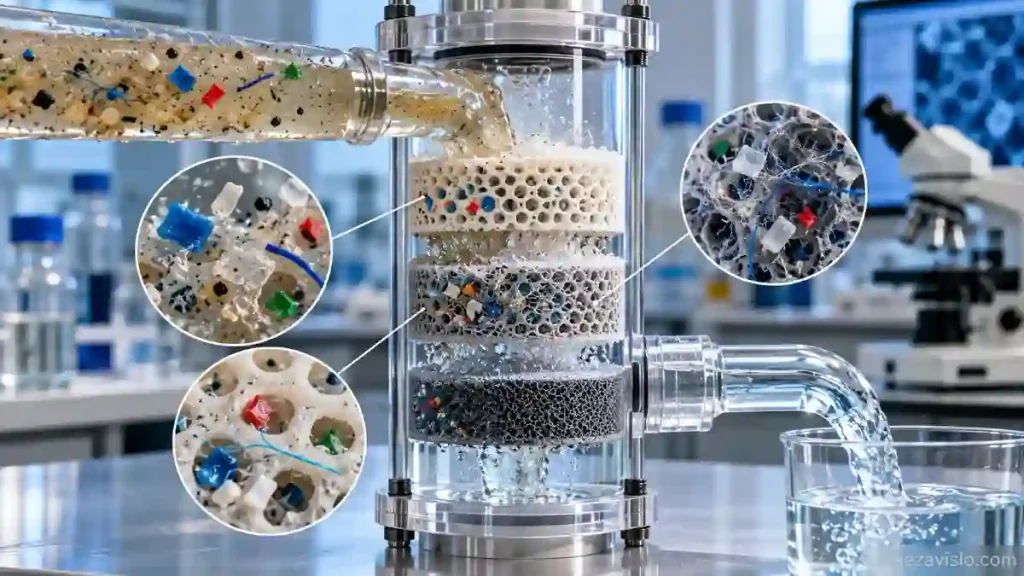
Engineers at the University of Waterloo have built a prototype of an inexpensive gravity-powered filter that can capture up to 90% of the microplastics in tap water and wastewater. The device needs no pumps or external power sources: the liquid moves through the system on its own. Eventually, that could allow the technology to be used both in home water treatment systems and at treatment plants in remote areas.
The filter is built around porous disks made of biodegradable polylactide (PLA). To get the right texture, the team added a water-soluble polymer to the material during 3D printing. After the part was rinsed in hot water, the additive washed out, leaving a network of microscopic pores on its surface. To make the plastic grip better, the researchers coated it with a special adhesive — a chemical layer that attracts contaminant particles and keeps them from being washed away by the clean flow. As reported in a University of Waterloo press release, a column assembled from 20 such filter layers delivered the highest efficiency.
Prototype limitations and washing machine tests
Despite the impressive numbers, the development is still at the concept stage. The authors of the study, published in the journal Separation and Purification Technology, are upfront about the weak points of the current architecture. First, the tests were run under controlled laboratory conditions with an artificial solution rather than real dirty water. Second, the filter struggles with the smallest fractions: about 80% of the microplastics that did manage to seep through the 20 layers consisted of particles smaller than 10 micrometers.
Commercial scaling also remains an open question. The creators call the production cheap because it relies on standard FDM printing, but neither the approximate cost of a household cartridge nor its service life has been disclosed yet.
Next, the engineers plan to test the system under real-world conditions. The main target will be wastewater from washing machines — one of the largest sources of synthetic microfibers released into city sewers and the world’s oceans. The team still has to find out how quickly the porous disks will clog with organic matter and soap foam, and whether they can be washed effectively for reuse.