









Scientists Create Tattoos You Can Turn On and Off with Light
 ·
09.10.2026 22:03
·
3 min read
·
09.10.2026 22:03
·
3 min read
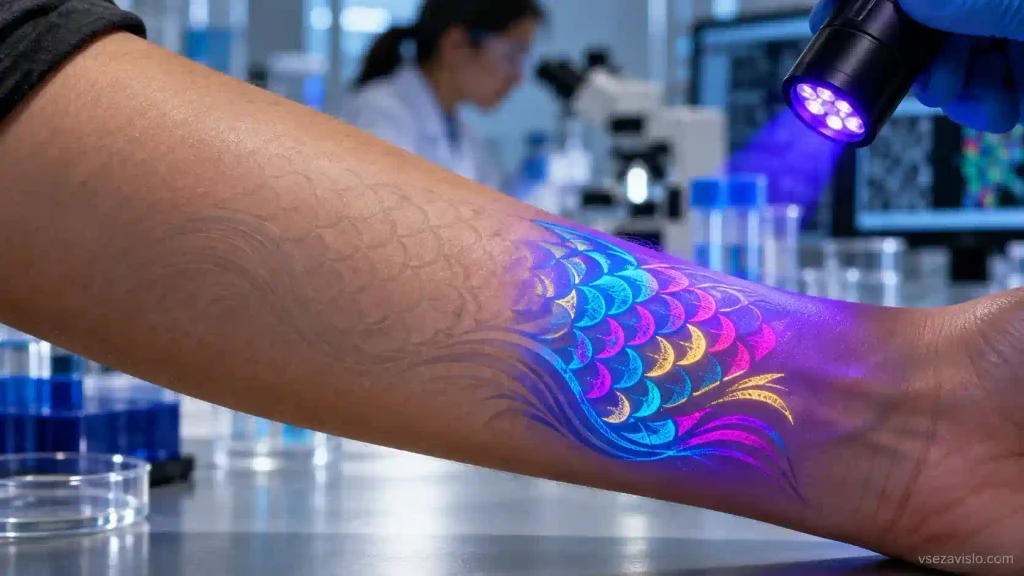
Engineers at the University of Colorado Boulder have developed PhotoTat, a multicolor tattoo ink that appears under light and then fades almost completely. The pigment stays beneath the skin—only its color changes. The study was published October 9 in the journal Matter & Light.
PhotoTat relies on photochromic dyes enclosed in microscopic particles of polymethyl methacrylate (PMMA), a clear acrylic polymer already used in certain medical devices. A team led by Carson Bruns created three base pigments: blue, magenta, and yellow.
Tattoos Appear in Seconds
Photochromic molecules alter their structure depending on the light they are exposed to. An ultraviolet LED with a 365 nm wavelength can reveal a design in about 2–3 seconds. Under standard indoor lighting, the color then lasts anywhere from several hours to several days.
Bright visible light triggers the reverse reaction. For example, a white LED flashlight makes the design virtually invisible again, while direct sunlight can fade it in seconds.
The researchers also figured out how to independently control different pigments using specific wavelengths of light. By mixing the three base colors, they produced 16 color variations, allowing a single tattoo to be partially recolored after application.
Bruns tested PhotoTat on himself, filling in the scales of an existing leg tattoo with the new pigments. According to the team, all three color channels retained their ability to switch inside the skin for roughly 1.4 to 2.2 years. However, this remains a single-researcher experiment rather than a full clinical safety trial on humans.
The Main Question for Now Is Safety, Not Design
The technology also has a less obvious use case. In radiation therapy, small permanent tattoos are sometimes used as reference marks for accurate patient positioning. PhotoTat could theoretically make these markings visible only when a doctor needs them, keeping them hidden the rest of the time.
However, Nature notes that the new multicolor inks will need further testing before widespread adoption. Researchers have yet to prove their long-term safety in humans.
It is important not to confuse PhotoTat with the team’s earlier development, the single-color Magic Ink. In a clinical study published in July 2026, that ink was compared to standard tattoo pigment across 11 volunteers. Over the observation period, researchers reported no adverse events, and the photochromic effect lasted at least a year. Still, those findings cannot be applied automatically to the new multicolor PhotoTat formulation.
The developers have not yet shared a release window for PhotoTat. The single-color Magic Ink is already on sale for $100 per 2 ml vial, but the multicolor technology remains experimental.