









100,000 km Space Elevator: Scientists Find Promising Tether Material, but Construction Is Still a Ways Off
 ·
03.09.2026 22:01
·
2 min read
·
03.09.2026 22:01
·
2 min read
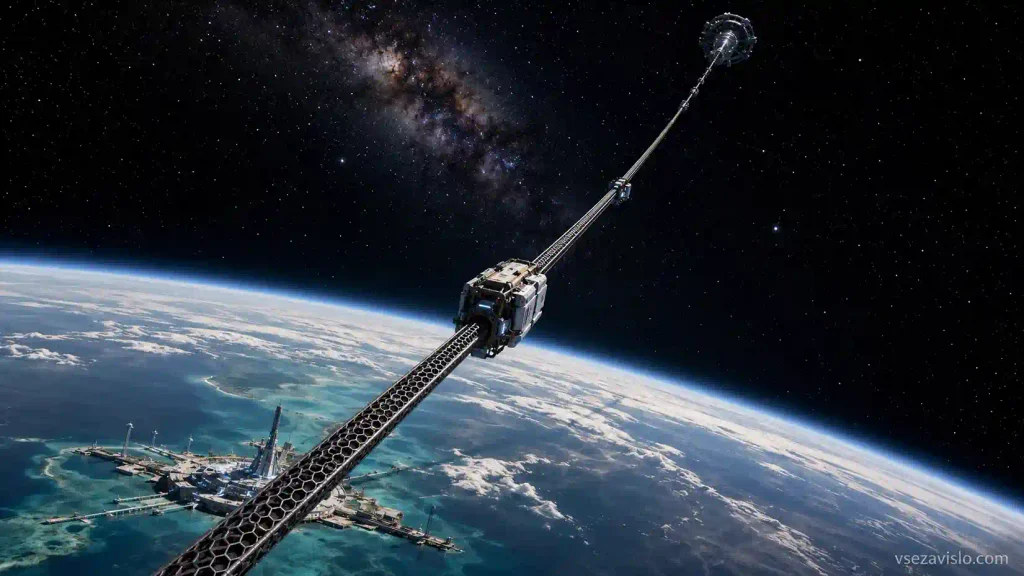
The International Space Elevator Consortium (ISEC) has identified polycrystalline graphene as the most realistic candidate for creating an ultra-strong 100,000-kilometer tether.
The space elevator concept involves delivering payload into orbit using electric climbers without traditional launch vehicles.
Under the proposal, the lower end of the structure is anchored at Earth’s equator, while the upper end is held by a massive counterweight (Apex Anchor) far beyond geostationary orbit. Centrifugal force from the planet’s rotation keeps the tether permanently under tension.
The Main Challenge: Tensile Strength
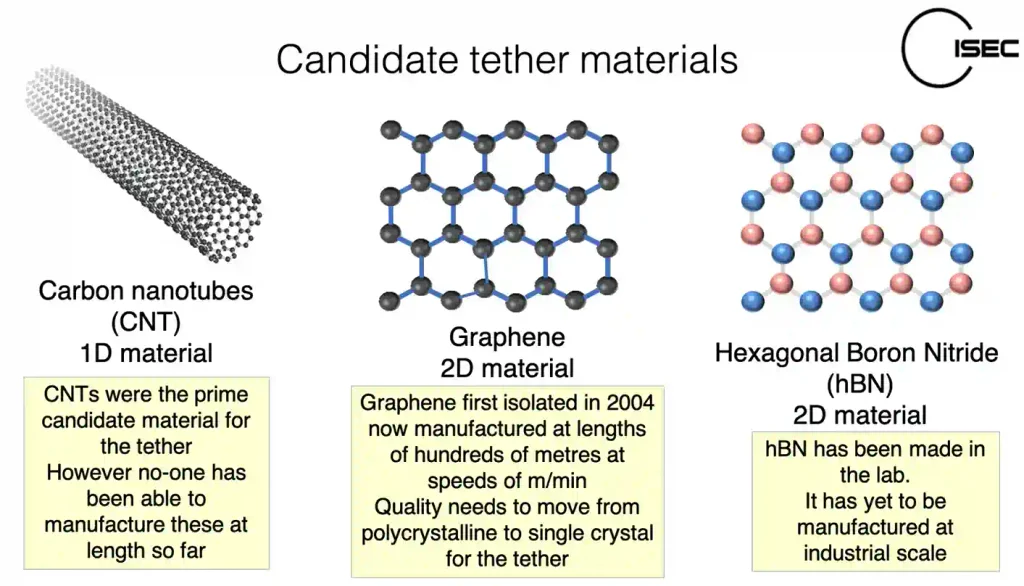
Conventional structural materials are unsuitable for such a project: steel, titanium, or carbon fiber would snap under their own weight. A multilayer graphene laminate could be the solution. Reports from ISEC on tether materials note that industry can already synthesize continuous sheets of polycrystalline graphene up to one kilometer long.
However, before building a finished tether, researchers must solve the issue of interlayer bonding. Currently, the bonding strength between graphene layers is roughly 35 times below the calculated threshold required to support a 20-ton climber. To prevent delamination under the cabin’s wheels, scientists are experimenting with creating additional interatomic sp³ bonds.
A Two-Week Journey at 300 km/h
ISEC engineers estimate that the climber’s average speed along the tether will be about 298 km/h. At that pace, the ascent to the top will take roughly two weeks.
Propulsion options under consideration include mechanical wheel drives and linear electromagnetic motors, with power delivered to the cabin via laser beams, microwave radiation, or onboard solar panels.
According to calculations by Universe Today, a full-scale system could launch up to 30,000 tons of payload into space per year. At the top of the elevator, spacecraft would gain enough kinetic energy from Earth’s rotation to head toward the Moon or Mars without rocket boosters. Paired with lunar infrastructure, it looks like the next layer of space logistics: NASA is already working on traffic rules around Gateway.
Despite progress in graphene synthesis, the project remains in the theoretical and laboratory research phase: scaling the technology from meter-long lab samples to a 100,000-kilometer load-bearing thread continues to face technical limitations.