









Compost incubators: How giant titanosaurs raised offspring in cold Patagonia
 ·
16.09.2026 16:00
·
2 min read
·
16.09.2026 16:00
·
2 min read
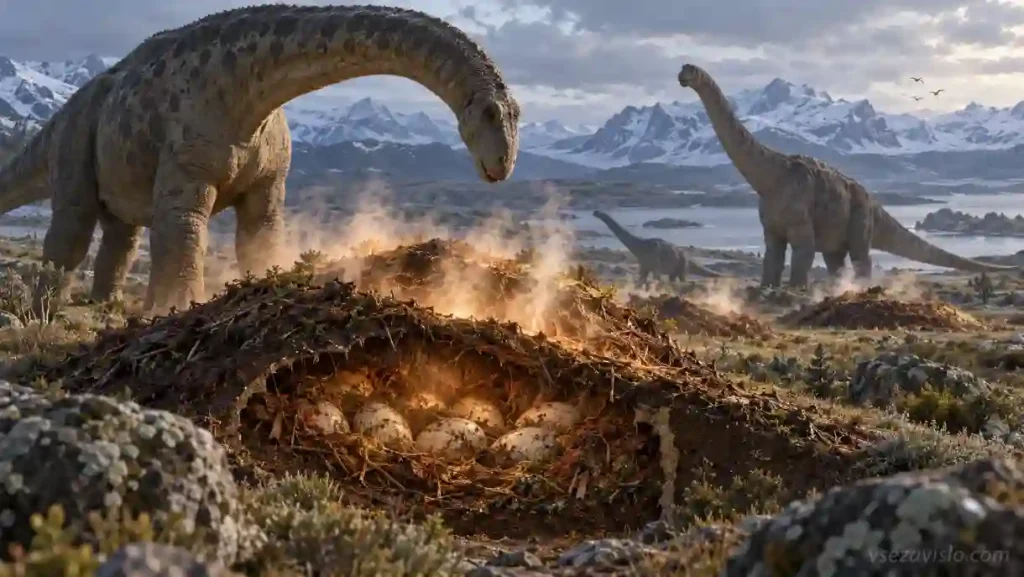
For a long time, giant herbivorous dinosaurs were believed to breed exclusively in warm tropical latitudes where the sun warmed the soil. However, an international team of paleontologists has proved that even in the harsh subpolar climate of the Late Cretaceous, dinosaurs found ways to warm their clutches. In a study published in Royal Society Open Science, researchers described 255 fossilized eggshell fragments from southern Argentina: the structure of the eggs indicates that titanosaurs buried them in mounds of decaying vegetation that acted as natural incubators.
Eggshell pores and heat from rotting plants
The fossils were collected in the Chorrillo Formation in southern Patagonia during 2020 and 2024 expeditions. At the end of the Cretaceous period, roughly 66–69 million years ago, this region was located at 55–60 degrees south latitude. Today, this is the southernmost point in the Southern Hemisphere where sauropod nesting sites have been confirmed.
According to the University of Tsukuba, the shell’s microstructure made it possible to attribute the eggs to the oogenus Fusioolithus, which is associated with titanosaurs. Determining the exact biological species is impossible due to the lack of embryos or skeletons near the clutch, but the physiology of the eggs revealed how they cared for offspring.
Micro-CT scans of the eggshells showed an extremely high pore density. In an open nest, an egg with such a shell would quickly die from dehydration. Consequently, the clutch was buried under a thick layer of moist soil and decaying plants.
Decomposing organic matter released steady biochemical heat generated by bacteria—a method used today by Australian megapodes (mound-builders) and crocodiles. In a cool climate where solar radiation was insufficient to heat the ground, bacterial fermentation was the only way to warm the embryos.
Limits of the discovery and the survival of giants
According to Phys.org, paleontologists were unable to find intact nests or fossilized mounds; the sedimentary rocks preserved only scattered fragments. Thus, the “compost incubator” remains the most well-supported scientific reconstruction, based on egg gas-exchange physics and regional climate models.
The discovery fundamentally alters our understanding of the ecology of Late Cretaceous giants. Titanosaurs were not merely seasonal migrants wandering south in search of food, but had fully adapted to cool regions, modifying their nesting behavior to reproduce successfully far from the equator.