









Scientists Linked the MIND Diet to Slowing Brain Aging by 2.5 Years. What’s Wrong With That Headline
 ·
01.10.2026 17:42
·
3 min read
·
01.10.2026 17:42
·
3 min read
In early October, science news outlets picked up a story that a special diet can “rejuvenate” the brain by two and a half years. The trigger was a post on ScienceDaily that summarized the results of a large American study. Observations of older adults did show a link between diet and the physical preservation of gray matter, but it’s still too early to treat the reported numbers as a direct call to action.
The work, published in the Journal of Neurology, Neurosurgery & Psychiatry, draws on years of data from the Framingham Heart Study Offspring project. Researchers tracked the eating habits of 1,647 participants (average age at the start was about 60) for more than a decade and regularly scanned their brains with MRI.
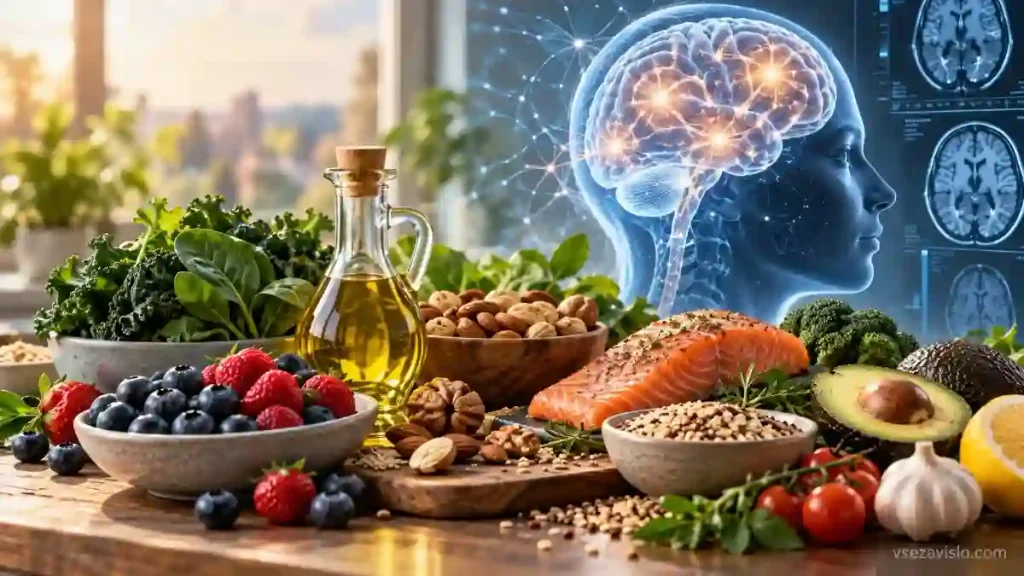
The researchers examined how closely following the MIND diet — a combination of the Mediterranean diet and the DASH diet — affects tissue structure. This eating plan emphasizes green leafy vegetables, berries, nuts, legumes, fish and olive oil while limiting fast food, red meat, butter and sweets.
12 Years Under the Scanner and the Rescue of Gray Matter
It turned out that people who followed this diet strictly saw their tissue thin more slowly. Every additional three points on the questionnaire corresponded to preserving about 0.279 cubic centimeters of gray matter per year. The authors calculated that this reduces the age-related rate of structural brain aging by roughly 20%, which over the long term is statistically equivalent to 2.5 years. A similar pattern showed up for the brain’s ventricles — their age-related enlargement slowed by 8%.
However, the study has serious methodological limitations that make the sensational headlines about “rejuvenation” incorrect.
First, the work is purely observational. The researchers cannot prove that the diet itself saved the brain from shrinking. People who preferred healthy food smoked less, were almost never obese and had fewer cardiovascular problems. In calculations like these, it’s impossible to separate the effect of broccoli from the effect of an overall healthy lifestyle.
The Cheese Anomaly and the Questionnaire Problem
Second, the statistics turned up several strange correlations. In this particular sample, frequent consumption of whole grains was somehow associated with worse results, while a love of cheese, on the contrary, was statistically linked to preserving tissue. The authors themselves on PubMed acknowledge that this is no reason to cut out porridge and switch to cheese — such skews only prove the shortcomings of assessing diet through subjective questionnaires.
What’s more, the scientific paper itself is far from new: it was published online back in March 2026 and appeared in the journal’s print issue in May. The fall spike in interest was driven entirely by a fresh press release that conveniently highlighted the right numbers. The study confirms that a balanced diet benefits the central nervous system, but the claimed “2.5 years” remains only a mathematical model of tissue volume on an MRI scan, not a proven reversal of cognitive aging.