










Congressional Staffers Use ChatGPT to Draft Bills, Forcing Lawyers to Spend More Time Fixing Errors Than Writing From Scratch
 ·
19.08.2026 18:37
·
2 min read
·
19.08.2026 18:37
·
2 min read
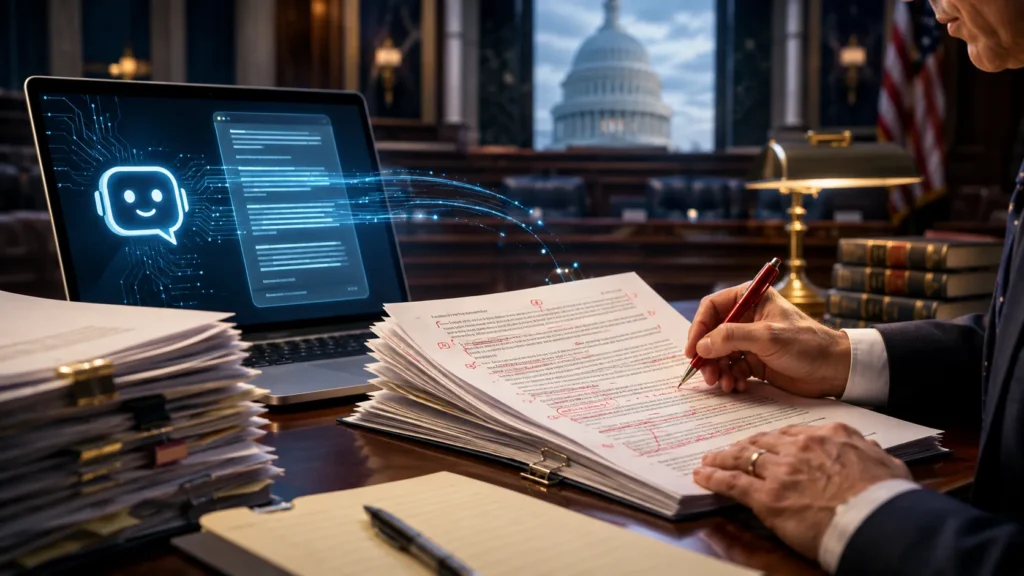
US Congress staffers are increasingly using ChatGPT, Claude, and other generative AI models to draft legislative proposals. According to an investigation by Politico, House of Representatives staff attorneys are facing the unintended consequences of automation: fixing hidden AI errors takes more time than drafting bills from scratch.
Instead of speeding up the legislative process, the widespread use of chatbots has created a bottleneck during the official legal review stage.
Drafting Errors and Legal “Bugs”
The main challenge lies in the AI’s fundamental lack of understanding of legal nuances: language models regularly confuse tax credits, deductions, exemptions, and direct government subsidies.
When defining the term “state,” the algorithms often limit the scope to just the 50 states, unintentionally cutting off funding for the District of Columbia, US territories, and Native American tribes. Experts also note that AI distorts cross-references to existing sections of the US Code, creating systemic contradictions in the legislative framework.
Overwhelming House Attorneys
The brunt of the burden has fallen on the nonpartisan House Office of Legislative Counsel (HOLC), which is responsible for turning lawmakers’ policy ideas into legally sound bills. A staff of 78 attorneys must now manually proofread thousands of AI-generated pages.
As reported by Engadget, during the first 13 months of the 119th Congress, the office received 23,239 drafting requests (a 5.7% increase).
In official testimony to a House committee, HOLC Director Warren Burke warned that using third-party AI increases rather than decreases the workload for staff. Attorneys also report a decline in comprehension among congressional aides: by outsourcing drafts to AI, staffers have a weaker grasp of the specific details of the legislation they propose.
Controlled Rollout: Copilot and the Comparative Print Suite
Congress itself is taking a highly controlled approach to adopting algorithmic tools. In 2026, the legal office began internal testing of Microsoft Copilot within a secure environment for basic statutory research.
According to The Next Web, the primary verification tool remains the government’s Comparative Print Suite, which launched back in 2022. Unlike generative AI, this algorithmic system mathematically compares the text of a bill against the current US Code and flags any discrepancies, eliminating the risk of hallucinations.
Journalists emphasize that no law passed by Congress has been written entirely by AI: the technology is only used for unofficial drafts, which are then completely rewritten by legal experts.