








Moon to Get Its Own Space Airport as NASA Engineers Draft Traffic Rules
 ·
25.08.2026 19:30
·
2 min read
·
25.08.2026 19:30
·
2 min read
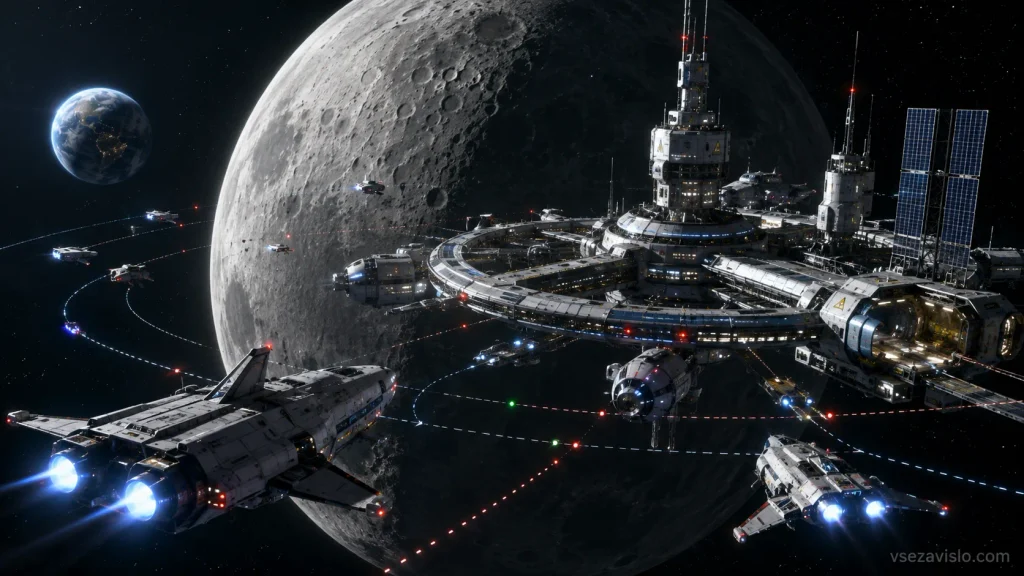
Engineers from Texas A&M University, Purdue University, and NASA have developed the first cislunar traffic management system for the Gateway international space station. The system organizes incoming spacecraft much like airport air traffic control, routing vessels into safe holding zones.
The Gateway station will serve as the first permanent inhabited outpost in lunar orbit and a logistics hub for the Artemis program to land humans on the surface. The launch of its first modules is scheduled for no earlier than 2027.
NRHO Halo Orbit and the “String of Pearls” Pattern
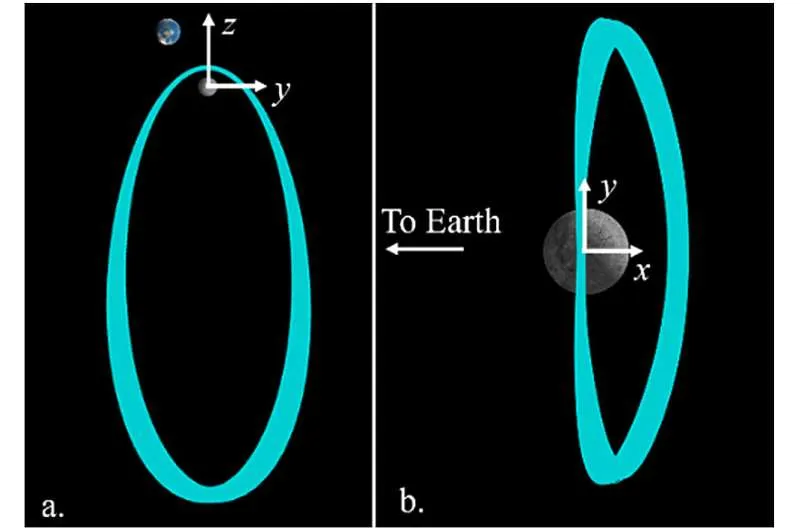
The station will be placed in a near-rectilinear halo orbit (NRHO)—an elongated trajectory with a perilune of 1,600 km above the Moon’s north pole and an apolune of up to 64,000 km over the south pole. The orbit ensures stable direct radio communication with Earth and requires minimal fuel consumption to maintain position.
During active lunar mission periods, crewed Orion spacecraft, lunar landers, and cargo resupply ships will approach the station simultaneously, unable to dock all at once due to a limited number of docking ports.
According to a study published in the journal Acta Astronautica, engineers proposed lining up waiting spacecraft in a “string of pearls” pattern. Vessels are spaced strictly one behind the other along the orbital path ahead of and behind the station, maintaining calculated safety margins.
Thousands of Simulations and Fuel Efficiency
As reported by the science portal Phys.org, researchers ran thousands of numerical simulations accounting for gravitational perturbations from the Sun, Earth, and the Moon’s uneven gravity field, as well as navigation gyro drift errors.
A specialized relative stationkeeping algorithm demonstrated that a series of regular thruster micro-pulses allows precise control over the distance between adjacent spacecraft without excessive fuel burn.
As lunar infrastructure expands, managing traffic at a distance of 386,000 km from Earth will become a distinct branch of space navigation, ensuring safe operations for NASA, ESA, JAXA, and Canadian Space Agency expeditions. On an even longer horizon, the same problem of cheap cargo delivery is being tackled more radically through the space elevator concept.