








Enthusiast Builds AI System With Qwen3.8-27B That Finds ‘Best Moments’ in Porn
 ·
28.08.2026 23:30
·
2 min read
·
28.08.2026 23:30
·
2 min read

A developer and researcher of local neural networks has created an automated pipeline for analyzing adult video content. Using the open-source model Qwen3.8-27B, the enthusiast wrote an algorithm that scans the audio track and video dynamics, automatically identifies key emotional fragments, and cuts 10-second clips for further generation in ComfyUI.
Qwen3.8’s Role: AI as Code Architect
Viral posts often describe the project as “a neural network that watches porn itself,” but the technical implementation is different. Direct analysis of multi-hour videos with a multimodal model proved inefficient and inaccurate, so the open-source model Qwen3.8-27B on Hugging Face acted as an autonomous programmer: the neural network generated code for mathematical analysis of audio and video signals.
Three Markers for Finding the Right Moment
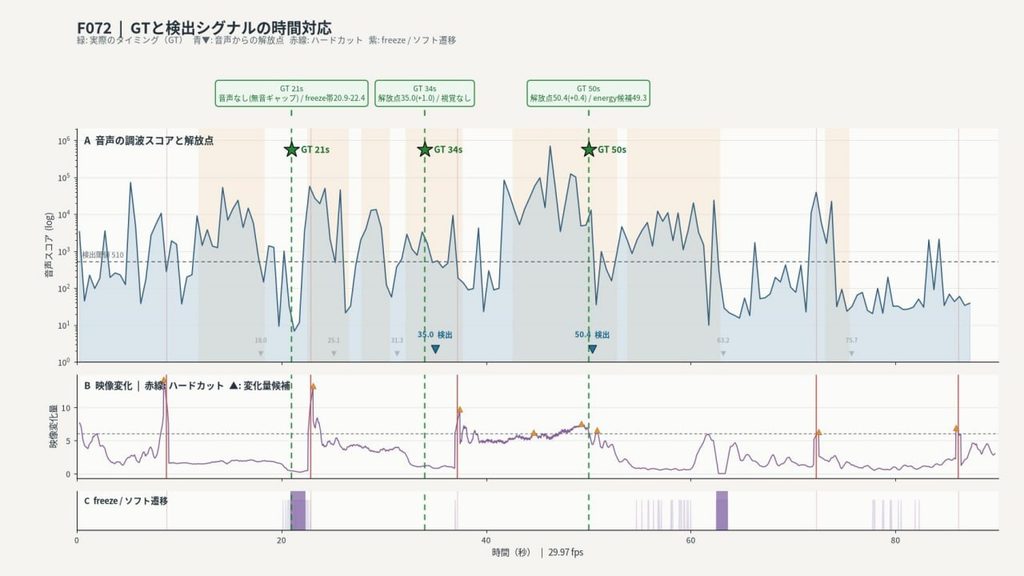
The algorithm calculates timestamps of climax scenes based on a combination of three key metrics:
- Spectral audio analysis: tracking sharp spikes in loudness and voice formants in the 100–1500 Hz frequency range, followed by a characteristic drop;
- Inter-frame difference: detecting sharp changes in optical flow and motion between adjacent frames;
- Editing markers: recognizing freeze frames, abrupt pauses, and dissolve effects typical of post-production in such scenes.
The algorithm matches these parameters against ground truth annotations. Currently, the system operates on heuristic rules and serves as a basis for collecting a training dataset.
Classification with CatBoost and Noise Reduction
The next step is integrating the gradient boosting library CatBoost. The developer is building a dataset with two classes — target moments and regular scenes. This will allow training a lightweight binary classification model that more accurately recognizes feature combinations regardless of individual performer characteristics and audio quality.
End-to-End Pipeline for ComfyUI
The developer’s ultimate goal is a fully autonomous content processing pipeline:
- A system script downloads and parses the long source video;
- The algorithm finds the most likely climax point;
- A utility cuts a 10-second segment, normalizes the frame rate to 24 FPS, and converts the video to a unified standard;
- The resulting file is automatically sent to the input directory of ComfyUI’s modular interface for generating derivative clips via diffusion models.
The project clearly demonstrates the growing trend of using local LLMs: powerful open-source models are increasingly used to quickly create specialized analytical software for unconventional tasks.