








Astronomers Find Chemical “Gold Mine” Near Milky Way Center, Detecting Over 120 Molecules in Gas Cloud
 ·
03.09.2026 17:50
·
2 min read
·
03.09.2026 17:50
·
2 min read
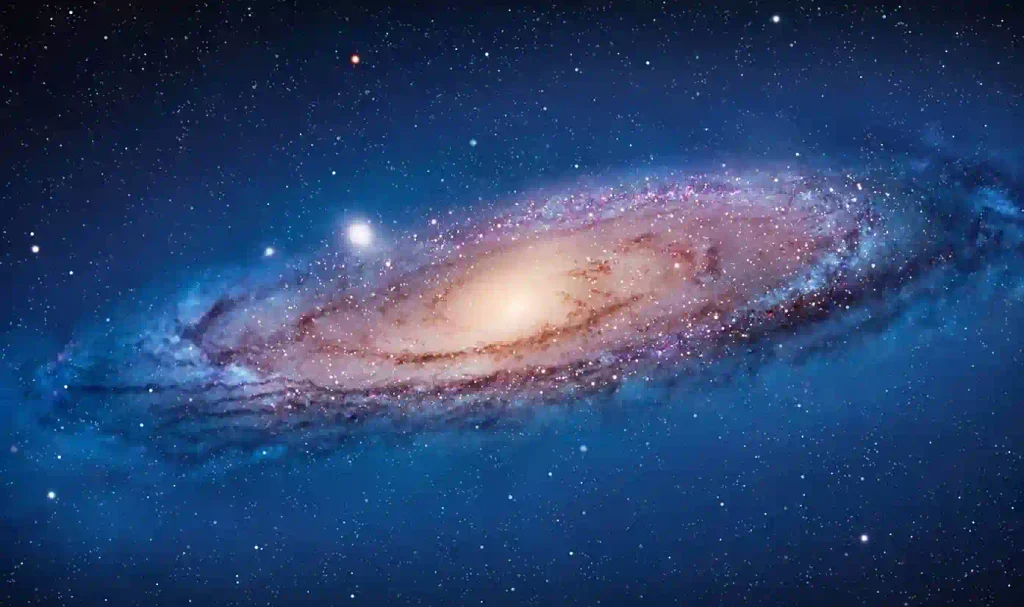
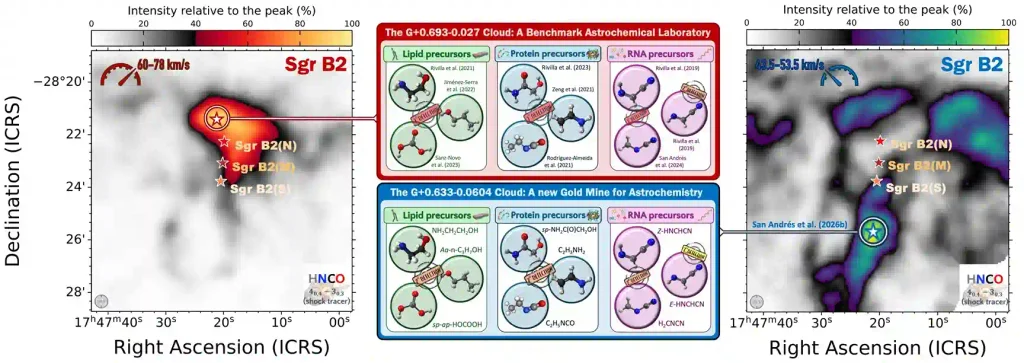
Astronomers have discovered a giant molecular cloud, G+0.633-0.0604, near the center of our Galaxy boasting a record diversity of chemical compounds. Inside the gas cluster on the southern outskirts of the Sagittarius B2 complex, researchers detected over 120 molecular species, including key precursors to biological molecules.
According to a study published on the arXiv repository, the identified collection includes all six basic chemical elements essential for life on Earth (carbon, hydrogen, oxygen, nitrogen, phosphorus, and sulfur). This does not indicate signs of extraterrestrial life, but rather complex prebiotic chemistry—the fundamental raw materials from which amino acids, nucleotides, and lipids can assemble under favorable conditions.
Building Blocks for Membranes and DNA
Astrophysicists highlight several rare compounds among the detections:
- Ethanolamine — a primary building block for phospholipids that make up cell membranes. This marks only the second confirmed detection of the molecule in deep space;
- sp-glycolamide — a structural isomer of glycine, the simplest amino acid;
- Three isomers of cyanomethanimine — compounds involved in the synthesis pathways of adenine, one of the four nucleobases in DNA and RNA.
According to Phys.org, cloud G+0.633 is located just 32 light-years from the well-known G+0.693 cluster, where roughly 40% of all interstellar molecules known to science were previously identified. The composition matches so closely that the authors termed the newly studied object the first true “astrochemical twin” of the Milky Way’s primary cosmic chemical plant. This confirms that complex organic synthesis is not an isolated anomaly, but a standard process under specific physical conditions.
Why Telescopes Can See the Cloud
Researchers attribute these chemical reactions primarily to low-velocity shock waves caused by colliding gas streams. The shocks gently strip icy mantles off interstellar dust grains, releasing frozen molecules into the gas phase where radio telescopes can spot them.
The observations were carried out using the Yebes and IRAM radio telescopes in Spain alongside the APEX observatory in Chile. Spectral lines in G+0.633’s spectrum proved twice as narrow as those in its neighbor, enabling astronomers to distinguish faint radio signals more clearly and hunt for even more complex organic structures.