









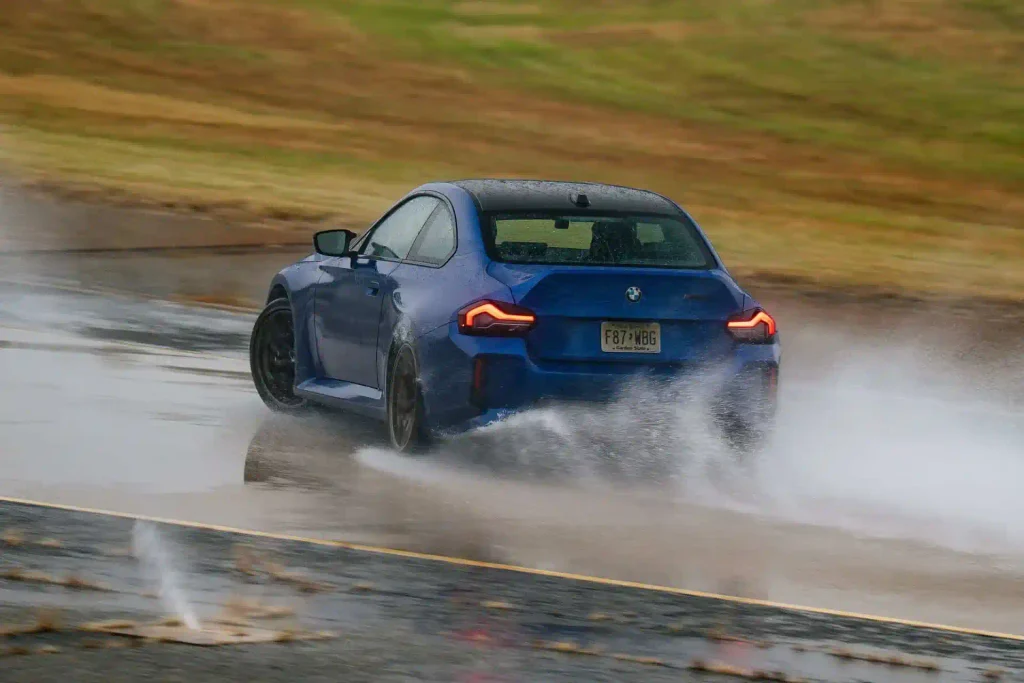
BMW has developed an innovative system to help drivers initiate controlled drifts. Instead of the usual approach of feeding excess power to the rear wheels, the electronics momentarily reduce their grip on the road by using the active chassis. The patent application, number DE 10 2025 106 033.9, was published in the register of the German Patent and Trade Mark Office (DPMA).
An Upward Jolt and Loss of Traction
Traditional drift assists in modern cars rely on engine torque, differential lock-up, and selective wheel braking. BMW engineers Roman Rohr and Patrick Schulz have proposed a different physical approach: instead of managing engine thrust, they control the vertical load on the tires.
As BMWBLOG explains, the system assesses the driver’s intentions based on a range of parameters: steering angle, speed, trajectory, and throttle position. When the driver begins to provoke a slide, the active suspension or active anti-roll bars deliver a sharp upward jolt to the unsprung mass of the rear axle.
For a moment, the vertical load on the rear tires drops. As a result, the wheels easily lose grip even without a sudden stab at the throttle, and the rear end smoothly steps out into a slide. Once the initial phase of the drift is underway, the suspension returns to its standard stiffness settings to maintain stability.
Evolution of M Assist Systems and Development Status
In current BMW M models, similar tasks are handled at the software level: M Traction Control and M Drift Analyzer manage wheelspin purely through engine and brake electronics. The new solution physically alters the suspension geometry, which could prove useful for heavy electric sports cars, where the battery’s mass makes it difficult to break the rear wheels loose without causing rapid tire wear.
According to Carscoops, the patent also includes the possibility of adaptively saving individual steering settings for a specific driver.
For now, the development remains at the patent application stage: the company has protected the concept but hasn’t announced a timeline for bringing such a feature to production cars. Whether the adaptive drift suspension will make it to the assembly line of future M models depends on the results of track testing.